

Outside counsel management is how an in-house legal department decides which law firms it uses, on what terms, and how it holds them to those terms from the first engagement to the final invoice. The need is growing. A 2026 survey of 1,049 chief legal officers in 43 countries found that use of outside counsel to manage regulatory pressure jumped to 48 percent, while operational efficiency stayed their top strategic priority.
Those two pressures meet in the relationship with law firms. Budgets are tight, and a 2026 benchmarking study of 576 legal departments found median legal spend fell to 0.43 percent of company revenue, so every dollar going to firms is expected to be spent well. This guide walks through the outside counsel lifecycle (select, engage, onboard, guide, review, score, and renew) and the control that belongs at each step. Most of those controls run inside an enterprise legal management platform, so the guide also covers what the system should hold. For the basics, start with what outside counsel is, and for the earlier choice of what to send out, see outside counsel vs in house counsel.
What is outside counsel management?
Outside counsel management is the set of policies, processes, and systems a legal department uses to select law firms, agree their terms, guide their work, pay their invoices, and evaluate their performance across every matter.
It works best as a cycle with a control at each step. The table below shows the lifecycle, the control that belongs at each stage, and where that control usually lives:
| Step | Control | System |
|---|---|---|
| Select | Firms chosen from an approved panel, with approval needed for any firm outside it | ELM vendor records and panel list |
| Engage | Engagement letter, fee arrangement, and budget agreed before work starts | Matter record and budget module |
| Onboard | Firm set up with timekeepers, rates, billing contacts, and portal access | eBilling vendor portal |
| Guide | Billing guidelines acknowledged and translated into invoice rules | eBilling validation rules |
| Review | Every invoice checked against rates, guidelines, and budget before payment | eBilling invoice review and approval workflow |
| Score | Performance rated at matter close and reviewed each year | Scorecards and spend analytics |
| Renew | Panel membership and rates renegotiated on the evidence | Panel review and rate approval |
The cycle closes at renewal. The scores and spend data collected over the year decide which firms stay on the panel, which get more work, and which rate increases you accept. Without that last step, the department collects data it never uses.
This program sits inside wider legal vendor management, which covers every outside provider from law firms to eDiscovery and court reporting vendors. Law firms get their own program because they account for most outside spend and carry the most risk.
How do you select and engage outside counsel?
You select outside counsel from an approved panel based on expertise, cost, and past performance, and you engage them with a signed engagement letter, an agreed fee arrangement, and a budget before any billable work begins.
Selection is where most of the money is decided, so it needs a few firm rules:
- Default to the panel. Matters go to approved firms with agreed terms, using a selection step that assigns each matter to a vendor. A firm outside the panel needs a documented reason and sign-off from a senior lawyer or the general counsel.
- Match the firm to the work. High-stakes litigation and regulatory work justify premium firms. Routine employment, real estate, or collections work usually does not.
- Compare on more than rates. Look at blended rates, past budget accuracy, and scorecard results for similar matters.
- Use competitive bids for large matters. A short law firm RFP that produces comparable answers sent to two or three panel firms works well for matters expected to exceed a set threshold, often $250,000.
Large or recurring purchases often run with procurement, which is covered in how procurement and legal ops buy legal services together. Engagement then turns the choice into terms. The outside counsel engagement letter states the scope, the staffing, the fee arrangement, and the billing guidelines that apply. A budget follows within the first 30 days. Both should be attached to the matter record so reviewers can check every later invoice against them.
How do you onboard a law firm?
You onboard a law firm by setting it up as a vendor in your systems, loading its approved timekeepers and rates, confirming that it has acknowledged your billing guidelines, and training its billing staff on the eBilling portal before the first invoice is due.
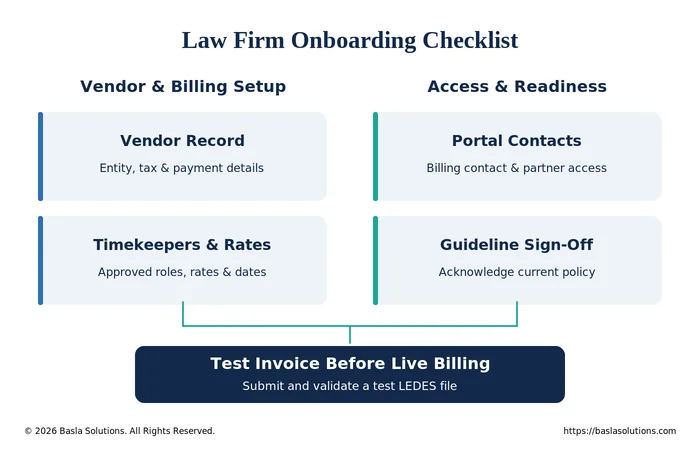
A clean onboarding prevents most of the invoice rejections that follow, and running outside counsel onboarding as its own workstream keeps it on schedule. A practical checklist covers:
- Vendor record. Legal entity, tax ID, offices, remit-to details, and the link to the vendor record in accounts payable.
- Timekeepers and rates. Every timekeeper with role, level, and approved rate, effective from a set date.
- Contacts and access. A billing contact and a relationship partner, each with portal access.
- Guideline acknowledgement. A signed acknowledgement of the current billing guidelines, renewed each year.
- A test invoice. One test LEDES file submitted and validated before the first live invoice.
For a panel of 15 to 30 firms, onboarding usually runs over four to eight weeks, starting with the firms that receive the most spend. A firm that skips the test invoice tends to have its first three live invoices rejected, which sours the relationship before it starts.
What do outside counsel guidelines cover?
Outside counsel guidelines cover how law firms must staff, bill, communicate, and report on your matters, and what you will and will not pay for.
Good outside counsel guidelines set out staffing, billing, expense, and reporting rules that firms agree to before they bill. The typical sections are:
- Staffing. Limits on the number of timekeepers per matter, approval for staffing changes, and no billing for training junior lawyers, with staffing guidelines that eBilling can flag.
- Billing. Increments of 0.1 hours, task-level entries with no block billing, required task codes, and invoice deadlines.
- Expenses. What is reimbursable, what needs prior approval, and caps on travel and meals.
- Budgets and communication. When a budget is required, how often it is updated, and when the firm must flag a likely overrun.
- Rates. How often firms may request increases and the window for doing so.
Guidelines are only as strong as their enforcement, which is why outside counsel billing guidelines get translated from document to rules. Each clause should map to an automated invoice rule, a reviewer checklist item, or nothing at all. A clause that nobody checks should be rewritten until someone can, or removed.
How do you review and score law firm performance?
You review and score law firm performance by rating each firm on a short, consistent scorecard at matter close, then combining those scores with spend data in an annual panel review.
The scorecard needs to be short enough that matter leads actually fill it in. Four to six criteria on a simple scale, such as a traffic light legal vendor scorecard, tend to work: quality of advice, responsiveness, budget accuracy, staffing efficiency, and outcome against expectations. A scorecard that takes under five minutes and is triggered automatically at matter close gets completed far more often than an annual survey sent by email.
The panel review then brings scores and spend together. A structured law firm panel review uses scorecard results, spend, rates, and budget accuracy to decide which firms keep their place. Run it once a year, ahead of rate negotiations. Firms with weak scores and high spend become candidates for removal or reduced work. Firms with strong scores and accurate budgets become candidates for more work, often on better terms.
How do rates and fee arrangements fit in?
Rates and fee arrangements fit in as the price side of every engagement: approved rates set what each timekeeper may charge, and the fee arrangement sets how the work is priced overall.
Rate control works best on a fixed annual cycle:
- One rate window a year. Firms submit rate increase requests in a set window, usually in the fourth quarter, for rates effective the following year.
- Approval against evidence. Increases are compared with the firm’s scorecard, its share of your spend, and market movement, and approved, reduced, or refused.
- Matter-specific rates. Large or long-running matters can lock rates for the life of the matter.
Fee arrangements sit beside hourly rates. Fixed fees suit repeatable work with a predictable scope, such as routine filings. Capped fees suit work where the scope is mostly known but some risk remains. Hourly billing remains the norm for complex litigation, usually with a phase-based budget. Whatever the arrangement, record it on the matter so invoice review can check that the firm billed accordingly.
How does eBilling support outside counsel management?
eBilling supports outside counsel management by enforcing the agreed terms on every invoice and collecting the data that scorecards, budgets, and panel reviews depend on.
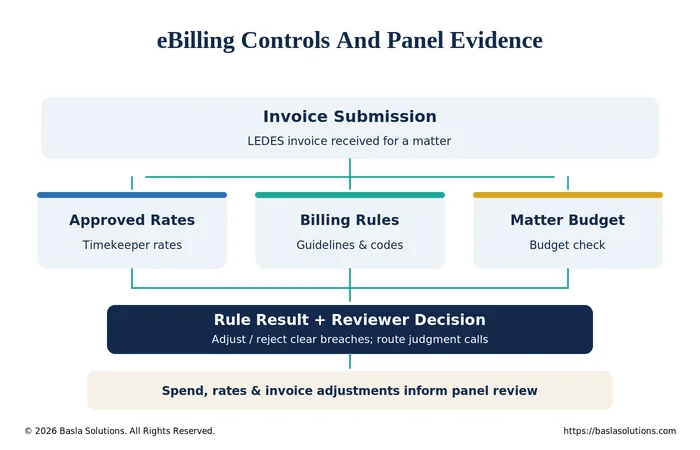
Every invoice arrives as a LEDES file, and the eBilling system checks it against approved timekeepers and rates, billing guidelines, task codes, and the matter budget at submission. Clear breaches are adjusted or rejected automatically, and judgment calls are routed to the matter lead, which is how legal bill review combines rules and reviewers. The same vendor portal holds each firm’s rates, budgets, and accrual estimates, so all of the firm’s terms live in one place.
The data then flows back into the lifecycle and into the department’s wider legal spend management program. Spend by firm, blended rates, budget accuracy, and invoice adjustment rates all feed the annual panel review. Departments that route 90 percent or more of outside spend through eBilling can review firms on actual numbers. Departments with large amounts of spend outside the system end up reviewing firms on impressions.
Conclusion
Outside counsel management works when each step of the lifecycle has a control and a place where that control lives. Select from a panel, engage on written terms with a budget, onboard firms properly, enforce guidelines on every invoice, score firms at matter close, and use all of it at renewal. Each of those steps is also one of the practical ways to reduce outside counsel costs. The firms that perform well earn more of your work, and the department can show finance and the general counsel exactly what its outside spend is buying.
How Basla Solutions can help
Basla Solutions provides delivery teams for enterprise legal management and eBilling software implementation, covering business analysis, vendor and panel setup, law firm onboarding, timekeeper and rate configuration, billing guideline rules, scorecards, testing, documentation, and post-go-live support. Basla delivers legal technology services through staff augmentation or a Basla-managed delivery unit, so your law firm onboarding can run to schedule without pulling your own team off their day jobs.
Basla teams have delivered matter management and eBilling across 10 or more global jurisdictions and doubled delivery team size to meet compressed implementation timelines.
Frequently asked questions
What is an outside counsel program?
An outside counsel program is the formal set of policies a legal department uses for its law firms, covering panel selection, engagement terms, billing guidelines, rates, and performance reviews. It is how outside counsel management is written down and applied the same way on every matter.
Who manages outside counsel in a legal department?
Legal operations usually runs the program, including the panel, guidelines, systems, and reporting. Matter leads manage the day-to-day relationship and approve invoices on their matters, and the general counsel signs off on panel and rate decisions.
What is a law firm panel?
A law firm panel is a short list of approved firms that a legal department uses by default, each with agreed rates and terms. Work goes to panel firms unless a lawyer documents a reason and gets approval to use another firm.
How many law firms should a department use?
There is no single right number, but most departments benefit from a core panel of 10 to 30 firms, depending on size and geographic reach. Fewer firms give you more leverage on rates and better data, while too few can leave gaps in expertise or jurisdictions.
What are outside counsel management best practices?
Select firms from a panel, agree terms and a budget before work starts, and onboard every firm with a test invoice. Enforce billing guidelines through eBilling, score firms at matter close, and use those scores in an annual panel and rate review.
This article is for general information only and is not legal, business, financial or tax advice. For questions about your specific situation, please consult a qualified professional.