

A law firm panel review is a structured, recurring assessment of every firm on your outside counsel panel, scored on evaluator feedback, matter outcomes, billing compliance, and final spend after adjustments. Done well, it turns panel renewals and rate conversations into decisions you can defend with numbers. Most legal departments already hold the raw material in their ELM or eBilling platform. The review is the feedback loop of outside counsel management.
This guide uses SimpleLegal, now Onit Unity, as the worked example.
What is a law firm panel review?
A law firm panel review is a periodic evaluation that compares the firms on your approved panel against the same measures, so renewal, allocation, and rate decisions rest on evidence. It usually runs once a year for the full panel, with lighter quarterly check-ins on the largest relationships. Many departments skip the evidence: a 2025 survey of 1,000 general counsel found fewer than a third track outside counsel performance, value, or stakeholder satisfaction. Rates make the review urgent, since invoice data covering more than $75 billion of 2025 spend shows average partner rates increased 5.1 percent in 2025.
The review answers three questions for each firm. How good was the work? What did it actually cost? How easy was the firm to work with? A data-driven version answers all three from records collected throughout the year.
Why do outside counsel evaluations based on recollection fail?
Outside counsel evaluations based on recollection fail because they overweight the most recent matter, the most senior voice in the room, and the most painful invoice dispute. A firm that handled 40 routine matters well can lose ground to a firm that handled one high-profile matter memorably.
Recollection also distorts cost. Submitted invoice totals can differ sharply from final billings once deductions and adjustments are applied. A firm with frequent write-downs may look expensive on submitted totals while its final spend is reasonable, and the real cost shows up in the hours your reviewers spend correcting its invoices.
What data should a data-driven panel review combine?
A data-driven panel review combines qualitative evaluator feedback with quantitative matter and spend data from your ELM or eBilling platform. Scores without spend miss value, and spend without scores misses quality, so you need both halves.
- Evaluator ratings and comments. Structured scores from the in-house attorneys who worked with the firm, with comments that explain low marks.
- Final spend. Total billings after deductions and adjustments, which is the figure your department actually paid.
- Matter volume and status. The number of matters assigned to each firm, split into open and closed, so spend is read against workload.
- Billing compliance. Rejected invoices, line-item adjustments, and guideline violations, which show how much reviewer effort each firm consumes.
- Budget performance. Budget variance and accrual accuracy, which show whether the firm forecasts its own costs reliably.
Billing compliance data is only as reliable as the rules behind it.
How should a law firm scorecard be structured?
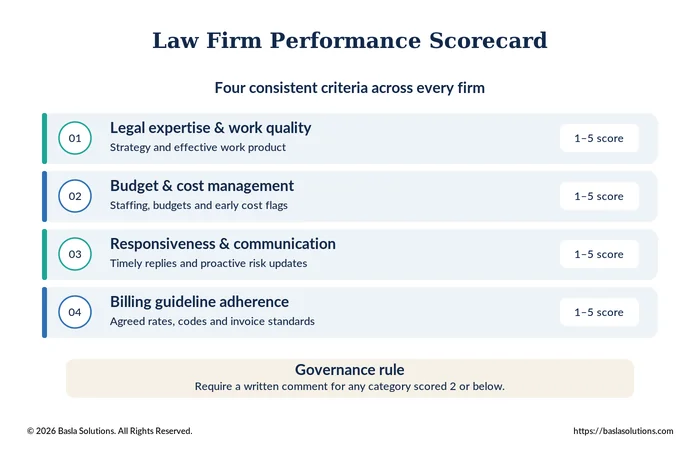
A law firm scorecard works best with four categories rated on the same scale, each built around one plain question an evaluator can answer in under a minute. Four categories keep the survey short enough to hold completion above 90 percent.
- Legal expertise and work quality. Did the firm provide effective strategy and high-quality work product on this matter?
- Budget and cost management. Did the firm manage the budget, staffing, and accruals, and flag cost changes early?
- Responsiveness and communication. Did the firm respond promptly, communicate clearly, and raise risks before they became problems?
- Billing guideline adherence. Did invoices follow agreed rates, task codes, narrative standards, and your outside counsel guidelines?
A 1 to 5 scale is the most common choice. Set a comment threshold so any category scored at 2 or below requires a written explanation, because a low score with no reason gives the firm nothing to act on. The categories, scale, and threshold are governance decisions, covered in more depth in our legal vendor scorecard guide.
How are vendor surveys configured for panel reviews in SimpleLegal?
Vendor surveys in SimpleLegal are configured at the matter template level, with settings for survey status and default evaluators that individual matters can then adjust. Set up once, every new matter starts collecting feedback automatically.
- Survey status. Each matter template sets Vendor Surveys to active, inactive, or hidden, so you can switch feedback on for litigation and off for low-value advisory work.
- Default evaluators. Templates assign default evaluator roles or named users, typically the matter owner or the lead in-house attorney.
- Matter-level overrides. Users with the right permissions can adjust survey settings on an individual matter when the default evaluator is wrong for that work.
Once configured, SimpleLegal periodically sends survey requests to assigned evaluators on open matters, on a schedule your administrator defines.
How often should outside counsel performance be reviewed?
Outside counsel performance should be reviewed continuously at the matter level and formally at the panel level, usually quarterly for your top firms and annually for the full panel.
A workable cadence sends survey requests on open matters every 90 days, with a closing survey when a matter ends. Send a reminder after 7 days and escalate to the matter owner’s manager after 14. In most departments, the ten largest firms account for the majority of outside counsel spend, so those firms earn the quarterly attention.
SimpleLegal’s Enhanced Reports Builder lets you create and save custom reports, with data refreshed every 24 hours. Tell stakeholders up front that an invoice approved today appears in the report tomorrow. The same discipline applies to every reporting layer: dashboards work when they track a small set of decision-ready measures.
Why should panel spend comparisons use final billings after adjustments?
Panel spend comparisons should use final billings after deductions and adjustments because that is the amount your department actually paid. Submitted totals overstate spend by the value of every write-down, and two firms with similar submitted invoices can finish the year tens of thousands of dollars apart.
SimpleLegal vendor reporting can show the matters assigned to each firm, open and closed counts, and total billings after deductions or adjustments for the selected period.
Final spend still needs context before firms are compared side by side:
- Matter type. Litigation and transactional work carry very different cost profiles, so compare firms within the same type of work.
- Jurisdiction. Rates in a major financial center can run two to three times higher than in regional markets.
- Complexity. A firm handling your highest-stakes matters should be benchmarked against similar work from other firms.
Outside counsel costs fall fastest when work goes to the right firm at the right rate, and the panel review is where that allocation gets decided.
How do you segment a law firm panel by spend and performance?
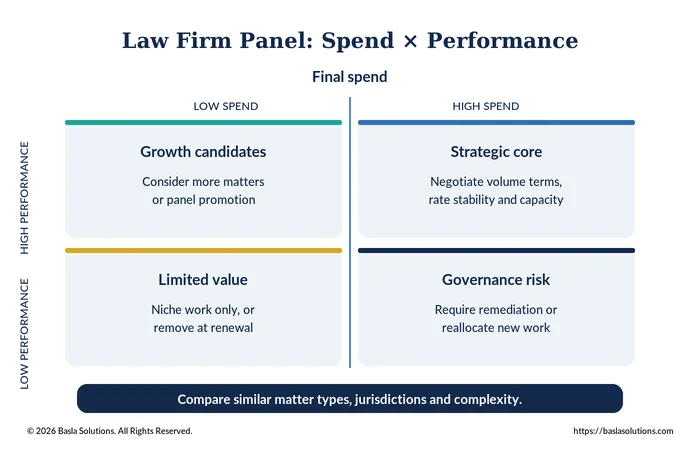
You segment a law firm panel by plotting each firm on two axes, final spend and average performance score, and splitting the panel into four groups that each call for a different action.
- High spend, high performance. These are your strategic core firms. Negotiate volume discounts, rate stability, and guaranteed capacity.
- High spend, low performance. This is your highest governance risk. Require a remediation plan, an executive conversation, or reallocation of new work.
- Low spend, high performance. These are growth candidates. Consider assigning them more matters or promoting them within the panel.
- Low spend, low performance. These firms add limited value. Keep them for niche matters only, or remove them at renewal under clear vendor suspension rules.
Start with any firm in the top spend quartile that scores below the panel median. On a panel of 20 to 30 firms, that usually surfaces two to four relationships. Strategic core firms are also natural candidates for alternative fee arrangements that trade rate certainty for committed volume.
How do panel review results support rate negotiations and panel decisions?
Panel review results support rate negotiations by giving you current, firm-specific evidence on spend, performance, billing compliance, and rate history at the moment a firm asks for an increase. A firm requesting a 6 percent rate increase with frequent adjustments and slipping scores is negotiating from a weak position.
Before any renewal conversation, assemble a one-page pack for each firm: twelve months of final spend, matter counts, scores by category, adjustment rate, and rate history. Record every decision with its owner, date, rationale, and resulting action, so next year’s review can check whether remediation worked.
Conclusion
A law firm panel review earns its place when it runs on data gathered all year and closes with decisions someone owns. What makes it work is consistency: the same categories, the same final-spend basis, and the same segmentation applied to every firm, every cycle. When firms know scores are collected on every matter and read at renewal, quality and billing behavior tend to improve before the review even starts.
How Basla Solutions can help
Basla Solutions provides delivery teams for enterprise legal management and eBilling software implementation, covering legal technology consulting, business analysis, matter template and vendor survey configuration, billing rule setup, report and dashboard builds, testing, documentation, and post-go-live support. For a panel review program, that means configuring survey status and evaluators across your matter templates and building the final-spend reports your scorecard depends on.
Basla has delivered matter management and eBilling across more than 10 global jurisdictions, and its delivery bench scales with your program so platform work keeps moving while your team runs the business.
Frequently asked questions
What is a law firm panel review?
A law firm panel review is a periodic evaluation that compares every firm on your outside counsel panel using the same measures: evaluator scores, matter volume, billing compliance, and final spend after adjustments. It usually runs annually, with quarterly check-ins on the largest firms.
What should a law firm scorecard measure?
A law firm scorecard should measure legal expertise and work quality, budget and cost management, responsiveness and communication, and billing guideline adherence. Rate each on the same 1 to 5 scale and require a comment for any low score.
How often should outside counsel be evaluated?
Outside counsel should be evaluated continuously through matter-level surveys, typically every 90 days on open matters plus a closing survey. Formal panel reviews run quarterly for top firms and annually for the full panel.
Does SimpleLegal support vendor surveys for outside counsel?
SimpleLegal supports vendor surveys configured through matter templates, with survey status set to active, inactive, or hidden and default evaluators assigned by role or user. It sends periodic survey requests to evaluators on open matters on an administrator-defined schedule.
Why compare law firms on final billings after adjustments?
Comparing law firms on final billings after deductions and adjustments shows what your department actually paid. Submitted invoice totals overstate spend and can make firms with very different real costs look similar.
What should happen to a high-spend, low-performance law firm?
A high-spend, low-performance law firm should receive a documented remediation plan with clear targets and a review date. If scores and billing compliance do not improve by then, reallocate new work or remove the firm at the next renewal.
This article is for general information only and is not legal, business, financial or tax advice. For questions about your specific situation, please consult a qualified professional.