


Outside counsel is a lawyer or law firm that a company hires from outside its own organization to advise it or represent it on legal matters. The company’s in-house lawyers decide what goes to which firm, set the terms, and approve the invoices. That makes the relationship part of your wider enterprise legal management program, alongside matters, budgets, and eBilling. This guide covers who external firms are, how they differ from in-house lawyers, and the outside counsel management controls a department uses across the full lifecycle of selection, guidelines, rates, and review.
What is outside counsel?
Outside counsel is an independent lawyer or law firm that a company retains, one matter at a time or under a standing arrangement, while the company’s own legal department directs the work and pays for it.
The firm owes its professional duties to the company as its client, and the in-house team acts as the buyer and manager of that service. In practice, external firms play four roles:
- Advocate. They represent the company in court, arbitration, and regulatory proceedings, where trial experience and local admission matter.
- Specialist. They bring depth in areas such as patents, antitrust, tax, or securities, where a firm may handle dozens of similar matters each year.
- Extra capacity. They absorb peaks, such as a large lawsuit or an acquisition, that would overwhelm a team sized for normal volume.
- Independent voice. They lead internal investigations and give formal opinions where the business or a regulator expects someone outside the reporting line.
How is outside counsel different from in-house counsel?
External firms differ from in-house lawyers in who employs them, how they are paid, and how much of the business they see day to day.
- Employer. An in-house lawyer is an employee of the company. A firm lawyer works for a firm with many clients.
- Pay. In-house lawyers earn a salary, so each extra hour of work has no direct cost. Firms bill for their time or a fixed fee, so every hour shows up on an invoice.
- Context. In-house lawyers know the products, people, and risk appetite. Firms know the law and the market across many clients, and need briefing on the business.
- Volume. In-house teams handle the steady flow of contracts, advice, and compliance. Firms handle the work that needs specialism, scale, or independence.
Which side should handle a given type of work is a make-or-buy decision based on volume, specialism, and risk, set out in our guide to outside counsel vs in house counsel, and it should be revisited as your team grows.
What work do companies send to outside counsel?
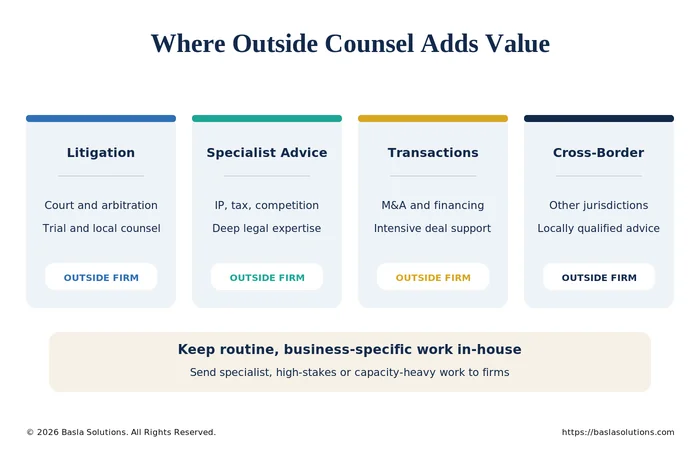
Companies send specialist, high-stakes, and capacity-heavy work to external firms, and keep repeatable, business-specific work inside. A 2025 analysis of 395 legal departments found 71 percent send intellectual property work to outside firms, while only 14 percent send out contract management.
- Litigation. Lawsuits that reach court, especially where trial experience or local admission is needed.
- Specialist advice. Intellectual property, competition, tax, and regulatory work that rewards deep, repeated practice.
- Transactions. Mergers, acquisitions, and financings, where due diligence brings short, intense peaks of work.
- Cross-border matters. Work in jurisdictions where nobody on your team is qualified.
Demand for external help is rising. In one annual survey of chief legal officers, almost 45 percent planned to increase spending on external firms, up 17 percentage points on the prior year, driven by more complex litigation and investigations.
How is outside counsel engaged and paid?
Companies engage a law firm through an engagement letter that sets the scope, rates, staffing, and billing terms, then pay it by the hour or under an alternative fee arrangement.
- Hourly rates. Each timekeeper has an agreed rate, and the firm bills in tenths of an hour with a narrative for each task.
- Fixed fees. A single price covers a defined piece of work, such as a trademark filing or a routine employment claim.
- Capped fees. The firm bills hourly up to an agreed ceiling, and anything above it needs written approval.
- Budgets. Larger matters start with a phase-by-phase budget that the in-house lawyer approves before work begins.
Most departments receive invoices through an eBilling system in the LEDES format, so each line can be checked against the agreed rates and rules before anyone approves payment.
How do legal departments manage outside counsel?
Legal departments manage law firms through written rules, approved budgets, invoice review, and regular performance reviews, all tracked against the matter in an ELM system.
- Guidelines. Firms work to written guidelines that set the billing, staffing, and expense rules every firm must follow.
- Rate approval. New timekeepers and annual rate increases are approved before they can be billed.
- Invoice review. eBilling rules flag block billing, unapproved timekeepers, and expenses over the limit, and a reviewer approves or adjusts each invoice.
- Budget tracking. Spend to date is compared with the approved budget, with warnings at 75 and 90 percent.
- Performance reviews. Each firm is scored on quality, responsiveness, and value at matter close or once a year.
Public bodies show how strict these controls can get. A federal banking regulator’s counsel deskbook, revised in 2026, bars firms from billing for any timekeeper who is missing from the approved rate schedule.
What is a panel firm?
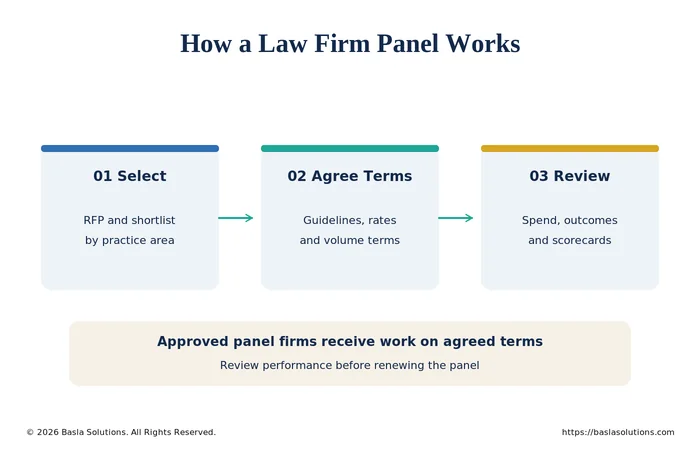
A panel firm is a law firm that a legal department has pre-approved, usually through a request for proposal, to receive its work in one or more practice areas on agreed rates and terms for a set period, often two to three years.
- Selection. Firms compete on expertise, rates, diversity, and service, and the department picks a short list per practice area.
- Terms. Panel firms accept the department’s guidelines, rate commitments, and volume discounts in return for a steady flow of work.
- Review. Each firm’s spend, outcomes, and scorecards are reviewed before the panel is renewed.
A panel concentrates work with fewer firms, which gives the department more pricing power and makes performance easier to compare.
Conclusion
Outside counsel gives a legal department the specialism, scale, and independence its own team cannot provide on demand. The relationship works best when the department treats it as a managed service: clear decisions on what goes out, engagement terms in writing, guidelines enforced through eBilling, budgets tracked per matter, and firms reviewed against each other on a panel.
How Basla Solutions can help
Basla Solutions provides delivery teams for enterprise legal management and eBilling software implementation, covering business analysis, vendor and rate setup, billing guideline rules, budget tracking, firm onboarding, testing, documentation, and post-go-live support. Basla delivers legal technology services through staff augmentation or a Basla-managed delivery unit, so the controls you set for your firms are built into the platform from day one.
Basla teams have delivered matter management and eBilling across 10 or more global jurisdictions.
Frequently asked questions
Is outside counsel the same as external counsel?
Outside counsel and external counsel mean the same thing: a lawyer or law firm hired from outside the company. Some organizations also use “panel counsel” for external firms on an approved list.
Can a company have many outside counsel?
A company can work with many law firms at once, and large departments often use dozens across different practice areas and countries. Many consolidate them into a smaller panel to gain pricing power and consistency.
How are outside counsel fees controlled?
Fees are controlled through agreed rates in the engagement letter, billing guidelines, approved budgets, and eBilling rules that check every invoice line. Alternative fee arrangements such as fixed or capped fees add cost certainty.
What is an outside counsel guideline?
A guideline is a written set of rules a department gives its law firms, covering billing, staffing, expenses, reporting, and communication. eBilling systems turn the billing rules into automatic invoice checks.
This article is for general information only and is not legal, business, financial or tax advice. For questions about your specific situation, please consult a qualified professional.