

The outside counsel vs in house counsel decision comes down to three questions for each type of legal work: how often it recurs, how specialized it is, and how much risk sits on the outcome. Repeatable work that depends on knowing the business belongs with your own team. Specialist, peak-load, or high-stakes work usually belongs with outside counsel. This guide covers the criteria, a decision table, the cost comparison, and how to track the split in your enterprise legal management system. The decision itself is one step in a wider outside counsel management program that also covers selection, guidelines, rates, and performance review.
When should legal work go to outside counsel?
Legal work should go to outside counsel when it needs expertise your team lacks, capacity your team cannot free up in time, or an independent voice the business or a regulator expects.
- Specialist expertise. Patent prosecution, antitrust filings, and tax controversy reward lawyers who handle dozens of similar matters a year.
- Capacity peaks. A major lawsuit or an acquisition can need five to fifteen lawyers for three to six months.
- Independence and risk sharing. Investigations involving senior executives, formal opinions, and bet-the-company disputes need an outside voice.
- Jurisdiction. Matters in a country or court where nobody on your team is admitted need local counsel.
Intellectual property shows the pattern clearly. A 2025 analysis of 395 legal departments found 71 percent send intellectual property work to outside counsel, while only 14 percent outsource contract management.
The decision table below sets a starting default for the outside counsel vs in house counsel choice by type of work.
| Type of work | Default | Deciding factor |
|---|---|---|
| Commercial contracts and NDAs | In-house | High volume, playbook-driven |
| Compliance and corporate governance | In-house | Needs daily business context |
| Employment advice | In-house, litigated claims go out | Volume inside, court work outside |
| Patent and trademark prosecution | Outside counsel | Specialist skill and filing systems |
| Major litigation and trials | Outside counsel, managed in-house | Trial capacity and experience |
| M&A due diligence | Outside counsel or alternative provider | Short, intense volume peaks |
| eDiscovery processing and review | Alternative provider | Technology and scale |
| Regulatory investigations | Outside counsel | Independence |
What work should stay in-house?
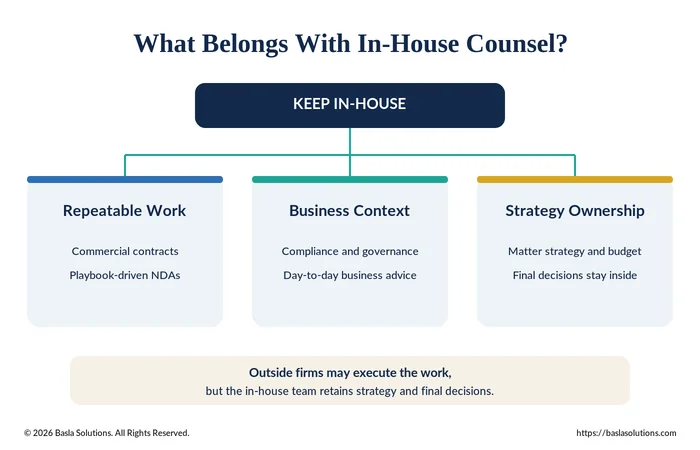
Work that should stay in-house is the high-volume, repeatable work that depends on knowing the business, such as commercial contracts, compliance, governance, and day-to-day advice to business teams.
- Volume work. A matter type that arrives 30 or more times a year and follows a playbook gets cheaper and faster every time your own lawyers handle it.
- Business-context work. Advice on product launches, sales terms, and internal policies is better from a lawyer who knows the people and the risk appetite.
- Matter strategy. When a firm does the work, an in-house lawyer still owns the strategy, the budget, and the final decision.
How do you compare the cost of in-house and outside counsel?
You compare the cost of outside counsel vs in house counsel by converting an in-house lawyer to a fully loaded cost per productive hour, then setting that against the effective rate firms bill for the same type of work.
- Salary and benefits. Add 25 to 35 percent to base salary for benefits, bonus, and payroll taxes.
- Overhead. Include office space, technology licenses, training, and bar fees.
- Productive hours. Count 1,400 to 1,600 hours a year of substantive legal work.
- Hidden outside costs. Add in-house time spent briefing firms and reviewing invoices.
A lawyer costing $250,000 fully loaded across 1,500 productive hours works out to about $167 an hour. The same lawyer hired for work that only fills 400 hours a year costs $625 an hour, which is why low-volume specialist work rarely belongs inside. Once the right work is going out, there are eight practical ways to reduce outside counsel costs without losing quality, from rate controls to fee arrangements.
How do you track the in-house versus outside split?
You track the in-house versus outside split by tagging every matter with who did the work, then reporting spend and effort by matter type every quarter from your ELM system.
- A handling field on every matter. Make it required at matter open, with four values: in-house only, outside counsel, alternative provider, and mixed.
- Outside spend from eBilling. Approved invoices already carry the matter, vendor, and amount, so outside spend rolls up by matter type.
- Internal effort. Light time capture or an effort band set at closure is enough to compare against outside spend.
- A quarterly review. Flag any matter type where the outside share moves by more than 10 points.
A 2025 survey of 186 legal departments found in-house teams handle about 60 percent of legal work, outside counsel 35 percent, and alternative providers 5 percent.
How does headcount planning interact with outside counsel spend?
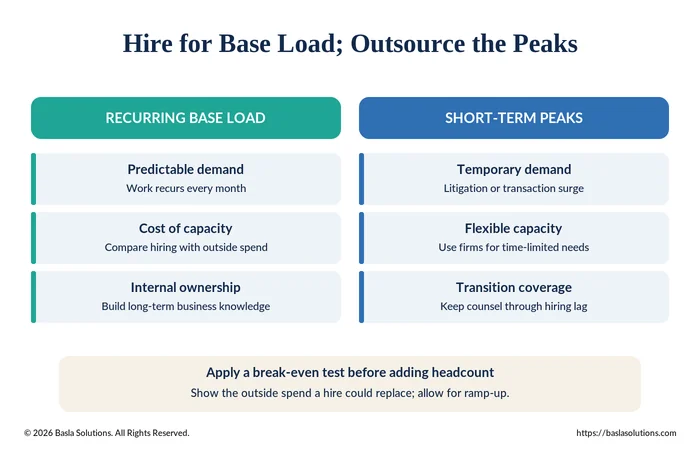
Headcount planning and outside counsel spend draw on the same legal budget, so every hire request should show which outside spend it replaces, and every rise in outside spend should be tested against the cost of a hire.
- The break-even test. If a matter type steadily sends out $400,000 or more a year of work that one $250,000 lawyer could absorb, the hire usually pays back within a year.
- Base load versus peaks. Hire for the work that recurs every month, and buy capacity for the peaks.
- Hiring lag. Recruiting and ramp-up take six months or more, so keep the firm engaged through the handover.
What are alternative providers?
Alternative providers, often called alternative legal service providers or ALSPs, are companies outside the law firm model that deliver legal work such as eDiscovery, document review, contract support, and flexible lawyer staffing, usually at lower cost than law firm rates.
- eDiscovery and document review. Processing, hosting, and first-pass review run on technology few departments want to own.
- Contract support. Managed teams handle high-volume contract review, data extraction, and repository cleanup.
- Flexible staffing. Contract lawyers cover a parental leave, a backlog, or a project for three to twelve months.
Set alternative providers up as their own vendor type in your ELM system, so their share shows up in the split.
Conclusion
The outside counsel vs in house counsel question has a clear answer for most work once you look at volume, specialism, and risk. Keep repeatable, business-specific work inside, send specialist and peak work out, and route process-heavy work to alternative providers. Then tag every matter and review the split each quarter alongside headcount plans.
How Basla Solutions can help
Basla Solutions provides delivery teams for enterprise legal management and eBilling software implementation, covering business analysis, matter and vendor configuration, handling and spend reporting, invoice validation rules, testing, documentation, and post-go-live support. Basla delivers legal technology consulting and hands-on configuration through staff augmentation or a Basla-managed delivery unit, so the data behind your sourcing decisions is captured from the first matter.
Basla teams have delivered matter management and eBilling across 10 or more global jurisdictions.
Frequently asked questions
What percentage of legal spend is typically outside counsel?
Outside counsel typically accounts for roughly half of total legal spend in large benchmarking surveys, with internal spend close to the same amount. The share varies widely with industry and litigation load, which is why the outside counsel vs in house counsel split is best tracked by matter type.
Is in-house always cheaper?
In-house is cheaper only when there is enough recurring work to keep a lawyer busy. Low-volume specialist work can cost more per productive hour inside than a firm charges for the same work.
How do you insource work from a firm?
You insource work from a firm by picking one high-volume matter type, building the playbook and templates, and running the firm and your team in parallel for one to three months. Move the remaining matters once quality and turnaround hold steady.
What is a captive or ALSP model?
A captive is a legal support center the company owns and staffs, often in a lower-cost location. An ALSP model buys the same kind of process work from an outside provider under a contract.
This article is for general information only and is not legal, business, financial or tax advice. For questions about your specific situation, please consult a qualified professional.