

Managing legal spend means deciding what the department pays outside counsel and other legal vendors before the work starts, checking it when the invoices arrive, and reporting it in a way finance and the general counsel can act on. Most of the tools for this already sit inside an enterprise legal management platform. What is usually missing is the program that connects them, from matter budgets to accrual automation that collects law firm estimates every month.
The pressure to build that program is rising. A 2025 survey of in-house legal teams found 83 percent expect demand for legal services to keep growing, and most departments are not getting a matching increase in headcount. This guide covers what the program includes, how each part runs, who owns it, and how to tell whether it is working.
What is legal spend management?
Legal spend management is the program a legal department runs to plan, capture, review, forecast, and report on what it pays outside counsel and other legal vendors, so that money is spent on purpose and stays inside budget.
It runs as a cycle of six steps. Spend is captured in one system, invoices go through legal bill review against agreed terms, matters are budgeted, unbilled work is accrued each month, the data is analyzed, and the findings lead to action, such as renegotiated rates or a changed panel. Each step depends on the one before it. A budget is only useful if invoices are captured against the right matter, and an analysis is only trusted if the accruals behind it were accurate.
The step that connects legal to finance most directly is the monthly accrual. Legal spend accruals record the cost of work law firms have done but not yet billed, so the books reflect legal costs in the month they were incurred. When accruals are wrong or missing, or when money leaks through unchecked rates, expenses, and duplicate bills, finance sees legal spend as a series of surprises, and the department loses credibility on every other number it reports.
The program is broader than cost cutting. A department can spend more this year than last and still be well managed, provided the spend was planned, approved, and tied to the matters that needed it.
What does a legal spend management program include?
A complete program includes six components, each with a named owner: capture, review, budgeting, accruals, analytics, and action.
| Component | What it does | Owner |
|---|---|---|
| Capture | Brings every invoice and engagement into one system, tagged to a matter, vendor, and legal entity | Legal operations |
| Review | Checks each invoice against approved rates, billing guidelines, and the matter budget before payment | Matter leads, using rules set by legal operations |
| Budgeting | Sets the expected cost of each matter, and of the department for the year | Matter leads with outside counsel, rolled up by legal operations |
| Accruals | Estimates work done but not yet billed at each month end | Finance, with estimates submitted by law firms |
| Analytics | Reports spend by firm, matter type, business unit, and trend | Legal operations |
| Action | Turns findings into rate negotiations, panel changes, and guideline updates | General counsel, supported by legal operations |
Programs rarely fail because a component is missing from the legal spend management software. They fail because a component has no owner. The most common gap is the last one. Departments build good reports, review them at a quarterly meeting, and change nothing. Put one named person against each row, and give the action step a standing slot on the general counsel’s agenda at least twice a year.
How do you control legal spend?
You control legal spend by deciding, before work starts, who does the work, at what rate, under what fee arrangement and budget, and then enforcing those decisions on every invoice.
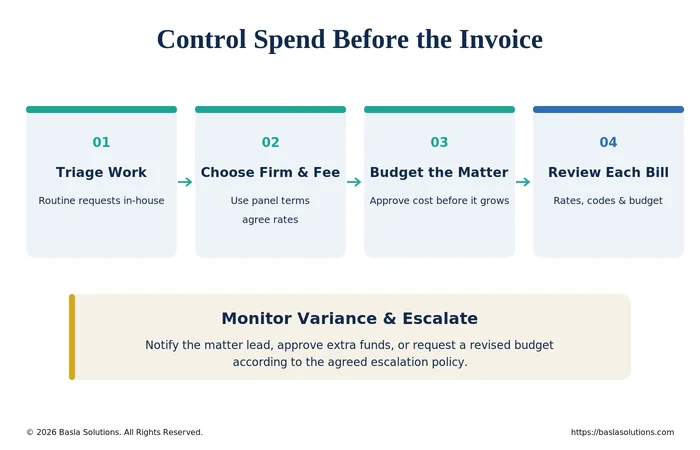
Most of the money is committed by the time the first invoice arrives, so the controls that matter most sit early in the matter:
- Decide what goes outside. A triage step at intake keeps routine work, such as standard NDAs or simple employment questions, with in-house lawyers.
- Choose the firm deliberately. Send work to panel firms with agreed terms, and require approval for any firm outside the panel.
- Fix the price. Approve timekeeper rates once a year, hold rate increase requests to a set window, and use fixed or capped fees for repeatable work.
- Set a budget at matter open. Require a budget within the first 30 days for any matter expected to cost more than a set threshold, often $25,000 to $50,000.
- Enforce guidelines on every invoice. Validation rules catch rate, expense, and task code breaches automatically, and reviewers judge staffing and necessity.
- Watch variance in real time. Budget variance warnings at 80 and 100 percent give the matter lead time to act before the overrun lands.
- Review the panel. An annual review of cost, outcomes, and responsiveness decides which firms get more work next year.
The later controls only work if the earlier ones are in place. Invoice review cannot recover much on a matter that went to an expensive firm with no budget and no fee agreement. Start at intake and work forward.
Control also needs a clear escalation path. Decide in advance what happens when a matter crosses its budget: who is told, who can approve more money, and whether the firm must submit a revised budget before its next invoice is paid. Write those rules into the platform so they run the same way on every matter. A department with 200 open matters cannot rely on each matter lead remembering to check, and the matters that overrun quietly are usually the ones nobody was watching.
How do budgets and accruals fit into spend management?
Budgets and accruals are the forward-looking half of spend management: the budget says what a matter should cost, and the accrual says what has been spent this month but not yet billed.
Budgets come in several levels of detail, from a single matter total to phase and task budgets. An annual department budget is what finance holds legal to, and setting it is the core of legal budget management. Matter budgets are what make the annual number credible, because they add up from the work actually underway. The strongest approach is collaborative legal budgeting, where outside counsel submit and revise matter budgets inside the platform and the matter lead approves each version.
Accruals sit beside the budgets and close the timing gap. Law firms often invoice 30 to 90 days after the work, so without accruals, a busy quarter shows up on the books a quarter late. The practical setup has four parts:
- Matter budgets above a threshold. Every matter expected to cross the threshold carries a budget, broken into phases for litigation, as in a phase-based litigation budget firms can follow.
- Monthly accrual requests. Firms submit an estimate of unbilled work for each open matter, typically by the third business day after month end, on a cadence set per matter and an accrual setup configured in the eBilling system.
- Accrual review. Legal operations or the matter lead checks law firm estimates against the budget and recent invoices before finance books them.
- True-up. When the invoice arrives, it is compared to the accrual. Firms whose estimates miss by more than 20 percent month after month get a follow-up call.
Together, these give finance a monthly legal number it can rely on, and they give matter leads early warning that a budget is running hot.
What is legal spend analytics?
Legal spend analytics is the reporting layer that turns invoice, budget, and matter data into answers about where the money goes, which firms deliver value, and where spend is heading.
Good analytics answers a short list of questions that each lead to a decision. Legal spend analytics dashboards should track a few views and drop the rest:
- Spend by firm. Who receives the most, how that share changes year to year, and how each firm’s blended rate compares with its peers.
- Spend by matter type and business unit. Which kinds of work and which parts of the company drive cost, so you can charge it back or plan for it.
- Budget against actual. Which matters are over, which firms budget accurately, and which phases tend to overrun.
- Rate and staffing trends. Average rates by timekeeper level, and the share of hours billed by partners compared with associates and paralegals.
- Fee arrangement mix. The share of outside spend under fixed, capped, or other alternative arrangements.
Analytics is only as good as the data under it. If matter types are inconsistent, task codes are optional, or a fifth of invoices arrive as PDFs outside the eBilling system, the reports will be argued over before anyone acts on them. Fix the classification and the capture first.
How does eBilling feed spend management?
eBilling feeds spend management by turning every law firm invoice into line-level structured data (timekeeper, rate, hours, task code, matter, and legal entity) that budgets, accruals, and analytics all draw from.
Without eBilling, spend data is a set of PDF totals keyed into accounts payable. With it, each invoice arrives as a LEDES file, is validated against rates and billing guidelines on submission, and is approved, adjusted, or rejected before it reaches finance. The same portal that receives invoices usually collects budgets and accrual estimates from firms, so all three sets of numbers sit against the same matter records.
Three connections make eBilling useful to the wider program. First, coverage: aim for 90 percent or more of outside spend to flow through eBilling, because anything outside it is invisible to the reports. Second, task codes: requiring UTBMS codes gives you spend by phase and activity, which is what makes litigation budgets comparable. Third, the finance link: approved invoices pass to the accounts payable or ERP system with the right legal entity and cost center, so legal and finance report the same number.
Rollout order matters here. Onboarding the firms that receive the most spend first, often the top 10 to 20 firms, can bring most outside spend into eBilling within the first few months. Smaller firms and one-off vendors follow on a set schedule, with a firm date after which invoices outside the system are no longer paid.
How do you measure legal spend management results?
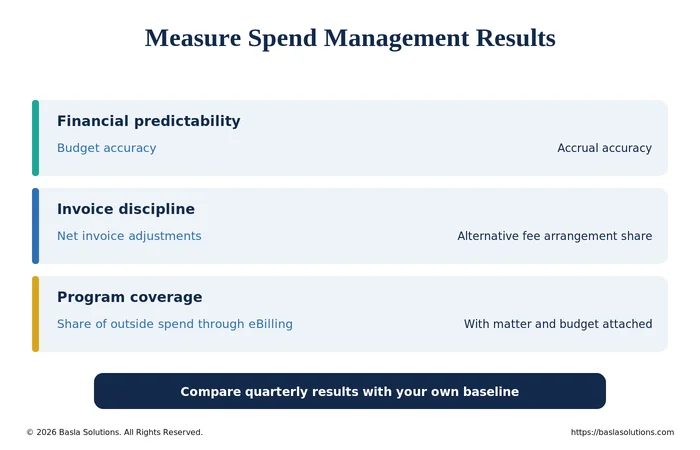
You measure the results of spend management with a short set of metrics tracked against your own baseline, reported quarterly to the general counsel and finance.
The headline comparison is spend as a share of company revenue. A 2026 benchmarking study of 576 legal departments in 45 countries found total legal spend fell to 0.43 percent of company revenue, a six-year low, which gives you a reference point, though industry and company size move it a long way. Below that headline, these measures show whether the program is working:
- Budget accuracy. The share of closed matters that finished within 10 percent of their approved budget.
- Accrual accuracy. The monthly variance between accrued amounts and the invoices that followed, by firm.
- Net invoice adjustments. Reductions that held after law firm appeals, as a share of billed fees.
- Fee arrangement share. The portion of outside spend under fixed, capped, or other alternative fee arrangements.
- Coverage. The share of outside spend that flows through eBilling with a matter and budget attached.
There is no reliable published benchmark for how much a program like this should save, so set your own. Use the first two quarters after go-live as the baseline period, then report each metric against it. A department that can show budget accuracy climbing and accrual variance falling has a stronger case with finance than one quoting a savings estimate nobody can check.
Conclusion
Spend management works when it is run as one program. Capture, review, budgeting, accruals, analytics, and action each need an owner, and each depends on the step before it. Start with the controls that act before work begins, put every invoice through eBilling, give finance an accrual number it can trust, and report a small set of measures against your own baseline. The reports then become the reason rates, panels, and guidelines change.
How Basla can help
Basla provides delivery teams for enterprise legal management and eBilling software implementation, covering business analysis, budget and accrual configuration, billing guideline rules, LEDES and UTBMS setup, finance and ERP integration, spend dashboards, testing, documentation, and post-go-live support. Basla brings legal technology consulting and hands-on configuration through staff augmentation or a Basla-managed delivery unit, so your spend program can grow without slowing month-end close.
Basla teams have delivered matter management and eBilling across 10 or more global jurisdictions and doubled delivery team size to meet compressed implementation timelines.
Frequently asked questions
What is the difference between legal spend management and eBilling?
eBilling is the system that receives, validates, and approves law firm invoices. Spend management is the wider program that uses that invoice data alongside budgets, accruals, and analytics to plan and control what the department spends.
What is corporate legal spend management?
It is the program an in-house legal department runs to plan, track, and control what the company pays outside counsel and legal vendors. It usually sits with legal operations and connects the department’s eBilling, budgeting, and reporting to finance.
How much can legal spend management save?
No reliable published figure exists for typical savings, because results depend on how much spend was uncontrolled at the start. Measure your own results against a baseline set in the first two quarters, using net invoice adjustments, budget accuracy, and the share of spend under alternative fee arrangements.
Who owns legal spend management?
Legal operations usually owns the program, including the systems, rules, and reporting. Matter leads own the budgets and invoice approvals on their matters, finance owns the accruals, and the general counsel owns the decisions that follow from the reports.
What are legal spend management best practices?
Set budgets at matter open, approve rates once a year, and route all outside spend through eBilling with task codes required. Collect monthly accruals from firms, track a few measures against your own baseline, and review the panel each year.
*This article is provided for general information only and does not constitute legal advice. Basla Solutions provides legal technology implementation and support services and does not practice law.*