

A litigation budget is the law firm’s estimate of what a case will cost, broken into the phases of the case and agreed with the legal department before the work is done. Built by phase, it becomes a working control: each invoice is coded to a phase, each phase has a number, and the gap between them shows up early. Litigation is a large line for most departments. A 2017 survey of chief legal officers found that on average, 24 percent of the law department budget is spent on litigation. Budgeting is one part of a wider legal spend management program, and it sits inside the matter and billing controls of any enterprise legal management platform.
How do you build a phase-based litigation budget?
You build a phase-based litigation budget by asking the law firm to estimate fees and expenses for each phase of the case, using the same phase codes it will use on its invoices, and then approving that estimate in the eBilling system. The shared codes are what let you compare budget and actual spend line by line.
- Agree the structure first. Send the firm a budget template with the phases, the date range, and the level of detail you expect before the case starts.
- Ask for assumptions. Each phase estimate should state what it assumes, such as the number of depositions, the expected document volume, or a trial date.
- Separate fees and expenses. Expert fees, eDiscovery vendors, and court reporters behave differently from attorney time, so budget them as their own lines.
- Set the time horizon. Choose between a budget for the whole case and a budget for the current year, and record the choice on the matter.
Guidance on choosing the right level of detail for each legal budget type covers that decision.
What phases and tasks should a litigation budget use?
A litigation budget should use the phases of the UTBMS litigation code set, so the budget and the invoices speak the same language. The original code set, released in 1997, includes 5 phases and 29 more granular task codes. The phase level carries the budget, and the task codes beneath each phase explain where the hours go.
| Phase | Code | Typical tasks |
|---|---|---|
| Case assessment, development and administration | L100 | Fact investigation, analysis and strategy, settlement and ADR, budgeting |
| Pre-trial pleadings and motions | L200 | Pleadings, dispositive motions, other written motions |
| Discovery | L300 | Written discovery, document production, depositions, expert discovery |
| Trial preparation and trial | L400 | Witness preparation, exhibits, trial attendance, post-trial motions |
| Appeal | L500 | Appellate motions, briefs, oral argument |
Firms already code their time to these UTBMS task and activity codes, so a phase budget asks for nothing new in their billing systems.
- Phase-only budgets. Five numbers, one per phase. Quick to produce, and enough for most matters under a set value.
- Task-level budgets. Estimates at the task code level within each phase. Worth requiring for high-value or high-risk cases.
- Expense lines. A separate line per phase for vendor costs, using expense codes, so a large eDiscovery bill does not hide inside discovery fees.
How do law firms submit and update budgets?
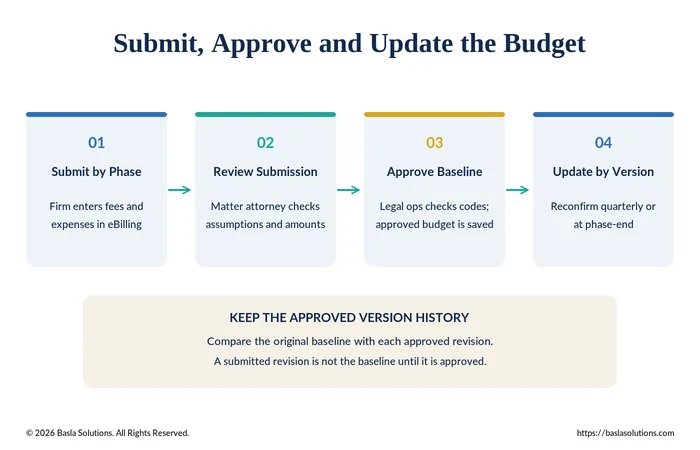
Law firms submit and update budgets through the client’s eBilling or vendor portal, entering an amount for each phase or task against the matter. The legal department reviews the submission, approves or returns it, and the approved version becomes the baseline for variance tracking. This is collaborative legal budgeting in practice.
- Initial submission. Require the budget within a set period after the matter is opened, often 30 days, and before the first invoice is paid.
- Review and approval. The matter attorney reviews the assumptions and amounts, and legal operations checks the structure and codes.
- Version history. Each approved revision is saved as a new version, so you can see the original estimate next to the current one.
- Update cadence. Ask firms to confirm or update the budget at set points, such as quarterly or at the end of each phase.
How is budget variance tracked?
Budget variance is tracked by comparing the approved amount for each phase with the fees and expenses billed to that phase, and flagging any phase that crosses a set threshold. The eBilling system does this automatically when invoices carry the same phase codes as the budget.
- Spend to date by phase. Show billed amounts against the budget for each phase, with the percentage consumed.
- Warning thresholds. Budget variance warnings alert the matter attorney and the firm at 80 percent of a phase budget, and again at 100 percent.
- Phase progress. Compare the share of the phase budget spent with how far through the phase the case actually is. A discovery budget 90 percent spent with half the depositions still to come signals an overrun.
- Accrued work. Include work done but not yet billed, so the variance reflects the full position, including invoices still to come.
Review variance monthly for active litigation, and report it by firm across the portfolio.
When should a budget be revised?
A budget should be revised when the scope or assumptions of the case change, such as new claims, added parties, a moved trial date, or a significant change in document volume. Ordinary overruns stay visible against the original number.
- Scope change. New claims, counterclaims, or parties change the work in several phases at once.
- Timeline change. A trial date that moves by months changes both the total cost and when it falls in the financial year.
- Phase completion. When a phase closes, move any unused amount into a reserve, and let the matter attorney decide whether it moves to a later phase.
- Settlement or resolution. Close out the remaining phases so open budget does not distort reporting.
Require a short written reason with every revision, approved by the matter attorney.
How do budgets connect to accruals and invoices?
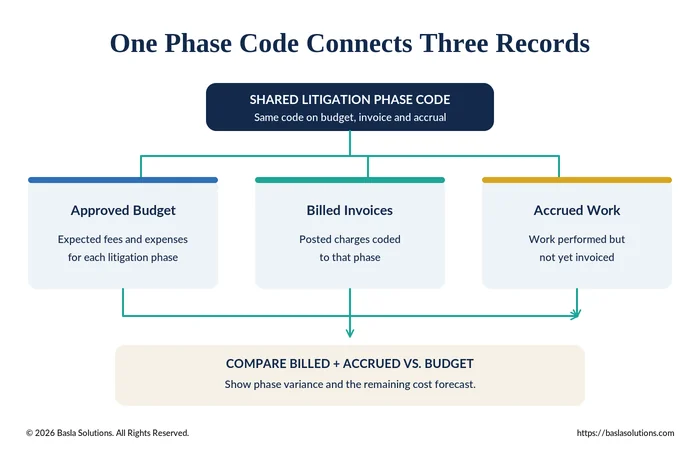
Budgets connect to accruals and invoices through the phase codes they share: invoices record what has been billed against each phase, accruals estimate the work done but not yet billed, and the budget sets the expected total for both. Together they give finance an accurate view of litigation cost at month end.
- Invoices against budget. Each invoice line is coded to a phase and task, so billed spend rolls up to the right budget line automatically.
- Accruals against budget. Firms report unbilled work at month end, and the system compares billed plus accrued spend with the phase budget.
- Invoice review. Reviewers see the remaining budget for the phase when they approve an invoice, and lines that push a phase over budget can be routed for extra approval.
- Forecasting. Remaining budget per phase, adjusted for the latest accruals, gives finance a forecast for the rest of the year.
Using one phase structure across all three removes most of the reconciliation work at close.
Conclusion
A litigation budget works when it is built by phase, uses the same codes as the invoices, and is revised only when the case itself changes. Ask firms for phase estimates with stated assumptions, approve them in the eBilling system, track variance against billed and accrued spend, and keep every version on record. The result is a budget firms can follow and finance can rely on.
How Basla can help
Basla provides delivery teams for enterprise legal management and eBilling software implementation, covering business analysis, budget template and phase design, UTBMS code mapping, variance thresholds and alerts, accrual configuration, testing, documentation, and post-go-live support. Basla delivers legal technology services through staff augmentation or a Basla-managed delivery unit, so budgeting, accruals, and invoice review can be configured as one connected process.
Basla teams have delivered matter management and eBilling across 10 or more global jurisdictions and doubled delivery team size to meet compressed implementation timelines.
Frequently asked questions
Should litigation budgets use UTBMS phases?
Litigation budgets should use UTBMS phases, because law firms already code their invoices to them. Shared phase codes let the eBilling system compare budget and actual spend automatically.
How accurate are law firm budgets?
Law firm budget accuracy varies widely by firm and by case, and early estimates for discovery and trial are the least reliable. Tracking variance across several matters shows which firms budget well.
Can a budget be enforced at invoice review?
A budget can be enforced at invoice review by flagging or routing for extra approval any invoice that takes a phase over its approved amount. Most departments use these as warnings and approval steps, with automatic rejection reserved for fixed or capped fees.
What is a life-of-matter budget?
A life-of-matter budget estimates the total cost of a case from opening to resolution, across all phases and years. It differs from an annual budget, which covers only the spend expected in the current financial year.
*This article is provided for general information only and does not constitute legal advice. Basla Solutions provides legal technology implementation and support services and does not practice law.*