

Financial leakage in legal spend is money a legal department pays out that it never needed to pay: fees above agreed rates, duplicate invoices, discounts that were negotiated and never applied, and payments diverted to the wrong account. Each instance is small, often a few hundred dollars on one invoice, so invoice-by-invoice review rarely catches it. Across a year, those small amounts add up to a real line in the budget. Stopping it is central to legal spend management.
What is financial leakage in legal spend?
Financial leakage in legal spend is any amount paid to outside counsel or legal vendors that exceeds what the department agreed to pay or owed. It comes from process gaps, billing errors, unenforced agreements, and fraud.
Leakage is a known problem in contracting generally, where research puts average value erosion at 8.6 percent of contract value, with the worst performers losing more than 20 percent. Leakage is different from overspending on purpose. A department that chooses to staff a matter heavily is spending, while a department that pays a partner rate the firm agreed to freeze is leaking. Reducing outside counsel costs covers the spending side, and this article covers leakage.
Where does money leak in outside counsel spend?
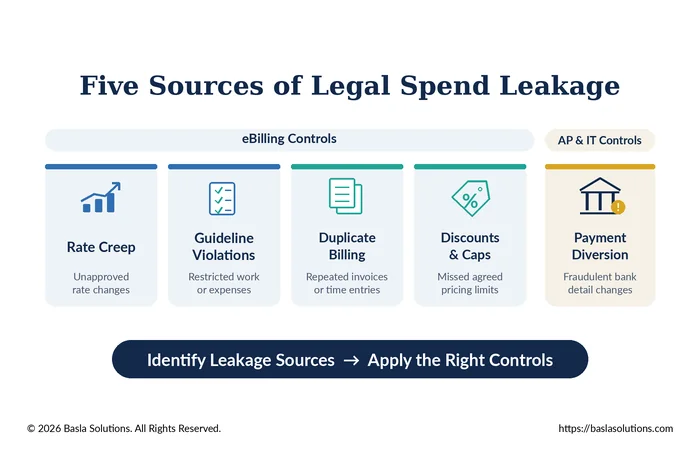
Leakage in outside counsel spend happens at five points between the engagement letter and the bank.
- Rate creep. A firm bills a new annual rate before it was approved, or a timekeeper promoted mid-year is billed at the senior rate from the first day.
- Guideline violations that slip through. Block billing, unapproved timekeepers, administrative tasks, and excess travel get paid because the rule was configured as a warning and reviewers approve warnings.
- Duplicate invoices and lines. The same invoice is resubmitted after a rejection, or the same time entries appear on two invoices for the same month.
- Unapplied discounts and caps. A volume discount, a fixed fee, or a budget cap was agreed in writing and never configured in the billing platform.
- Payment diversion. A fraudster impersonating a firm changes the bank details, and a legitimate invoice is paid to the wrong account.
The first four are billing problems the eBilling platform can catch. The fifth is a payment problem that needs AP and IT controls as well.
How do you measure a financial leakage rate?
You measure a financial leakage rate by dividing the identified leakage value by the total relevant spend over the same period and expressing it as a percentage. If a quarterly review finds $250,000 in overbilled rates, duplicates, and missed discounts against $20 million of outside counsel spend, the leakage rate is 1.25%.
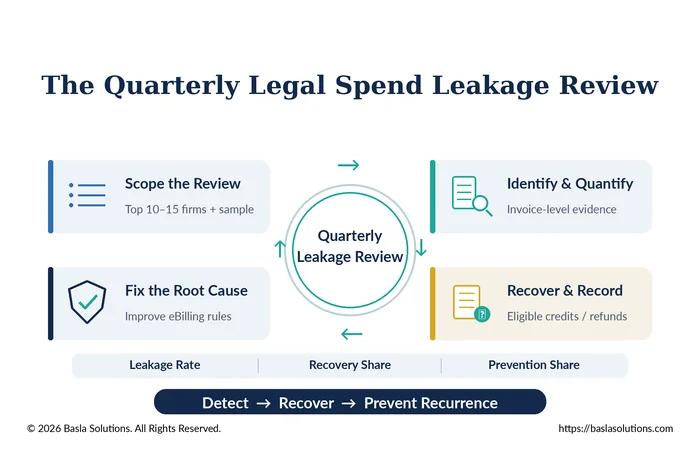
The figure only means something when the method is consistent. Use the same spend base every quarter, either all outside counsel fees or a defined set of top firms, and count only leakage you can evidence line by line. Track two further numbers alongside it: the share of identified leakage actually recovered as credits or refunds, and the share prevented before payment by a rule. A rising prevention share is the sign that controls are working, because leakage caught at submission never needs to be clawed back.
How does eBilling configuration stop billing guideline leakage?
eBilling configuration stops billing guideline leakage by turning each guideline into a rule that rejects or adjusts the line automatically, so payment no longer depends on a reviewer noticing. The configuration choices below decide whether a guideline is enforced or just written down.
- Rate cards with effective dates. Load each approved rate with a start date, so a new rate billed early is rejected and the old rate applies until approval.
- Timekeeper approval. Reject time from any timekeeper who has not been approved for the matter, including new associates added without notice.
- Task and phase rules. Reject administrative task codes and time billed to a phase the matter has already closed.
- Expense caps. Apply per-item caps for travel, meals, and copying, and auto-adjust lines above the cap.
Translating a guidelines document into rules is covered in outside counsel billing guidelines: from document to rules. The most common configuration mistake is setting rules to warn when they should adjust. A warning that a reviewer clicks through 40 times a week stops being a control.
How do duplicate invoices leak legal spend?
Duplicate invoices leak legal spend when the same work is paid twice, either as a whole invoice resubmitted under a new number or as individual time entries repeated on a later invoice.
A useful duplicate rule compares vendor, amount, invoice date, and invoice number together, then adds a line-level check that flags the same timekeeper, date, hours, and narrative appearing on two invoices. Resubmissions after a rejection need particular care, since the firm legitimately resends a corrected invoice and the platform must void the original. The AP side needs its own check on vendor, amount, and invoice reference within a window of 30 to 90 days, because invoices occasionally reach AP outside eBilling, for example as a PDF emailed directly to an AP mailbox.
How do discounts, caps, and alternative fee arrangements leak money?
Discounts, caps, and alternative fee arrangements leak money when the commercial terms are agreed in the engagement letter and never configured in the billing platform. The firm bills its standard rates, the platform has nothing to check against, and the reviewer has no reason to look.
- Volume discounts. A 10% discount that applies once annual fees pass $1 million needs a running total in the platform, or it is never applied.
- Fixed fees. A fixed fee for a phase needs a cap on that phase, so hourly time billed above the fee is rejected.
- Budget caps. A matter budget agreed as a cap needs a hard stop, since a soft budget alert only reports the overrun after it is paid.
Every new arrangement needs a configuration step, which starts with an engagement letter that states each term in numbers. The commercial side of these structures is covered in alternative fee arrangements: a legal operations guide.
How do payment controls prevent leakage from law firm impersonation?
Payment controls prevent leakage from law firm impersonation by verifying every bank detail change outside the email channel and by protecting the mailboxes where invoices and payment instructions arrive. Law firms are attractive impersonation targets, because large invoices and urgent payment requests are normal in legal work.
Business email compromise cost US victims close to $2.8 billion across 21,442 complaints in 2024, and a single diverted payment on a litigation invoice can exceed a year of billing guideline savings.
- Callback verification. Confirm any bank detail change by phone, using a number already on file, before the vendor master record is updated.
- Mailbox protection. Give shared AP and billing inboxes a named owner, label all external mail, and alert on any inbox rule that forwards messages containing “invoice” or “payment” to an outside address.
- Segregation of duties. Keep vendor master changes, payment processing, and disbursement access with different people, and add a review of every bank change where staff numbers make full separation impossible.
How do accruals and late billing hide legal spend leakage?
Accruals and late billing hide legal spend leakage because work billed months after it was done is reviewed with less context and sometimes at a newer rate. An invoice for March work that arrives in October is harder to challenge.
Set a billing deadline in your guidelines, such as 60 days from the end of the month in which the work was done, and configure the platform to reject or flag older time entries. Request monthly accruals from firms on major matters, so finance can see unbilled work building up and legal operations can compare the accrual against the invoice that follows. Accrual setup is covered in eBilling accrual configuration.
How should legal operations run a quarterly leakage review?
Legal operations should run a leakage review every quarter on a defined sample of spend, recover what can be recovered, and turn each finding into a rule so the same leak does not recur.
- Scope. Review the top 10 to 15 firms by spend, which usually cover the large majority of outside counsel fees, plus a random sample of smaller firms.
- Recovery. Request credits for confirmed overbilling within the period your engagement terms allow, and record each recovery against the firm.
- Root cause. Classify every finding by type, such as rate, duplicate, discount, or guideline, and change the configuration that let it through.
Findings belong in your firm scorecards, where they inform panel decisions alongside quality and responsiveness, as described in legal vendor management best practices.
Conclusion
Mitigating financial leakage in legal spend starts with treating it as a measurable rate. Calculate it each quarter, separate prevented leakage from recovered leakage, and trace every finding back to the control that missed it. Most leakage comes from terms that were agreed and never configured, rules set to warn when they should adjust, and payment changes verified by email alone.
How Basla can help
Basla provides delivery teams for enterprise legal management and eBilling software implementation, covering legal technology consulting for billing guideline and rate rules, configuration of discounts, caps, and duplicate checks, testing of invoice and payment controls, documentation, and post-go-live support. Basla teams have delivered matter management and eBilling across more than 10 global jurisdictions.
Basla business analysts map each engagement term and guideline to a platform rule, QA proves each rule rejects or adjusts the right lines, and hypercare feeds findings back into configuration.
Frequently asked questions
What is financial leakage?
Financial leakage is money an organization loses or pays out unnecessarily because of process gaps, billing errors, unenforced agreements, or fraud. In legal spend, it includes overbilled rates, duplicate invoices, missed discounts, and payments diverted to fraudulent accounts.
How do you calculate a leakage rate for legal spend?
A leakage rate for legal spend is calculated by dividing the identified leakage value by the total relevant spend for the same period and multiplying by 100. For example, $250,000 of leakage found in $20 million of outside counsel spend is a rate of 1.25%.
What are the most common causes of leakage in legal invoices?
The most common causes of leakage in legal invoices are rates billed before approval, guideline violations that reviewers approve as warnings, duplicate invoices or time entries, and discounts or fixed fees that were never configured in the billing platform.
Can eBilling software prevent billing leakage?
eBilling software prevents most billing-related leakage when guidelines, rate cards, discounts, and caps are configured as rules that reject or adjust lines automatically. Payment diversion also needs AP and mailbox controls.
How often should a legal department review for leakage?
A legal department should review for leakage at least quarterly, covering its top firms by spend and a sample of smaller firms.
How do you stop payment fraud on law firm invoices?
Payment fraud on law firm invoices is stopped by verifying every bank detail change by phone using a number already on file, separating vendor master changes from payment processing, and monitoring shared AP inboxes for external forwarding rules and look-alike sender addresses.
*This article is provided for general information only and does not constitute legal advice. Basla Solutions provides legal technology implementation and support services and does not practice law.*