

Legal budget types describe how much detail a matter budget carries, from a single total for the life of the matter, through annual and phase budgets, down to budgets by task code or by accounting period. The right level depends on the matter’s value, risk, and length, and on what your department needs the budget to do. Budgets are one control in legal spend management, and disputes need a phase-based litigation budget.
Too little detail and you cannot see where a matter is going wrong until the total is gone. Too much and firms spend hours on budgets nobody reads, while reviewers drown in trivial variances. This guide sets out five budget levels, when each fits, how UTBMS codes support them, and how to control variance. The five levels are an implementation framework; confirm what your platform supports.
What are legal budget types?
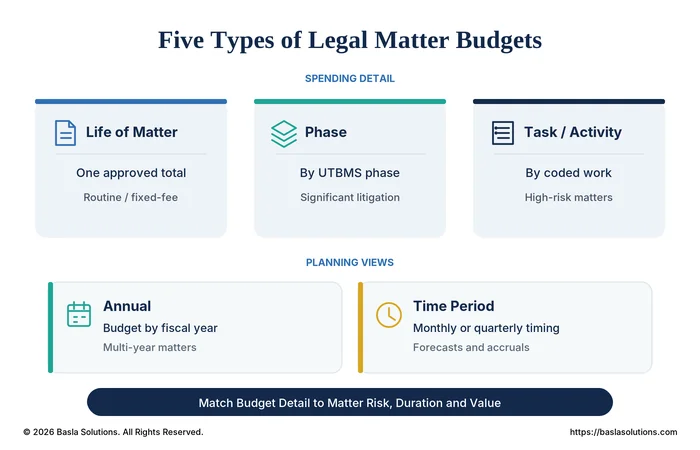
Legal budget types are the levels of detail at which a matter’s expected outside counsel cost is set and tracked: life of matter, annual, phase, task or activity, and time period. Each level answers a different question, from “what will this matter cost in total?” to “what will discovery cost this quarter?” Platforms support the finer levels directly: in Unity, phase budgets break spend into groups of tasks based on the standard UTBMS codes, with six phase sets built in. Budgeting is also a common priority, and in a 2025 survey of 188 companies, 50 percent of legal operations teams planned more consistent use of matter planning and budgeting.
Onit’s ELM platform supports configurable budgets alongside billing rules, alternative fee arrangements, and multi-currency support, so most departments can choose the level per matter. In practice, a portfolio usually mixes levels. Routine matters carry a single total, significant litigation carries phase budgets, and a handful of high-risk matters go down to task level.
Why does budget granularity matter for outside counsel spend?
Budget granularity matters because it decides how early you can see a matter going off track and how precisely you can discuss it with the firm. A single total shows an overrun only when most of the money is spent; a phase budget shows it the month discovery starts running hot.
- Earlier warning. More detail exposes variance in the part of the matter where it starts.
- Better conversations. A phase or task budget lets you ask about a specific piece of work, which firms find easier to explain.
- Effort and noise. Every extra level of detail costs the firm time to build and your reviewers time to check.
The goal is the least detail that still gives you a useful warning. That differs by matter, which is why a single policy for every matter rarely works.
When is a life-of-matter budget enough?
A life-of-matter budget is enough when the matter is low in value or complexity, short in duration, or priced under a fee arrangement that already controls cost. One approved total, compared with cumulative spend, gives all the oversight these matters need.
- Routine matters. Standard filings, contract reviews, and small disputes with predictable scope.
- Short engagements. Work expected to finish within three to six months, where a phase breakdown adds little.
- Fixed-fee matters. Work priced under a fixed fee, where the fee already controls the cost.
Set a variance alert at about 80 percent of the total and escalate at 100 percent. Because there is only one number, the assumptions behind it matter even more. Ask the firm to state them when it submits the budget.
When should a matter use an annual budget?
A matter should use an annual budget when it runs across several fiscal years and your department plans and reports spend by year. An annual figure, split between fees and expenses where useful, lines up with how finance builds the legal spend plan.
Annual budgets suit ongoing advisory relationships, long regulatory matters, and multi-year litigation in its quieter stretches. Request each year’s budget from the firm a month before the fiscal year starts, and refresh actuals and accrual estimates by around the fifth business day of each month. For larger multi-year litigation, pair the annual figure with phase budgets, so you see both the yearly cost and where within the matter it sits.
How do phase budgets use UTBMS codes?
Phase budgets use UTBMS codes by assigning an approved amount to each standard phase of a matter, so invoice lines coded to that phase can be compared directly with its budget. The Uniform Task-Based Management System was designed to let lawyers and clients budget and bill by task, and it aligns expectations about scope, deliverables, and fees.
For litigation, the standard phases include:
- L100, case assessment, development, and administration. Early analysis, fact gathering, and strategy.
- L200, pre-trial pleadings and motions. Pleadings, dispositive motions, and related work.
- L300, discovery. Written discovery, document production, and depositions.
- L400, trial preparation and trial. Witness preparation, trial work, and post-trial motions.
- L500, appeal. Appellate briefs and argument.
Onit supports these litigation phases, including an e-discovery code set, and also lets organizations configure custom task, activity, and expense codes. Phase budgets only work when firms code invoice lines accurately, and LEDES is the format that carries phase, task, and activity codes on every invoice line.
When are task or activity budgets worth the effort?
Task or activity budgets are worth the effort on high-value, high-risk, or discovery-heavy matters, where a variance in one task can move the whole matter’s cost. Budgeting by UTBMS task or activity code gives the most precise view, at the highest cost in preparation and review.
- High-value matters. Bet-the-company litigation or major investigations, where small variances are large in dollar terms.
- Discovery-intensive work. Matters where document review or depositions dominate spend and need close watching.
- Regulatory or class actions. Matters with heavy reporting obligations or board-level visibility.
Limit task budgets to the matters that need them, often fewer than 10 percent of the portfolio. Onit supports spend reporting by task code and code-based warnings or approval controls, which make task budgets workable once firms code consistently.
How do time-period budgets support forecasting and accruals?
Time-period budgets support forecasting and accruals by spreading a matter’s expected spend across months, quarters, or fiscal periods, so finance sees when the cost will land as well as how much it will be. They sit alongside another budget level and shape it for cash planning.
A phase budget says discovery will cost a set amount; a period view says most of it falls in the third quarter. That timing is what finance needs for forecasting, and it makes monthly accrual review easier, since each month’s estimate can be compared with the period budget. Keep forecast-to-actual variance within about 10 percent per month on major matters, and agree a reason for anything outside that range.
How do you choose the right budget level for each matter?
You choose the right budget level for each matter by weighing its expected value, risk, duration, and the forecasting finance needs, then applying a simple policy by practice area. Most departments can sort their portfolio with four questions.
- Expected value. Matters above a threshold, such as $250,000, move to phase budgets.
- Risk. Matters with board visibility or regulatory exposure move to task budgets regardless of value.
- Duration. Matters expected to span fiscal years add an annual view.
- Fee arrangement. Fixed-fee matters often need only a life-of-matter figure, since the fee controls the cost.
Record the chosen level and the reason on each matter, and review it when the matter changes. A dormant matter that revives may need more detail than it started with.
How should budget variance be controlled at each level?
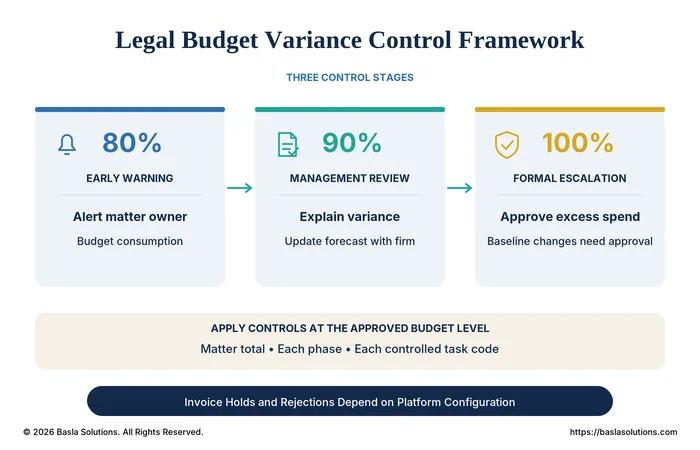
Budget variance should be controlled with the same three-stage model at every level: an early warning, a management review, and a formal escalation. Variance is actual or forecast spend minus the approved budget, divided by the approved budget; remaining budget is the approved amount minus billed spend and approved accruals.
- Early warning at 80 percent. Alert the matter owner when 80 percent of a budget is consumed, or when forecast spend exceeds 90 percent of what remains.
- Review at 90 percent. Require the matter owner to explain the variance and update the forecast with the firm.
- Escalation at 100 percent. Require formal approval for spend above the budget, for material scope changes, and for any revision that raises the baseline.
Apply the model at the level the matter is budgeted at: the total for life-of-matter budgets, each phase for phase budgets, each controlled code for task budgets. Whether your platform warns, holds, or rejects invoices at these points depends on configuration, so test it before relying on it.
Conclusion
Legal budget types let you match budget detail to what each matter actually needs. Use a single life-of-matter total for routine work, annual budgets for multi-year planning, UTBMS phase budgets for significant litigation, task budgets for the few high-risk matters that justify them, and period views where finance needs timing. Apply the same 80, 90, and 100 percent controls at whichever level you choose, and review the choice as matters change.
How Basla can help
Basla provides delivery teams for enterprise legal management and eBilling software implementation, covering legal technology consulting, business analysis, budget policy and type configuration, UTBMS code setup, variance alerts and reporting, testing, documentation, and post-go-live support. For budget granularity, that means defining which matters carry which level of detail, configuring phase and task budgets and code controls, and building variance reports at each level.
Basla has delivered matter management and eBilling across more than 10 global jurisdictions, and its delivery bench takes the weight off your team while budget policy is designed and rolled out.
Frequently asked questions
What are legal budget types?
Legal budget types are the levels of detail at which a matter budget is set and tracked: life of matter, annual, phase, task or activity, and time period. The right level depends on the matter’s value, risk, and length.
What is a life-of-matter budget?
A life-of-matter budget is a single approved total for a matter’s entire duration, compared with cumulative spend. It suits routine, short, or fixed-fee matters.
What are UTBMS phase budgets?
UTBMS phase budgets assign an approved amount to each standard phase of a matter, such as L100 case assessment or L300 discovery. Invoice lines coded to each phase are compared with its budget.
When should a matter have a task-level budget?
A matter should have a task-level budget when it is high in value or risk, or dominated by discovery, so that variance in one task matters. Most portfolios need task budgets on only a small share of matters.
How is budget variance calculated?
Budget variance is actual or forecast spend minus the approved budget, divided by the approved budget, expressed as a percentage. Remaining budget is the approved amount minus billed spend and approved accruals.
At what point should budget variance be escalated?
Budget variance should trigger an early warning at about 80 percent of budget, a matter owner review at 90 percent, and formal approval for any spend above 100 percent.
*This article is provided for general information only and does not constitute legal advice. Basla Solutions provides legal technology implementation and support services and does not practice law.*