


Fixed-fee legal billing is an alternative fee arrangement under which outside counsel receives an agreed sum for a whole matter, a defined phase, or a specific project. Your department gets cost certainty, and the firm takes on more of the risk that the work runs longer than expected.
The arrangement only delivers that certainty if invoices respect it. Fixed and other alternative fees are still a minority, since invoice data covering more than $75 billion of 2025 spend shows alternative fee arrangements accounted for 8.3 percent of matters and 6.3 percent of spend. A fixed fee billed as hourly time, coded to the wrong phase, or approved without a check against the agreed amount turns back into an hourly matter in practice. This guide covers how fixed fees are scoped, invoiced, validated, approved, and reviewed, using Onit as the worked example. For choosing between fee models in the first place, see our guide to alternative fee arrangements and how legal departments use them.
What is fixed-fee legal billing?
Fixed-fee legal billing is a pricing model in which a law firm charges an agreed amount for defined legal work, regardless of the hours it takes to complete. The fee can cover an entire matter, one phase such as discovery, or a repeatable task such as a standard contract review.
In Onit, fixed or flat-rate billing is an agreed sum for handling a matter or a defined portion of a case, one of several AFA types that improve cost predictability and share financial risk with firms. Fixed fees work well when both sides understand the work. They work poorly when the scope is vague, because every disagreement about scope becomes a disagreement about money.
When does a fixed fee suit a legal matter?
A fixed fee suits a legal matter when the work is well understood, the firm has done similar work many times, and your department values budget certainty over flexibility. The more predictable the work, the more accurately the firm can price it.
- Repeatable work. Trademark filings, standard contract reviews, and routine employment matters, where the firm has priced dozens of similar engagements.
- Defined phases. A single phase of a larger matter, such as early case assessment, where the tasks and deliverables can be listed.
- Portfolio work. A block of similar matters, such as 50 lease reviews a year, where volume evens out the variation between matters.
- Budget pressure. Matters where the business needs a firm number for planning, and an occasional overrun absorbed by the firm is worth the premium.
Interest is growing, and in a 2025 survey of 188 companies, 47 percent of legal operations teams planned wider use of alternative fee arrangements. Fixed fees suit unpredictable litigation less well. There, a phased fee or a capped hourly arrangement usually fits better.
How should fixed-fee scope be defined?
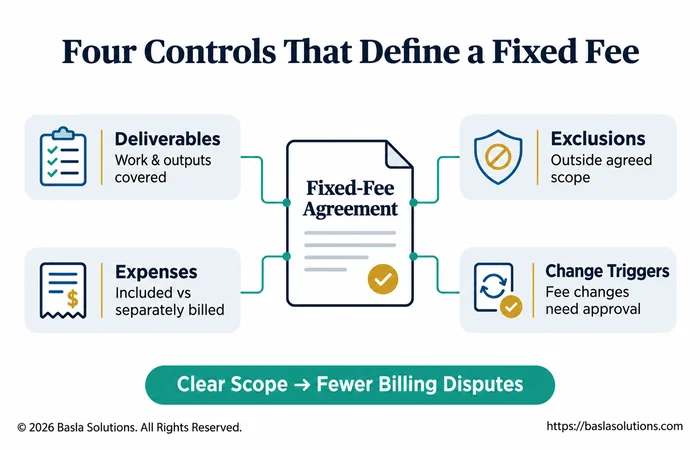
Fixed-fee scope should be defined in a short written document that lists what the fee covers, what it excludes, and what events allow the fee to be revisited. The scope is the single most important control, because every invoice dispute on a fixed-fee matter starts with a scope question.
- Deliverables. The specific outputs the fee pays for, such as a signed agreement or a filed application.
- Exclusions. Work outside the fee, such as additional parties, appeals, or third-party costs.
- Expenses. Whether disbursements sit inside the fee or are billed separately, and any approval rules for them.
- Change triggers. The events that allow a revised fee, and who on your side approves the change.
Keep the scope to one or two pages and store it against the matter, so reviewers read the same version the firm signed up to.
How should law firms submit fixed-fee invoices?
Law firms should submit fixed-fee invoices using a flat-fee rate type on the invoice line, coded to the agreed matter and phase, with no hourly time entries billed against the fixed amount. Clean coding lets the eBilling platform recognize the fee and check it automatically.
- Flat-fee line type. Bill the agreed amount as a fixed or flat fee line, so it is never mistaken for hourly time.
- Phase coding. Where the fee is phased, code each line to the right phase using the agreed task codes.
- Milestone timing. Agree when the fee is invoiced, such as in full on completion or in parts at defined milestones.
Spell these rules out in your billing guidelines before the first invoice. Invoice lines travel in a LEDES file, which carries rate types and task codes on each line.
How does Onit validate fixed-fee invoices?
Onit validates fixed-fee invoices through configurable AFA billing rules, and its invoice validation workflow lists fixed or flat fees and fixed total costs among the supported AFA rule types. The same rules framework covers billing guidelines, timekeepers, rates, discounts, line-item totals, and matter-specific and vendor rate cards.
- Fixed fee checks. Confirm the billed amount matches the agreed fee for the matter or phase.
- Fixed total cost checks. Confirm cumulative billing on the matter has not passed the agreed total.
- Line-level checks. Catch hourly entries, unapproved timekeepers, or expenses billed against a fee that includes them.
Depending on configuration, a rule can flag a line for review, adjust it, or reject the invoice. Test each outcome with sample invoices before go-live: one exactly at the fee, one above it, and one with hourly time mixed in.
How should approval workflows handle fixed-fee invoices?
Route fixed-fee invoices through an approval chain that matches the matter’s value and risk, with extra review when an invoice approaches the agreed fee. Onit supports monetary thresholds, matter- or vendor-specific approval chains, sequential or parallel approvers, escalations, and conditional approvers.
A compliant fixed-fee invoice is usually simple to approve. The matter lead confirms the deliverable was received, and the invoice moves on. Invoices that break a fixed-fee rule need a different route: the matter lead plus legal operations, and finance for larger amounts. Set the number of approval levels to fit your department. Two or three levels cover most matters, and adding more slows payment without adding much control. Set an escalation so an invoice that sits with one approver for more than five business days moves up the chain.
What is shadow billing on a fixed-fee matter?
Shadow billing on a fixed-fee matter is a request that the firm also records and reports the hours and rates it would have billed, alongside the fixed fee it actually charges. A shadow bill compares actual effort with the fee, so you can judge whether the arrangement delivered value.
- Fair pricing check. Shadow hours show whether the fee was generous, tight, or about right for the work.
- Renewal evidence. Several matters of shadow data give you a basis for setting the next fee.
- Staffing insight. The timekeeper mix shows whether the firm staffed the work at the right seniority.
Shadow billing is reporting only. It does not change what you pay, and firms should be told it will be used to calibrate future fees, so they report it honestly.
How do fixed-fee invoices flow to accounts payable?
Fixed-fee invoices flow to accounts payable through your ELM platform’s AP integration once approval is complete, carrying the coding finance needs to post and pay them. Onit’s ELM materials describe integration with accounts payable and other back-end systems alongside budget reporting and audit trails.
What actually transfers depends on your integration design. Typical fields include the vendor’s AP identifier, the general ledger code, and a purchase order number where your company uses them. Confirm each field in the integration specification, and test a fixed-fee invoice end to end before go-live, including an adjusted invoice, so finance sees the approved amount and the original.
How do you tell whether a fixed fee delivered value?
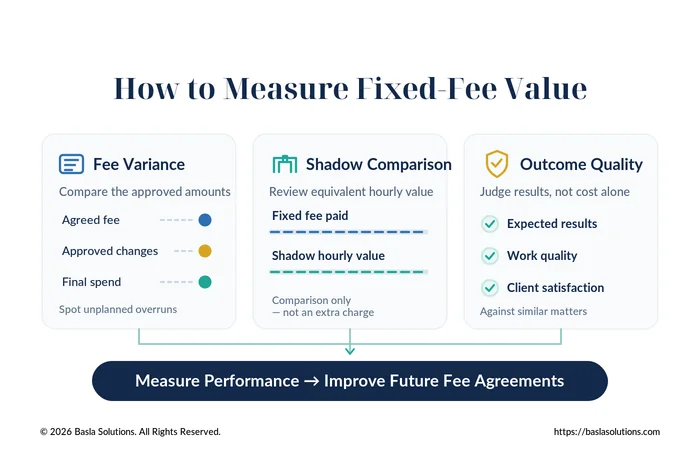
You tell whether a fixed fee delivered value by comparing the final approved spend with the agreed fee, separating approved scope changes from overruns, and comparing the result with shadow billing and similar hourly matters. Review each fixed-fee matter at close.
- Fee variance. Final approved spend minus the agreed fee, split into approved changes and unplanned overruns.
- Shadow comparison. The fee against the shadow hourly value, which shows who absorbed the risk.
- Outcome quality. Evaluator ratings on the matter, to confirm the fee did not come at the expense of the work.
Across a year, compare fixed-fee matters with hourly matters of the same type. If fixed fees consistently come in below the hourly equivalent with similar ratings, extend them to more of that work.
Conclusion
Fixed-fee legal billing gives your department cost certainty when the arrangement is backed by a clear scope, clean invoice coding, validation rules, and a sensible approval route. Onit provides the building blocks: fixed fee and fixed total cost rules, configurable approval chains, and AP integration. Your team supplies the scope, the guidelines, and the review at matter close, and shadow billing gives you the evidence to price the next fixed fee better than the last.
How Basla can help
Basla provides delivery teams for enterprise legal management and eBilling software implementation, covering legal technology consulting, invoice rule and approval workflow configuration, AP integration testing, reporting, documentation, and post-go-live support. For fixed-fee legal billing, that means configuring fixed fee and fixed total cost rules, designing approval chains that fit your matters, and testing invoices end to end from submission to accounts payable.
Basla has delivered matter management and eBilling across more than 10 global jurisdictions, and its delivery bench takes the weight off your team while fixed-fee processes are configured and tested.
Frequently asked questions
What is fixed-fee legal billing?
Fixed-fee legal billing is an arrangement in which a law firm charges an agreed amount for defined legal work, regardless of the hours it takes. The fee can cover a whole matter, one phase, or a repeatable task.
When should a legal department use a fixed fee?
A legal department should use a fixed fee when the work is well understood, the firm has done similar work many times, and budget certainty matters. Repeatable work and single defined phases suit fixed fees best.
How should a law firm bill a fixed fee?
A law firm should bill a fixed fee using a flat-fee rate type on the invoice line, coded to the agreed matter and phase. Hourly time entries should not be billed against the fixed amount.
Does Onit support fixed-fee invoice validation?
Onit supports fixed-fee invoice validation through configurable rules, with fixed or flat fees and fixed total costs listed among its supported AFA rule types. Depending on configuration, rules can flag, adjust, or reject invoices.
What is shadow billing?
Shadow billing is a report in which a firm on a fixed fee also records the hours and rates it would have billed hourly. It helps you judge whether the fee was fair and set future fees.
How many approval levels should a fixed-fee invoice need?
A fixed-fee invoice usually needs two or three approval levels, such as the matter lead, legal operations, and finance for larger amounts. Compliant invoices can move faster than those that break a fee rule.
*This article is provided for general information only and does not constitute legal advice. Basla Solutions provides legal technology implementation and support services and does not practice law.*