

Capped fee arrangements are alternative fee arrangements in which outside counsel bills hourly as usual, but total billing on the matter or phase cannot pass an agreed maximum. The firm keeps the flexibility of time billing, and your department gets a ceiling it can plan around.
Caps matter more as rates climb, and the average law firm saw 7 percent growth in worked rates in 2025, with 2026 increases expected to match or exceed it. A cap only protects you if someone tracks it. Many departments agree a cap during engagement, record it in an email, and find out it was breached when an invoice takes the matter over the limit. This guide covers how to set a cap well, how invoices are checked against it, what to do as the matter approaches it, and how to amend it when the work genuinely changes, using Onit as the worked example.
What are capped fee arrangements?
Capped fee arrangements are hourly billing agreements with a predetermined maximum on the total amount the firm can bill. In Onit, a capped fee is treated as hourly billing subject to a predetermined maximum, which keeps hourly records intact while limiting your exposure.
The cap can apply to a whole matter, a single phase such as discovery, or a period such as a calendar year. Below the cap, invoices work like hourly billing. At the cap, the firm absorbs further time unless your department agrees a change. That last point is what makes the cap a real control, and it only holds if the cap is recorded where invoice checks can use it.
How does a capped fee differ from a fixed fee or a budget?
A capped fee differs from a fixed fee and a budget in what the firm can bill and what happens when estimates prove wrong. All three give you a number to plan around, but only two of them limit what you pay.
- Fixed fee. The firm bills the agreed amount whatever the hours, so you pay the same whether the work runs short or long.
- Budget. The firm estimates the cost, but hourly billing continues past the estimate, so a budget informs your forecast without limiting spend.
- Capped fee. The firm bills actual hours up to the ceiling, so you pay less if the work runs short and no more than the cap if it runs long.
When should a legal department use a capped fee?
A legal department should use a capped fee when the work is reasonably well understood but the hours are hard to predict precisely, and when hourly records are still useful. It suits matters that sit between the certainty of a fixed fee and the openness of pure hourly billing.
- Defined phases. Early case assessment, a regulatory response, or a single round of negotiation, where scope is clear but effort varies.
- New firm relationships. A first matter with a firm, where you want a ceiling while you learn how it staffs and bills.
- Investigations with a known scope. Internal reviews where the questions are set but the volume of documents is uncertain.
- Matters with budget sensitivity. Work where finance needs a maximum figure for planning, and an hourly record for later analysis.
Capped fees suit open-ended litigation less well, because a cap set too early is either too high to matter or too low to hold.
How should the cap amount and scope be set?
The cap amount and scope should be set from a budget built with the firm, a written description of the covered work, and a clear rule on expenses and rates. A cap set without a scope invites the firm to argue that later work falls outside it.
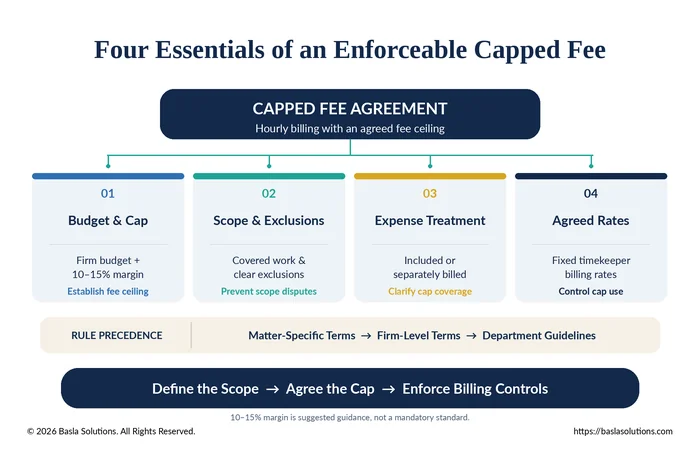
- Budget first. Request a budget proposal from the firm and set the cap from it, usually with a margin of 10 to 15 percent above the expected cost.
- Scope and exclusions. List the work the cap covers and the work it does not, such as appeals, additional parties, or expert fees.
- Expenses. State whether disbursements count toward the cap or are billed separately.
- Rates for the matter. Agree that timekeeper rates stay fixed for the life of the matter, so a rate increase cannot use up the cap faster.
In SimpleLegal, now Onit Unity, a budget can be requested from the firm when it is assigned to the matter, then reviewed by the Matter Lead, and phase budgets break spend into groups of tasks based on the standard UTBMS codes. Phase budgets built on standard task codes let you set and track a cap per phase where that makes sense.
Why should matter-level cap terms override general billing guidelines?
Matter-level cap terms should override general billing guidelines because they are the specific commercial agreement for that matter, negotiated after the guidelines were written. If automated invoice review applies the general rules first, it can approve hourly charges that the matter’s cap should have stopped.
Set the order of precedence explicitly in your billing guidelines and your invoice rules: matter-specific terms first, firm-level terms second, department-wide guidelines third. Then test it. Submit a sample invoice that complies with the general guidelines but takes the matter over its cap, and confirm the review flags it.
How are capped fees checked when invoices arrive?
Capped fees are checked when invoices arrive by comparing cumulative billing on the matter or phase with the agreed cap, alongside the normal checks on rates, timekeepers, and discounts. Onit’s invoice validation supports rules for fixed total costs, matter-specific and vendor rate cards, discounts, and line-item totals, which together cover what a cap needs.
- Cumulative total. Compare billing to date plus the new invoice with the cap, and flag any invoice that passes it.
- Rate checks. Confirm each timekeeper bills at the rate agreed for the matter, so the cap is consumed at the expected pace.
- Discount order. Agree whether negotiated discounts apply before the cap is calculated, and configure the check to match.
What happens to an over-cap invoice depends on how your environment is configured: it can be flagged for review, adjusted down to the cap, or rejected. Test each path with sample invoices before go-live.
What should happen as a matter approaches its cap?
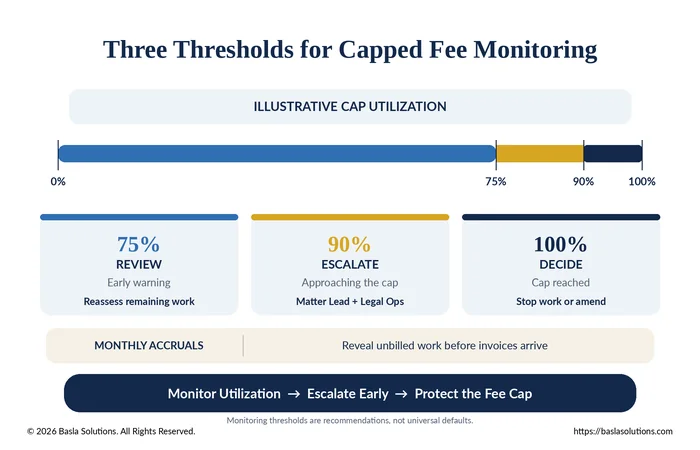
As a matter approaches its cap, alerts at set points should trigger a conversation with the firm while there is still room to adjust. A cap reached without warning becomes a dispute; a cap tracked at 75 percent becomes a planning discussion.
- At 75 percent. Review the remaining work with the firm and confirm the cap still covers it.
- At 90 percent. Require the Matter Lead and legal operations to review before further work proceeds.
- At 100 percent. Require a formal decision on scope, a cap amendment, or a stop on further billable work.
Monthly accruals give you an early view, because a firm’s estimate of unbilled work shows spend heading toward the cap before the invoice arrives. eBilling accrual configuration sets how firms submit those monthly estimates, so align the accrual cycle with your cap reviews.
How should a cap be amended when scope changes?
A cap should be amended through a refreshed budget and a documented approval, recorded before the additional work begins. SimpleLegal supports requesting an updated budget proposal from the firm when the scope of work changes.
The firm explains what changed and proposes a new figure, the Matter Lead reviews it, and approval sits at the level that matches the increase. Record the reason against the original scope, so you can later separate genuine scope changes from caps that were simply set too low. Who can change a cap value in the platform once it is set is a configuration choice: restricting it to a small administrator group protects the arrangement from casual edits.
How do you measure whether capped fees are working?
You measure capped fees by tracking how close matters finish to their caps, how often caps are amended, and whether invoices that pass the cap are caught. Review each capped matter at close and the program once a year.
- Cap utilization. Final approved spend as a percentage of the cap, which shows whether caps are set at sensible levels.
- Amendment rate. The share of capped matters that needed a higher cap, and why.
- Over-cap catch rate. How many invoices that passed the cap were flagged before approval.
If most matters close at 60 percent of the cap, caps are set too high to influence behavior. If most need amending, scope or budgeting needs work.
Conclusion
Capped fee arrangements give your department hourly transparency with a firm ceiling, but only when the cap is set from a real budget, recorded where invoice checks can use it, and watched as the matter progresses. Set clear precedence for matter terms, test over-cap invoices before go-live, alert at 75 and 90 percent, and amend caps through a documented process.
How Basla can help
Basla provides delivery teams for enterprise legal management and eBilling software implementation, covering legal technology consulting, business analysis, fee arrangement and invoice rule configuration, budget and phase setup, invoice scenario testing, reporting, documentation, and post-go-live support. For capped fees, that means configuring cap checks and rule precedence, building cap utilization reports, and testing over-cap invoices end to end before your first capped matter goes live.
Basla has delivered matter management and eBilling across more than 10 global jurisdictions, and its delivery bench takes the weight off your team while fee arrangements are configured and tested.
Frequently asked questions
What are capped fee arrangements?
Capped fee arrangements are hourly billing agreements with a predetermined maximum on what the firm can bill for a matter, phase, or period. Below the cap the firm bills actual hours; above it, further time is absorbed unless a change is agreed.
How is a capped fee different from a fixed fee?
A capped fee bills actual hours up to a ceiling, so you pay less if the work runs short. A fixed fee bills the agreed amount whatever the hours worked.
How should a fee cap be set?
A fee cap should be set from a budget proposal built with the firm, usually with a margin of 10 to 15 percent, plus a written scope and a rule on expenses. Fixing timekeeper rates for the matter keeps the cap meaningful.
What happens when an invoice exceeds the cap?
When an invoice exceeds the cap, it can be flagged for review, adjusted down, or rejected, depending on how your eBilling rules are configured. Test each outcome with sample invoices before go-live.
When should alerts fire on a capped matter?
Alerts on a capped matter typically fire at 75 percent and 90 percent of the cap, with a formal decision required at 100 percent. Monthly accruals can give earlier warning.
Can a fee cap be changed after the matter starts?
A fee cap can be changed after the matter starts through a refreshed budget and a documented approval before the extra work begins. Restrict who can edit the cap value in the platform.
*This article is provided for general information only and does not constitute legal advice. Basla Solutions provides legal technology implementation and support services and does not practice law.*