

Legal budget management is the process of setting the legal department’s annual budget, connecting it to the budgets on individual matters, tracking spend against both, and reporting the results to finance. Budgets are rising, which raises the stakes. A 2025 survey of 500 general counsel and chief legal officers found that 83 percent reported budget increases, averaging 10 percent. A bigger budget comes with closer questions from finance about where it went.
Budgeting is one part of a wider legal spend management program, alongside invoice review, accruals, and analytics. It also relies on the data an enterprise legal management platform collects on every matter and invoice. This guide works at the department level: the annual budget, how matter budgets feed it, forecasting, and reporting.
What is legal budget management?
Legal budget management is the work of planning, tracking, and explaining legal spend at two levels at once: the department’s annual budget, which finance owns as a number, and the matter budgets that describe how that money will actually be spent.
The process has five parts:
- The annual budget. A department total, split by spend category, business unit, and legal entity, agreed with finance before the fiscal year starts.
- Matter budgets. Estimates for individual matters, usually submitted by outside counsel and approved by the matter owner.
- Tracking. Invoices and accruals counted against both levels as they arrive.
- Forecasting. A running estimate of where the year will land, updated each month or quarter.
- Reporting. A regular view for finance and the GC that explains variances in plain terms.
The two levels answer different questions. The annual budget asks whether the department will stay within its number. Matter budgets ask whether each piece of work is costing what it should.
How do you set an annual legal department budget?
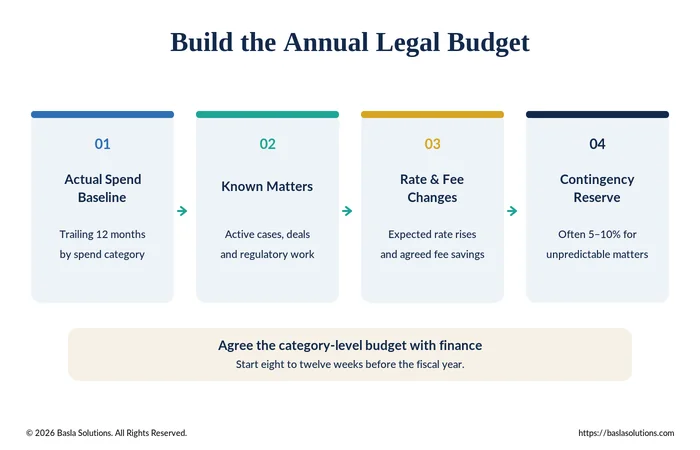
You set an annual legal department budget by starting from the current year’s actual spend by category, adjusting for known matters, expected rate increases, and planned changes, and agreeing the result with finance before the fiscal year begins.
- Baseline. Use the trailing 12 months of actual spend, split into outside counsel, eDiscovery, experts, other vendors, and internal costs.
- Known matters. Add the expected spend on active litigation, planned transactions, and regulatory work, drawn from their matter budgets, such as the phase-by-phase litigation budget for each open case.
- Rate changes. Apply the rate increases you expect to approve for panel firms, and any savings from new fee arrangements.
- Contingency. Hold a reserve, often 5 to 10 percent, for matters nobody can predict, such as a new lawsuit or an investigation.
Start eight to twelve weeks before the fiscal year, since finance calendars rarely move for legal. A budget built bottom-up from matters and categories is also far easier to defend when finance asks for a cut.
How do matter budgets roll up to the department budget?
Matter budgets roll up to the department budget when every matter carries the same categories the department budget uses, such as business unit, matter type, and legal entity, so matter totals can be added together and compared with the plan.
- Shared dimensions. Use one list of business units, matter types, and entities for both levels, so a matter budget lands in exactly one line of the department budget.
- Annual slices. A matter that runs for three years needs its budget split by fiscal year. The difference between life-of-matter budgets and annual budgets decides how that split is made.
- Pooled small matters. Low-value matters are budgeted as a pool by category, so the department does not chase hundreds of tiny budgets.
- The right level of detail. Large matters may need phase or task budgets, while routine work needs only a total. Choosing among the legal budget types for each level of detail keeps the effort proportionate.
The roll-up rarely matches the department budget exactly. The gap between the two is your unallocated reserve, and it should be visible in every report.
How do you track legal budgets with software?
You track legal budgets with software by loading approved budgets into the ELM or eBilling platform, so every approved invoice and accrual counts against its matter budget and rolls up to the department view automatically.
The tools are usually already in place. A 2025 survey of 186 legal organizations found that 84 percent use electronic billing, so the gap is usually configuration.
- Budget at matter opening. Require an approved budget before the first invoice on any matter expected to exceed a set amount, such as $25,000.
- Warnings on invoices. Alert the matter owner when spend passes 80 percent of budget, and hold invoices that would push a matter over 100 percent until an overage is approved.
- Accruals in the total. Count firm accruals for unbilled work alongside invoices, so tracking reflects work done.
- Revision history. Record every budget change with a date, a reason, and an approver, so finance can see why a number moved.
Set the thresholds by matter size. A 10 percent overrun on a $20,000 advisory matter rarely needs a meeting, while the same overrun on a $2 million litigation matter does. Most platforms let you set warning levels by matter type or budget amount, so test them with real matters before go-live.
How do you forecast legal spend?
You forecast legal spend by combining what has been billed, what has been accrued for unbilled work, and what remains on each active matter budget, then adding an allowance for matters not yet opened.
- Committed spend. Actual invoices paid or approved, plus accruals for the months already closed.
- Remaining matter budgets. The unspent balance on active matters, adjusted for how quickly each matter is actually burning its budget.
- New matter run rate. The average monthly spend on new matters from the past one to two years, applied to the remaining months.
Ask matter owners to confirm their remaining budgets before each quarterly reforecast. Outside counsel know when a trial date has moved or a deal has stalled long before invoices show it, so a short check-in with the five to ten largest firms improves the forecast more than any formula. Reforecast the full year every quarter, and every month for the largest matters. A forecast that moves gradually is a sign of good legal budget management. A forecast that jumps in the last quarter usually means accruals were missing earlier.
How do you report budget performance to finance?
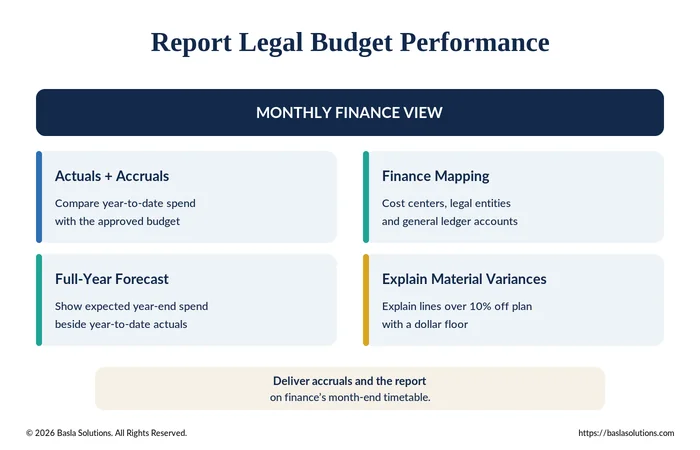
You report budget performance to finance with a monthly view of actual spend plus accruals against budget, organized by the cost centers and legal entities finance uses, with a short explanation of every variance above an agreed threshold.
- Finance’s structure. Report by finance’s cost centers, entities, and GL accounts, so the legal view reconciles with the ledger.
- Variance explanations. Explain every line more than 10 percent off plan, with a dollar floor so small lines do not create noise.
- The forecast. Show where the year is expected to land alongside year-to-date actuals.
- The close calendar. Deliver accruals and the report on finance’s month-end timetable.
Finance will also compare your total with peers. A 2026 benchmarking study of 576 legal departments found median legal spend fell to 0.43 percent of company revenue, so expect the question of why yours differs. Pairing the largest variances with what the spend achieved, such as a settlement below the reserve, makes the report far more persuasive.
Conclusion
Legal budget management works when the annual budget and the matter budgets share the same structure, so one rolls up into the other without manual reconciliation. Build the annual number from actuals, known matters, and a reserve, track invoices and accruals against both levels in your platform, reforecast every quarter, and report in finance’s own structure. Do that consistently and the budget conversation with finance becomes about choices, with far less time spent on surprises.
How Basla can help
Basla provides delivery teams for enterprise legal management and eBilling software implementation, covering business analysis, budget and matter category design, budget approval workflows, accrual configuration, finance and ERP integration, budget reporting, testing, documentation, and post-go-live support. Basla delivers legal technology services through staff augmentation or a Basla-managed delivery unit, so your budget structure is built once and reused across matters, invoices, and finance reports.
Basla teams have delivered matter management and eBilling across 10 or more global jurisdictions, with budgets and accruals mapped to multiple legal entities and currencies.
Frequently asked questions
What is legal budgeting software?
Legal budgeting software is the part of an ELM or eBilling platform that stores department and matter budgets, compares them with invoices and accruals, and alerts owners to overruns. It is the system behind legal budget management for most departments.
Should outside counsel spend be budgeted by matter or by firm?
Outside counsel spend should be budgeted by matter, because the matter is where work is scoped and approved, and matter budgets can then be summed into firm totals for panel reviews. Firm-level budgets suit only high-volume, low-value work under portfolio or fixed-fee arrangements.
How do accruals affect the budget?
Accruals add the value of work done but not yet billed, so budget-to-actual figures reflect real spend in the period. Without them, a department looks under budget until late invoices arrive, often months later.
What is a good budget variance threshold?
Many departments review any matter more than 10 percent over budget, with a dollar floor such as $25,000 so small matters do not create noise. At department level, a variance above 5 percent of the annual budget usually needs an explanation to finance.
*This article is provided for general information only and does not constitute legal advice. Basla Solutions provides legal technology implementation and support services and does not practice law.*