

Billing guideline compliance is the share of outside counsel fees and expenses that matches the rules your legal department has set, and it improves only when every invoice is checked against those rules before payment. Most departments already have a guideline document. Far fewer enforce it the same way on every invoice, because the document lives in a PDF while invoices arrive by the hundred each month.
Enforcement is one of the core controls an enterprise legal management platform exists to run. It sits inside the wider legal bill review process, which combines automated rules, in-house reviewers, and managed review services. This guide covers the enforcement side: rules, reviewer workflow, firm communication, exceptions, and reporting. Drafting the guidelines themselves is covered in how outside counsel billing guidelines become enforceable rules.
How do corporate legal departments enforce billing guidelines?
Corporate legal departments enforce billing guidelines by turning each guideline into a rule the eBilling system checks automatically, routing whatever the rules flag to a reviewer, and adjusting or rejecting noncompliant lines before the invoice is paid.
The departments that enforce well run five connected pieces:
- A rules engine. Rates, task codes, expense limits such as caps on expert witness fees, and budget caps are stored as rules, and every invoice line is tested against them on arrival.
- A reviewer workflow. Lines the rules cannot judge, such as vague narratives or heavy staffing, go to a named reviewer with a clear turnaround target, typically three to five business days.
- Firm communication. Every adjustment carries a coded reason, so the firm knows exactly which guideline it broke.
- Exception handling. Approved exceptions, such as a one-off rate for an expert partner, are recorded against the matter so the rule stops firing on them.
- Reporting. Adjustments, appeals, and violations by firm are summarized for the GC each month or quarter.
The weak point is usually the gap between the guideline and the rule. A guideline that says “staff matters efficiently” cannot be enforced by software. A rule that allows two timekeepers per internal meeting can.
How does software enforce outside counsel billing guidelines?
Software enforces outside counsel billing guidelines by reading each LEDES invoice line, comparing it with the rates, codes, budgets, and restrictions stored against the matter and the firm, and flagging, reducing, or rejecting any line that breaks a rule.
Most departments already own the tool. A 2025 survey of 186 legal organizations found 84 percent use electronic billing, the most widely used technology in the survey. The difference between departments lies in how the rules are configured, and they fall into three groups:
- Hard rejections. Invoice-level failures send the whole invoice back: a wrong matter number, a broken LEDES file, or an invoice submitted after the deadline set by the trailing invoice window.
- Automatic reductions. Lines that break a clear numeric rule are cut to the allowed amount: a rate above the approved rate, more than 10 billed hours in a day, or a banned expense such as first-class travel.
- Flags for review. Lines that need judgment are held for a person: block billing, vague narratives, or a fourth timekeeper on a call.
Start with 15 to 25 rules that cover the guideline items that cost the most money. Switching on 60 rules at go-live buries reviewers in low-value flags, and they start approving in bulk. The queues, tiers, and approval steps behind those flags are covered in automated legal invoice review for LEDES invoices.
How do you enforce rate and billing guideline compliance?
You enforce rate and billing guideline compliance by loading every approved timekeeper rate into the system, so each invoice line is checked against the rate approved for that timekeeper on that matter, and anything above it is reduced automatically.
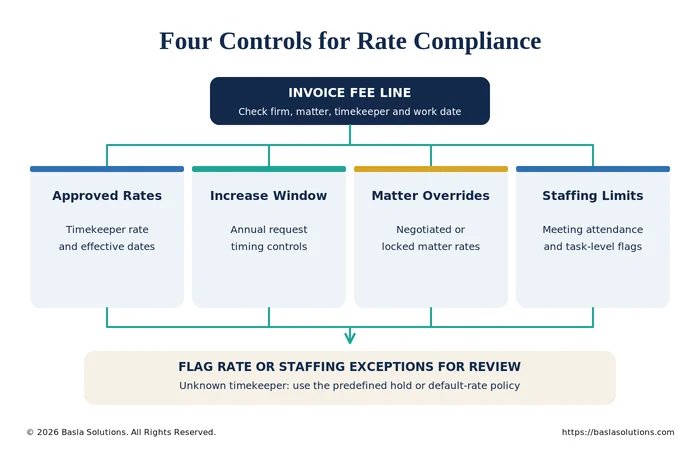
Rate rules are the easiest to automate and usually recover the most money. Four controls carry most of the load:
- Rate cards per firm and timekeeper. Each timekeeper has an approved rate, a classification such as partner or paralegal, and an effective date range.
- One annual increase window. Firms submit rate increase requests once a year, for example 60 days before January 1, and anything outside the window is held.
- Matter-specific rates. Negotiated or locked rates on a matter override the firm’s standard card for the life of that matter.
- Staffing limits. Rules cap attendees per meeting and flag paralegal-level tasks billed at partner rates.
The most common rate failure is an unknown timekeeper. A new associate appears on an invoice with no approved rate, and the system needs a clear default: hold the line until the rate is approved, or pay it at the lowest approved rate for that classification. Decide which before go-live.
What happens when a firm breaks a guideline?
When a firm breaks a guideline, the noncompliant line is reduced or rejected with a coded reason, the firm is told why, and it gets a fixed window to appeal or resubmit before the adjustment becomes final.
Coded reasons matter because firms often struggle to apply client guidelines internally. A 2021 survey of law firm leaders found that only 32 percent were confident that more than half of their lawyers knew the client guidelines for their matters. Standard codes help close that gap. The LEDES standard now publishes 65 error codes that tell a firm which field failed and what to fix, in a second version ratified in September 2024.
A clear consequence ladder keeps enforcement predictable:
- Reduce the line when part of the charge is valid, such as a rate above the approved amount.
- Reject the line when the charge is barred entirely, such as overtime meals or research billed without approval.
- Reject the invoice for structural failures the firm must fix and resubmit.
- Close the appeal window after a set period, commonly 10 business days, so adjustments become final and spend data settles.
Repeat violations belong in the firm’s performance review. A firm whose invoices trip the same rule for three months running needs a conversation with the relationship partner.
How do managed services ensure billing guideline compliance?
Managed services ensure billing guideline compliance by adding trained reviewers who judge the flagged lines and narratives the rules engine cannot, apply the department’s guidelines the same way across every invoice, and report what they adjusted and why.
A legal invoice review managed service usually takes over the review queue while the department keeps the final decision on disputed items. The work covers:
- Narrative review. Entries such as “attention to file” or “review documents” are tested against the guideline on task descriptions.
- Staffing judgment. Reviewers spot duplicate attendance, senior lawyers doing junior work, and training time billed to the client.
- Rule recommendations. When reviewers make the same manual adjustment for two or three months, they propose turning it into an automated rule.
A written decision log keeps the same issue treated the same way, whoever reviews it. The model fits departments with high invoice volume and few in-house reviewers. The department still owns the guidelines, approves rule changes, and decides appeals that touch the firm relationship.
How do you report guideline compliance to the GC?
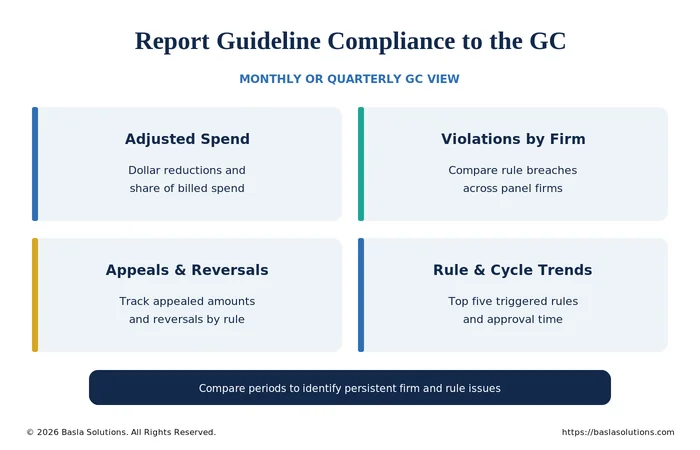
You report guideline compliance to the GC with a one-page monthly or quarterly view of how much was billed, how much the rules and reviewers adjusted, which firms broke which rules, and how many adjustments were appealed and reversed.
Keep the view short and comparable from one period to the next:
- Adjusted spend. Total reductions in dollars and as a percentage of billed spend.
- Violations by firm. Each panel firm’s violation rate, so trends show before panel reviews.
- Appeal and reversal rate. A reversal rate above about 20 percent on a rule usually means the rule is wrong.
Add the five rules that fire most often and the days from invoice receipt to approval, since enforcement that slows payment strains firm relationships. Guideline adjustments are one part of the wider picture of financial leakage in legal spend, and the GC report should show them alongside budget overruns and missed discounts, drawn from the same data as your legal spend analytics.
How often should guidelines and rules be reviewed?
Guidelines and enforcement rules should be reviewed in full once a year, checked quarterly for rule performance, and updated immediately whenever a guideline changes.
- Quarterly rule tuning. Retire or rewrite rules with high reversal rates, and review any rule that has not fired in six months.
- Annual guideline refresh. Align the full review with the rate increase cycle, so new rates and new guidelines take effect together.
- Change control. Give every change an effective date and at least 30 days of notice to firms, and test new rules in a sandbox against recent invoices before switching them on.
Testing against real invoices shows how many lines a new rule would flag. If a new rule would flag a third of all lines, the rule or the guideline needs another look.
Conclusion
Billing guideline compliance comes from enforcement that runs the same way on every invoice. Turn each guideline into a rule where possible, route judgment calls to a reviewer or a managed service, send coded reasons and a clear appeal window to firms, and report the results to the GC in a form that shows trends. Then review the rules every quarter, because guidelines that are never tuned drift away from how firms actually bill.
How Basla can help
Basla provides delivery teams for enterprise legal management and eBilling software implementation, covering business analysis, guideline-to-rule mapping, rate card and timekeeper setup, invoice validation and adjustment codes, reviewer workflows and appeal windows, compliance reporting, testing, documentation, and post-go-live support. Basla delivers legal technology services through staff augmentation or a Basla-managed delivery unit, so your enforcement rules are configured, tested, and tuned without pulling your team away from daily work.
Basla teams have delivered matter management and eBilling across 10 or more global jurisdictions, with rule sets built to handle local currencies and taxes.
Frequently asked questions
What is a legal billing guideline checker?
A legal billing guideline checker is the rules engine in an eBilling system that tests every invoice line against your outside counsel guidelines and flags, reduces, or rejects lines that break them. It is the automated core of billing guideline compliance.
Can billing guidelines be enforced without eBilling software?
Billing guidelines can be enforced without eBilling software at low volume, with a reviewer checking PDF invoices against a checklist. Above a few dozen invoices a month, manual checks miss rate and math errors, and line-level eBilling rules become the practical option.
Should a violation be rejected or reduced?
A violation should be reduced when part of the charge is valid, such as a rate above the approved amount, and rejected when the charge is barred entirely. Reject the whole invoice only for structural problems such as a wrong matter number or a broken LEDES file.
How do you get law firms to follow billing guidelines?
Law firms follow billing guidelines that are short, specific, and enforced the same way on every invoice. Send a coded reason with each adjustment, walk new firms through the guidelines at onboarding, and review compliance in relationship meetings at least twice a year.
What is billing guideline review?
Billing guideline review is the check of an invoice against the client’s outside counsel guidelines before approval, carried out by automated rules, a reviewer, or both. The term also covers the periodic review of the guidelines themselves.
*This article is provided for general information only and does not constitute legal advice. Basla Solutions provides legal technology implementation and support services and does not practice law.*