

Expert witness fees are the charges an independent expert bills for reviewing a case, forming opinions, writing reports, and giving deposition or trial testimony. Your department usually pays them in one of two ways: through outside counsel as a pass-through expense, or directly as a vendor in the eBilling system. This guide covers how the fees work, how they are agreed, and how experts, court reporters, and other non-law-firm vendors are onboarded and paid through enterprise legal management tools.
What are expert witness fees?
Expert witness fees are the amounts a retained expert charges for time and expenses on a legal matter, usually billed by the hour for case review, analysis, report writing, deposition, and trial testimony. They are separate from the fees of the law firm that retains the expert, even when the firm passes them through on its own invoice.
Most expert engagements bill for some or all of these components:
- Retainer. An upfront deposit, usually drawn down against the first invoices and sometimes replenished.
- Case review and preparation. Reading the record, research, analysis, and meetings with counsel.
- Report writing. Drafting the expert report, which in US federal litigation must include a statement of the compensation to be paid for the study and testimony.
- Deposition and trial testimony. Often billed at a higher hourly rate, sometimes with a half-day or full-day minimum.
- Travel and expenses. Travel time, often at a reduced rate, plus airfare, lodging, and materials at cost.
Rates keep climbing. A 2026 survey of more than 400 expert witnesses and litigation consultants found an average hourly fee of $465, up from $451 in 2024.
How are expert witness fees structured and agreed?
Expert witness fees are structured mainly by the hour and agreed in a written engagement letter that sets rates, the retainer, billing cadence, and who pays. Nearly all experts bill hourly or combine hourly rates with flat fees for defined pieces of work.
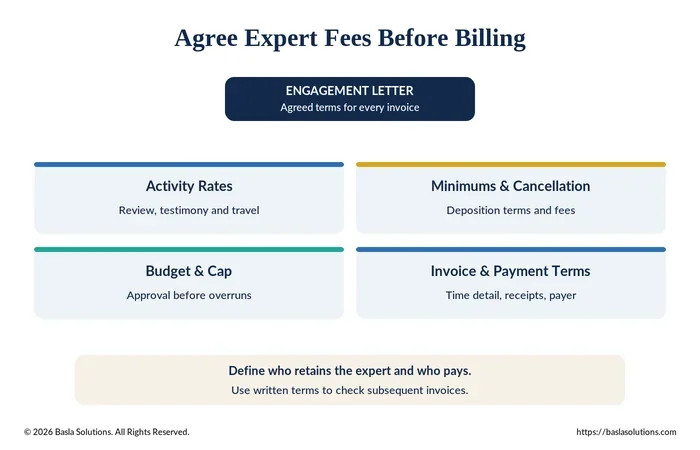
The engagement letter is the document every later invoice is checked against, so it pays to make it specific:
- Rate schedule. Separate rates for review, testimony, and travel time, fixed for the life of the matter or for 12 months.
- Minimums and cancellation. Any minimum charge for a deposition, and the fee if a deposition is canceled within 48 or 72 hours.
- Who retains and who pays. Outside counsel usually retains the expert to protect work product, while the client may pay the expert directly or through the firm.
- Budget and cap. Estimated hours by phase, with written approval needed before the expert exceeds the cap.
- Invoice requirements. Time in tenth-of-an-hour increments, a description of each task, receipts above a set amount, and a monthly invoice.
One cost often moves to the other side. Under the federal rules, the party that deposes your expert generally pays the expert a reasonable fee for that time, so the engagement letter should say how those payments are credited.
Can expert witnesses invoice through a legal eBilling system?
Expert witnesses can invoice through a legal eBilling system, either directly as a registered vendor or indirectly as an expense line on the retaining law firm’s invoice. The direct route gives your department line-level visibility, and the pass-through route is simpler for the expert.
- Pass-through by the law firm. The firm pays the expert and bills the cost as an expense line, typically under the UTBMS expense code E119 for experts.
- Direct vendor submission. The expert is set up as a vendor in eBilling and submits invoices against the matter like any other timekeeper-based vendor.
- Firm-submitted on the expert’s behalf. The firm uploads the expert’s invoice as a separate vendor invoice, which keeps the expert’s lines visible without asking the expert to learn a portal.
Most experts do not have billing software that produces LEDES files. That is rarely a blocker, because eBilling platforms can take non-LEDES invoices entered by hand alongside LEDES files and apply the same validation rules to both.
The same models apply to court reporters, investigators, translators, and eDiscovery vendors. eDiscovery invoices have their own structure, with hosting and processing charges, and the companion guide on reviewing eDiscovery vendor invoices covers how to check them.
How are non-law-firm vendors onboarded to eBilling?
Non-law-firm vendors are onboarded to eBilling by classifying them by vendor type, creating a vendor record linked to accounts payable, loading their agreed rates, and giving them a simple way to submit. Onboarding one vendor usually takes two to five business days, and most of that time is spent waiting on tax and payment paperwork.
- Classify the vendor. Tag each vendor as an expert, court reporter, eDiscovery provider, investigator, or similar, so rules and reports treat them separately from law firms.
- Create the vendor record. Collect tax details and the remit-to address, and map the record to the ERP vendor ID using the same vendor master data structure that links each vendor to accounts payable.
- Load the rates. Enter the engagement letter rates as approved rates for that vendor on that matter.
- Assign to matters. Only vendors assigned to a matter can bill it, which stops invoices landing on the wrong case.
Set the vendor up before the first invoice is due, with a one-page guide and a 15-minute walkthrough. A late setup is the most common reason an expert ends up paid outside the system by check or card.
What should be validated on an expert invoice?
An expert invoice should be validated against the engagement letter: the rate for each activity, hours against the budget, the matter it is billed to, and expenses against receipts. Automated rules handle the arithmetic, and a reviewer judges whether the hours are reasonable for the work.
- Rate by activity. Review, testimony, and travel hours each match the agreed rate, recorded in tenths of an hour.
- Duplicate billing. The same work is not billed directly by the expert and again as a pass-through on the firm’s invoice.
- Budget and cap. The invoice does not push the expert past the approved cap without a recorded approval.
- Expenses and travel. Receipts are attached above the threshold, and travel time is billed at the reduced rate.
These checks sit inside the department’s wider legal bill review program, which combines automated rules with human review across law firms and non-firm vendors alike.
How do expert fees get allocated to matters and budgets?
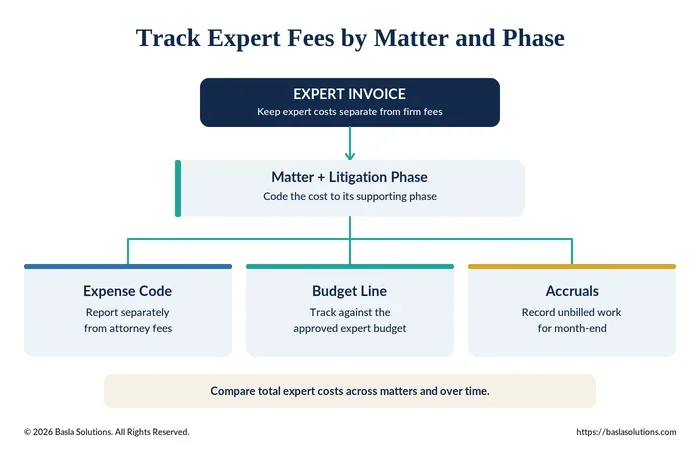
Expert fees are allocated by recording each invoice against the matter and budget phase it supports, coded as an expert expense so it reports separately from law firm fees. Clean allocation is what lets you see what experts cost by matter, by case type, and over time.
- Matter and phase. Each invoice is billed to one matter and the phase it supports, such as discovery or trial.
- Expense code. Expert costs carry their own expense code, so reports split them from attorney fees and other disbursements.
- Separate budget line. Litigation budgets carry an expert line of their own, approved with the rest of the budget.
- Accruals. Experts often bill irregularly, so include unbilled expert work in monthly accruals.
With allocation in place, you can compare expert rates across matters and spot rate creep before the next engagement letter is signed.
Conclusion
Expert witness fees are easier to control when they are agreed in a specific engagement letter and paid through the same eBilling system as your law firms. Classify every non-law-firm vendor, load agreed rates before the first invoice, check for duplicate pass-through billing, and code expert costs so they report on their own line. The result is one place to see what experts, court reporters, and other vendors cost on every matter.
How Basla can help
Basla provides delivery teams for enterprise legal management and eBilling software implementation, covering business analysis, vendor classification and onboarding design, rate and validation rule configuration, budget and accrual setup, testing, documentation, and post-go-live support. Basla brings legal technology consulting and hands-on configuration through staff augmentation or a Basla-managed delivery unit.
Basla teams have delivered matter management and eBilling across 10 or more global jurisdictions.
Frequently asked questions
What is a typical expert witness hourly rate?
A typical expert witness hourly rate sits in the mid-$400s on average in recent surveys, with individual rates running from under $200 to over $1,500. Testimony is often billed at a higher rate than review and preparation.
Do experts submit LEDES invoices?
Most experts do not submit LEDES invoices, because their billing tools rarely produce LEDES files. Their fees reach eBilling as an expense line on the law firm’s LEDES invoice, or as a manually entered invoice from the expert or the firm.
Who approves expert fees?
Expert fees are usually reviewed first by the retaining attorney at the law firm and then approved by the in-house lawyer managing the matter. Invoices above a set amount, or over the agreed cap, go to a second approver.
Are expert fees recoverable?
Expert fees are recoverable from the other side only in some cases, depending on the court, any applicable statute, and any contract that shifts costs. In US federal cases, the party that deposes an expert generally pays a reasonable fee for that time, while broader recovery is often limited.
*This article is provided for general information only and does not constitute legal advice. Basla Solutions provides legal technology implementation and support services and does not practice law.*