

A legal invoice is the itemized bill a law firm sends a client for the fees and expenses on a matter during a billing period. For a corporate legal department it is also a data record, because every line is checked against rates, guidelines, and budgets before anyone pays. This guide walks through each part of a law firm invoice, what reviewers check it against, and what changes when the invoice arrives through legal eBilling software.
What is a legal invoice?
A legal invoice is a law firm’s request for payment that lists, line by line, the work its timekeepers performed and the costs it incurred on one matter over one billing period, usually a calendar month. It is both a payment request and the main evidence of what the firm did.
Most corporate clients expect one invoice per matter per month. Outside counsel guidelines usually fix that frequency, because combined or quarterly bills make review and accruals harder. Public sector guidelines show how precise the requirements get: one state attorney general’s office lists 13 elements every outside counsel invoice must include, from a unique invoice number to time recorded in tenths of an hour.
What does a law firm invoice contain?
A law firm invoice contains a header, matter details, a timekeeper summary, fee lines, expense lines, adjustments, taxes, and totals. Each part is checked against a different source of truth.
- Header. Firm name, client name, invoice number, invoice date, and billing period. Checked against the vendor record and for duplicates, since a reused invoice number is a common reason for rejection.
- Matter block. The client’s matter number and the firm’s matter number. Checked against the open matters assigned to that firm, so time cannot be billed to a closed or unrelated matter.
- Timekeeper summary. Each timekeeper’s name, ID, classification, rate, hours, and total. Checked against the approved rate card and staffing limits.
- Fee lines. One entry per task with date, timekeeper, hours, rate, amount, and narrative. Checked against the billing guidelines for increments, block billing, and narrative quality.
- Expense lines. Date, description, quantity, unit cost, and amount for each disbursement, coded with UTBMS expense codes. Checked against the expense policy and receipts.
- Adjustments. Courtesy discounts, volume discounts, and write-downs. Checked against the agreed discount terms.
- Taxes. VAT, GST, or sales tax by line or by invoice where it applies. Checked against the firm’s tax registration and the client’s tax rules.
- Totals and remittance. Fees, expenses, adjustments, tax, amount due, and payment details. Checked by arithmetic and against the budget for the matter.
How these parts move from the firm’s billing system to approval and payment is the legal billing process, which follows the same order every month.
What is the difference between fees and disbursements?
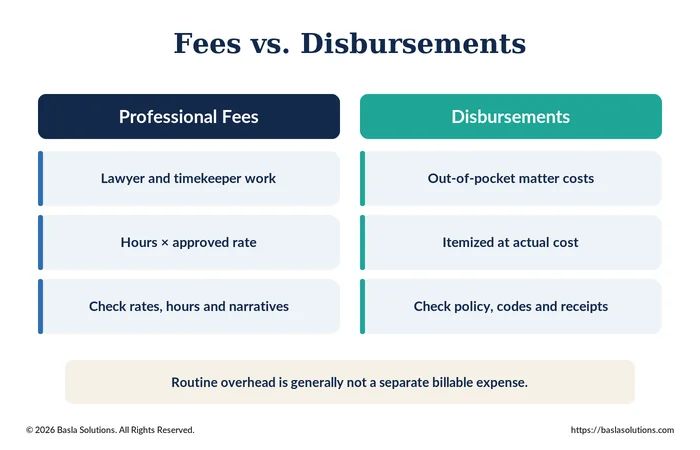
Fees are charges for the professional time of lawyers and other timekeepers, while disbursements are out-of-pocket costs the firm paid on the client’s behalf, such as court fees, transcripts, and travel. They appear in separate sections because different rules apply to each.
- Fees. Billed as hours multiplied by an approved rate, or as a fixed or capped amount under an alternative arrangement.
- Disbursements. Billed at actual cost with no markup under most guidelines, and itemized one cost per line.
- Overhead. Items such as routine copying, secretarial time, and software subscriptions are usually treated as firm overhead and rejected when billed.
In an electronic invoice, each disbursement also carries a UTBMS expense code, such as E112 for court fees or E115 for deposition transcripts. Validating those codes is covered in the guide to UTBMS expense codes.
How are timekeeper rates shown?
Timekeeper rates are shown twice on a law firm invoice: as an hourly rate on each fee line, and in a timekeeper summary that totals each person’s hours and fees for the period. The two have to agree.
The summary usually lists each timekeeper’s name, ID, classification (partner, associate, paralegal), rate, hours, and amount. In an electronic invoice, the line carries the standard rate as the unit cost and any discount as a separate adjustment amount, so the reviewer can see both the list rate and what is actually charged. A rate off the approved rate card, or an unapproved timekeeper, is a frequent reason for a reduced line.
What is a LEDES invoice?
A LEDES invoice is a law firm invoice delivered as a structured data file in the Legal Electronic Data Exchange Standard, so the client’s system can read every field and validate each line automatically. The PDF shows a person the bill. The LEDES file lets software check it.
The common formats are LEDES 1998B, a pipe-delimited text file used mostly in the United States, LEDES 1998BI, which adds tax and currency fields for international billing, and LEDES XML 2.x. Each line carries fields for invoice number, client and firm matter IDs, timekeeper ID, units, unit cost, adjustments, and UTBMS task, activity, and expense codes. The field-by-field detail is covered in LEDES billing format explained.
Structured invoices have been the norm in corporate legal departments for years. A 2017 industry survey of legal operations professionals found 83 percent of respondents were using eBilling.
How do corporate clients review a legal invoice?
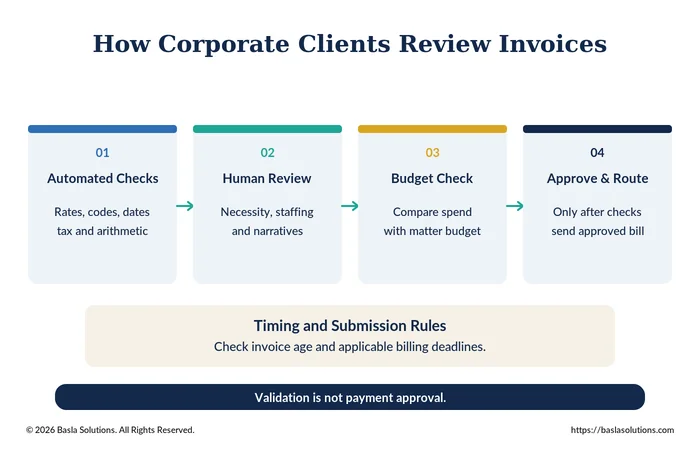
Corporate clients review a law firm invoice in two passes: automated validation that checks every field against rules and reference data, then a human review of the lines the rules flag and the invoice as a whole. Only invoices that clear both are approved for payment.
- Automated checks. Rates against the rate card, increments, block billing, missing codes, duplicate invoice numbers, tax, and arithmetic.
- Reviewer judgment. Whether the work was necessary, staffed at the right level, and described clearly enough to justify the time.
- Budget comparison. Spend to date against the matter budget, with a flag when the invoice pushes the matter over an agreed threshold.
- Timing rules. Many guidelines refuse time older than a set window, so invoice submission deadlines and trailing invoice windows are checked on every bill.
- Approval and payment. Approved invoices pass to accounts payable with the right cost center and general ledger codes.
Conclusion
A legal invoice is the record of what a firm did, who did it, at what rate, and at what cost, and every part of it is checked against something you already hold: the vendor record, the matter, the rate card, the guidelines, and the budget. Receiving invoices as LEDES files inside an enterprise legal management platform turns those checks into rules that run on every line.
How Basla can help
Basla provides delivery teams for enterprise legal management and eBilling software implementation, covering business analysis, invoice validation rules, rate card and timekeeper setup, LEDES and UTBMS configuration, law firm onboarding, testing, documentation, and post-go-live support. Basla offers legal technology consulting and hands-on configuration through staff augmentation or a Basla-managed delivery unit.
Frequently asked questions
Is an invoice a legal document?
An invoice is a commercial record and a formal request for payment, and in many jurisdictions it is also a tax document. It can serve as evidence of the amount owed, though the obligation to pay comes from the engagement letter between the firm and the client.
How do you read a legal invoice?
Start with the header and matter block to confirm the bill is for the right matter and period, then the timekeeper summary for rates and hours. Next, review the fee lines and narratives, the expense lines, and finally the adjustments, taxes, and totals.
What is a pro forma legal invoice?
A pro forma invoice is a draft bill the firm produces before the final invoice, usually so a billing partner can review entries and make write-downs. Some clients also ask to see a pro forma before the final bill is issued.
Why do legal invoices arrive late?
Invoices arrive late when firms hold bills for internal pre-bill review, wait for third-party costs such as transcripts, or batch matters at quarter end. Submission deadlines in the billing guidelines set a limit on how late time can be billed.
*This article is provided for general information only and does not constitute legal advice. Basla Solutions provides legal technology implementation and support services and does not practice law.*