

The legal billing process is the chain of steps that turns a lawyer’s recorded time into an invoice the client approves and pays. Half of it happens inside the law firm and half inside the corporate legal department, and most delays come from the handoff between the two. This guide follows one month of work from time entry to payment, with who owns each step and which system runs it, so you can see where your own cycle loses days. On the client side, most of the work runs through legal eBilling software.
What is the legal billing process?
The legal billing process is the sequence of time capture, narrative writing, pre-bill review, invoice submission, validation, review, approval, and payment that moves outside counsel work from the timesheet to the client’s bank account. For a monthly hourly matter, it typically runs 45 to 90 days end to end.
| Step | Who | System |
|---|---|---|
| Time capture | Timekeeper | Firm time entry |
| Narrative and coding | Timekeeper | Firm time entry |
| Pre-bill generation | Billing coordinator | Firm billing system |
| Pre-bill review and edits | Billing partner | Firm billing system |
| Invoice submission | Billing coordinator | Client eBilling portal |
| Automated validation | Rules engine | Client eBilling system |
| Invoice review | In-house lawyer or reviewer | Client eBilling system |
| Approval | Budget owner | Client eBilling system |
| Payment | Accounts payable | Client ERP |
The first five steps belong to the firm. The last four belong to the client. The invoice itself, with its header, timekeeper summary, fee lines, and expenses, is the record that crosses between them, and each part of a legal invoice is checked against something the client already holds.
How is time captured and narrated at the firm?
Time is captured at the firm by each timekeeper recording the task, matter, duration, and narrative for every piece of work, ideally the same day it is done. The quality of everything downstream depends on this step.
- Record daily. Entries written the same day carry specific detail. Entries rebuilt at month end drift toward vague phrases and round numbers.
- One task per entry. Each line describes one task, so the client can judge the time against the work.
- Code at entry. UTBMS task and activity codes are picked when the time is recorded, which avoids a rush of recoding at pre-bill.
- Write for the client. The narrative names the document, the issue, and the people involved, using the client’s own matter name and number.
Many clients make same-day recording a rule: one state’s outside counsel billing terms require time entries to be kept contemporaneously with the services rendered, in tenths of an hour.
The narrative is where most later rejections start. The standards reviewers apply, with good and bad examples, are covered in the guide to legal billing descriptions that pass review.
What happens between pre-bill and submission?
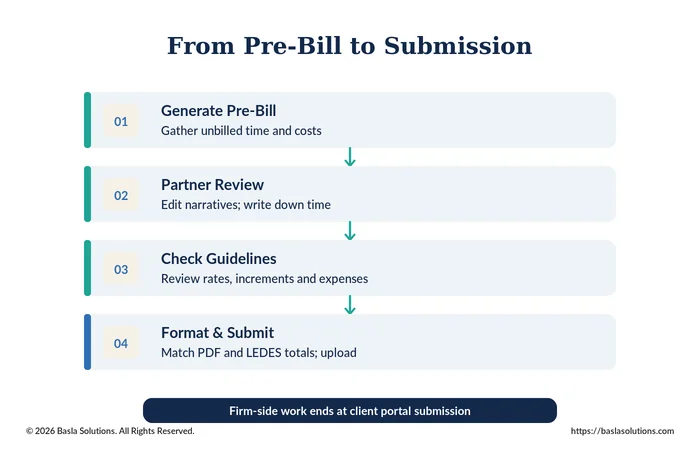
Between pre-bill and submission, the firm generates a draft invoice, a billing partner reviews and edits it, and a coordinator formats and submits the final invoice to the client’s portal. This stretch usually takes one to three weeks after month end.
- Pre-bill generation. The billing system pulls all unbilled time and costs for the matter into a draft.
- Partner review. The billing partner checks narratives, removes duplicate or unnecessary time, and writes down entries the client would challenge.
- Guideline check. The coordinator compares the draft against the client’s rules: rates, increments, staffing, and banned expenses.
- Formatting. The final invoice is produced as a PDF and, for eBilling clients, as a LEDES file with matching totals.
- Submission. The coordinator uploads both to the client’s portal before the submission deadline.
Write-downs at this stage cost the firm revenue, so the cheaper fix is a cleaner first draft. Firms that submit to many client portals need one consistent submission routine, and the approach is set out in the guide to e billing for law firms.
How does the client’s eBilling system validate and review the invoice?
The client’s eBilling system validates each invoice automatically against rules and reference data, then routes it to a human reviewer who checks the lines the rules flagged and the invoice as a whole. Validation takes minutes. Review takes days.
- File checks. The LEDES file is parsed, totals are recalculated, and missing fields or duplicate invoice numbers cause an outright rejection.
- Line checks. Rates are compared to the approved rate card, increments and codes are validated, and block-billed or vague lines are flagged or reduced.
- Timing checks. Time older than the allowed window is rejected under invoice submission deadlines and trailing invoice windows.
- Reviewer pass. The reviewer accepts, reduces, or rejects flagged lines with a comment, and checks spend against the matter budget.
Rejected invoices go back to the firm, which corrects and resubmits. Each round trip adds a week or more.
How are approval and payment handled?
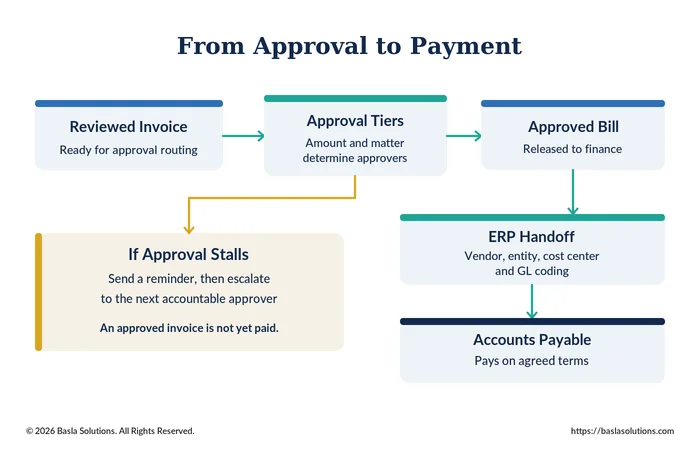
Approval and payment are handled by routing each reviewed invoice through approval tiers based on amount and matter, then passing the approved invoice to accounts payable for payment against agreed terms. The number of approvers and the payment terms decide how long this takes.
- Approval tiers. Invoices under a threshold need one approver. Larger invoices add a second tier, such as the head of litigation or the general counsel, as described in legal invoice approval workflow design.
- Escalation. An invoice that sits with an approver for more than five to seven business days is reminded and then escalated.
- ERP handoff. The approved invoice is sent to the ERP with vendor ID, legal entity, cost center, and general ledger codes.
- Payment terms. Accounts payable pays on the agreed terms, often 30 to 60 days from approval.
Where does the process usually break?
The legal billing process usually breaks at the handoffs: vague time entries that fail review, late pre-bills, invoices rejected for avoidable errors, and approvers who do not act. Each break adds days, and some add months.
- Month-end time entry. Time recorded weeks late produces weak narratives that reviewers cut.
- Pre-bill bottleneck. A billing partner with dozens of pre-bills holds every invoice until the last one is reviewed.
- Reference data drift. New timekeepers, rate increases, or matter numbers missing from the client’s system trigger rejections.
- Silent approvers. Invoices wait in queues with no reminder or escalation.
- Vendor setup gaps. Mismatched vendor IDs between eBilling and the ERP stall payment after approval.
The cost of delay compounds for the firm. One bar association’s benchmarking guidance puts the average law firm collection period at 120 to 150 days, and the odds of collecting a bill fall the longer it stays unpaid.
Conclusion
The legal billing process works when both sides treat it as one chain: daily time entry and clean narratives at the firm, a disciplined pre-bill, accurate reference data in the client’s system, and approvers with clear thresholds and reminders. Fixing the handoffs is what shortens the cycle. In a well-run enterprise legal management platform, every step leaves a timestamp, so you can measure where the days go and fix the slowest link first.
How Basla can help
Basla provides delivery teams for enterprise legal management and eBilling software implementation, covering business analysis, invoice validation rules, approval workflows, rate card and timekeeper setup, ERP integration, law firm onboarding, testing, documentation, and post-go-live support. Basla delivers legal technology services through staff augmentation or a Basla-managed delivery unit.
Frequently asked questions
How long does the legal billing cycle take?
The legal billing process typically takes 45 to 90 days from the end of the month worked to payment. Firm-side pre-bill and submission take one to three weeks, client review and approval one to four weeks, and payment terms add 30 to 60 days.
What is a pre-bill?
A pre-bill is the draft invoice a law firm generates from unbilled time and costs before issuing the final bill. The billing partner reviews it, edits narratives, and writes down time before the invoice goes to the client.
What causes invoice delays?
Invoice delays come from late time entry, slow pre-bill review, rejections for wrong rates or missing codes, and approvers who do not act on their queue. Mismatched vendor data between eBilling and the ERP can also hold payment after approval.
How does eBilling change the billing process?
eBilling replaces emailed PDF invoices with structured LEDES files submitted to a client portal, where rules validate every line automatically. Errors are caught at submission, review is focused on flagged lines, and every step is tracked with a timestamp.
*This article is provided for general information only and does not constitute legal advice. Basla Solutions provides legal technology implementation and support services and does not practice law.*