

Accrual cadence is the rule that decides how often a matter is included in your requests to law firms for estimates of unbilled work: every month, at each fiscal period close, once a year, or not at all. Set well, it concentrates firm and reviewer effort on the matters where unbilled spend moves; set badly, it floods your close with zero estimates or misses the matters that matter. Cadence keeps accruals, a core part of legal spend management, accurate without wasted effort.
Most departments start by accruing everything monthly, which adds to workloads that are already stretched: a 2025 survey of legal departments found that 83 percent of legal departments expect demand to increase, and 63 percent name workload and bandwidth as their top challenge. That is simple to configure but noisy to run. A firm with 30 open matters, of which five are active, ends up confirming 25 zeros every month, and response quality on the five that matter suffers. This guide covers the cadence options, choosing one per matter, aligning with your fiscal calendar, and keeping settings current, using Onit’s accrual settings as the worked example.
What is accrual cadence in legal operations?
Accrual cadence in legal operations is the frequency at which a matter’s unbilled outside counsel spend is estimated and recorded, set per matter so collection effort matches how quickly unbilled work builds up. It sits beneath firm-level enrollment, which decides whether a firm takes part in accruals at all.
Cadence matters because accrual requests are only useful when the estimate can change. A trial-heavy litigation matter can build significant unbilled time in a month. A long-running regulatory matter with a few hours of work a quarter cannot. Asking both for monthly estimates treats them the same and gives your reviewers more rows to check than the numbers justify.
Which accrual frequency options are typically available?
Accrual frequency options typically cover four choices: monthly, period, annual, and none. Each matter carries one setting, and the monthly request includes only the matters whose cadence is due.
- Monthly. The matter is included in every monthly request, which suits active matters with fluctuating unbilled work.
- Period. The matter is included at each fiscal period close, which suits companies whose accounting periods differ from calendar months.
- Annual. The matter is included once a year, usually at fiscal year end, which suits stable or low-activity matters.
- None. The matter is excluded from accrual requests even though the firm is enrolled.
Onit ELM, for example, offers None, Annual, Period, and Monthly as the corporate default, aligns periods to the fiscal or standard calendar, and lets exceptional matters carry their own cadence. Confirm the exact options your environment offers.
How do firm and matter settings combine to set accrual frequency?
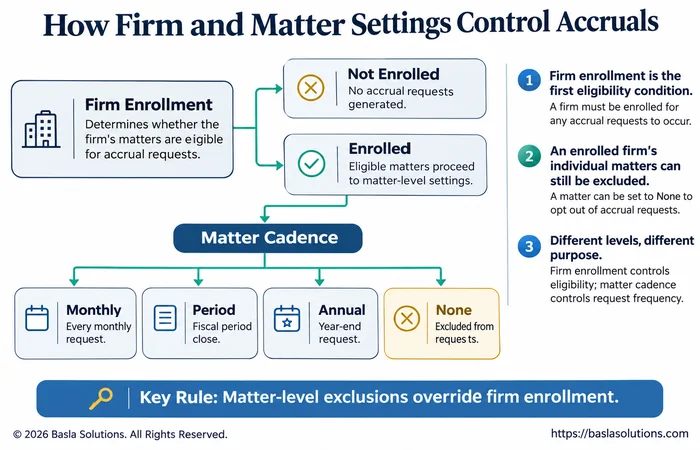
Firm and matter settings combine to set accrual frequency in two layers: the firm must be enrolled in accruals before any of its matters are requested, and each matter’s own setting then decides whether and how often it is included. A matter-level setting of none excludes a matter even when its firm is enrolled.
- Firm enrollment. Turns accruals on for the firm and makes its open matters eligible.
- Matter setting. Confirms the matter requires accruals and sets its cadence.
- Matter exclusion. Removes specific matters, such as fixed-fee work, without affecting the rest of the firm’s matters.
Set the matter cadence when the firm is assigned to the matter, so the decision is made by someone who knows the expected scope. Leaving it to a default means most matters end up on whatever the default happens to be.
Which matters should accrue monthly?
Matters should accrue monthly when their unbilled work can change materially from one month to the next and the amounts are large enough to affect the monthly close. These are the matters where an out-of-date estimate does real damage.
- Active litigation. Discovery, motions, and trial preparation build unbilled time quickly and unevenly.
- Transactions. M&A and financing work peaks around signing and closing, often within a single month.
- High-spend advisory. Ongoing advisory work above a set monthly threshold, such as $25,000, where the amount alone justifies monthly attention.
A practical rule is to accrue monthly on any matter expected to bill more than your materiality threshold in a typical month. Finance is working to a tight close, and a 2025 survey of 100 finance professionals found half of finance teams take six or more business days to close the month. Agree that threshold with finance, since it drives how many matters appear on each request and in the monthly legal spend accrual close.
When should a matter use a period accrual schedule?
A matter should use a period accrual schedule when your company closes its books on fiscal periods that differ from calendar months, such as a 4-4-5 calendar where each quarter is split into periods of four, four, and five weeks. Period cadence ties the request to the actual close dates.
For departments on calendar-month closes, period and monthly cadence produce the same rhythm, and monthly is simpler to explain to firms. For those on a 4-4-5 or similar calendar, period cadence avoids requests that land midway through an accounting period. In Onit ELM, the fiscal option works only once your fiscal calendar is integrated with the platform, so align the configured periods with finance’s calendar before go-live. Confirm the close dates each year, since period calendars shift.
Which matters suit an annual accrual schedule or none?
Matters suit an annual accrual schedule when they are long-running with low, steady activity, and they suit no cadence at all when accruals add nothing to the financial picture. Moving these matters off the monthly list is where most of the noise reduction comes from.
- Annual. Long-running regulatory matters, dormant litigation awaiting a ruling, and ongoing low-volume advisory work.
- None for fixed fees. Fixed-fee matters, where the cost is known and is often accrued on a schedule finance controls directly.
- None for low-value work. Matters below your materiality threshold for the whole year, where estimates would never change the close.
Record the reason for each annual or none setting, so later reviewers understand the choice. When a dormant matter wakes up, the reason tells reviewers the setting needs changing.
How should accrual frequency be reviewed as matters change?
Accrual frequency should be reviewed whenever a matter’s activity changes significantly, and at least once a quarter across the whole portfolio. Matters move between quiet and busy phases, and a cadence set at intake can be wrong six months later.
- Spend triggers. Move a matter to monthly when an invoice or a validated accrual estimate exceeds your materiality threshold.
- Phase changes. Review cadence when a matter enters trial preparation, settlement talks, or closing, and when it goes quiet.
- Quarterly sweep. List matters by cadence with their last three months of billing, and correct any that no longer fit.
Give one person ownership of the quarterly sweep, and send the corrected list to finance so its forecast reflects the same settings. It typically takes an hour or two for a portfolio of a few hundred matters and keeps the request list accurate. Keeping matter status and phase current makes these triggers easy to spot.
How does accrual frequency change what firms receive?
Accrual frequency changes what firms receive by limiting each automated accrual request to the matters whose cadence is due that month. A firm with 30 open matters might see 8 on a typical monthly request and all 30 at year end.
This shorter list improves response quality. Firms spend their time on the matters that matter, and fewer zero rows mean your reviewers can focus on real estimates. Explain the change when you introduce it, so firms are not surprised when a matter drops off the list or appears only at year end. Test that requests include exactly the expected matters each month, especially the first time an annual or period cadence comes due. A matter that silently drops off the list is the most common error, and it only shows up when finance asks why a known liability is missing from the close.
How do you test accrual cadence rules before go-live?
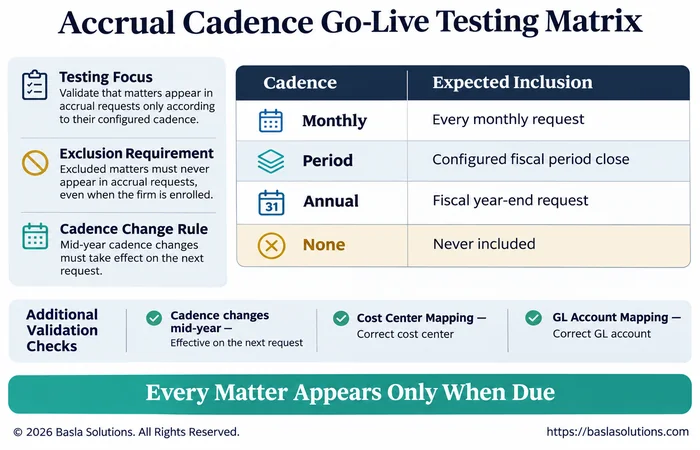
You test accrual cadence rules before go-live by setting up matters on each cadence for a few test firms, running request cycles for several simulated months, and confirming each matter appears exactly when it should. A test set of 12 to 20 matters covers the main combinations.
- Monthly matters. Appear on every monthly request.
- Period matters. Appear only at each configured fiscal period close.
- Annual matters. Appear only on the year-end request.
- Excluded matters. Never appear, even though their firm is enrolled.
Also confirm that changing a matter’s cadence mid-year takes effect on the next request, and that estimates still map to the right cost centers and GL accounts.
Conclusion
Accrual cadence turns accruals from a monthly census of every matter into a focused request for the estimates that matter. Enroll the right firms, set each matter’s cadence at assignment, accrue monthly where spend moves, use period cadence to match a non-calendar close, move stable and fixed-fee matters to annual or none, and sweep the settings each quarter. Test every cadence before go-live, and firms and reviewers will spend their effort where it changes the numbers.
How Basla can help
Basla provides delivery teams for enterprise legal management and eBilling software implementation, covering legal technology consulting, business analysis, accrual and fiscal calendar configuration, matter setup, request testing, finance integration, documentation, and post-go-live support. For cadence, that means defining materiality thresholds with finance, setting cadence across your matter portfolio, and testing that every request includes exactly the right matters.
Basla has delivered matter management and eBilling across more than 10 global jurisdictions, and its delivery bench takes the weight off your team while accrual settings are designed and rolled out.
Frequently asked questions
What is accrual cadence?
Accrual cadence is the rule that decides how often a matter is included in requests to law firms for estimates of unbilled work. Common options are monthly, period, annual, and none.
What accrual frequency options are usually available?
Accrual frequency options usually include monthly, period, annual, and none. Monthly matters appear on every request, period matters at each fiscal close, annual matters at year end, and excluded matters never.
Which matters should accrue monthly?
Matters should accrue monthly when their unbilled work can change materially each month, such as active litigation, transactions, and high-spend advisory work. A materiality threshold agreed with finance helps decide.
What is a period accrual schedule for?
A period accrual schedule is for companies whose fiscal periods differ from calendar months, such as a 4-4-5 calendar. It ties accrual requests to the actual accounting close dates.
Should fixed-fee matters be accrued?
Fixed-fee matters are often excluded from accrual requests, because the cost is known and finance can accrue it on a schedule. The decision should be agreed with finance and recorded.
How often should accrual frequency settings be reviewed?
Accrual frequency settings should be reviewed when a matter’s activity changes and at least once a quarter across the portfolio. Matters move between busy and quiet phases.
*This article is provided for general information only and does not constitute legal advice. Basla Solutions provides legal technology implementation and support services and does not practice law.*