


How to ask someone to sign an NDA comes down to three things: a short, friendly email that explains why, the right template from your legal team, and a request logged through your company’s intake so legal can track it. Below is the email, then the process behind it, ending with the request in the legal request portal where business users send every legal request.
How do you ask someone to sign an NDA?
You ask someone to sign an NDA by sending your company’s standard template in a short email that names the purpose, the type of NDA, and the date you need it back, before you share anything confidential. Most counterparties expect the request and sign a standard NDA within a few days.
Knowing how to ask someone to sign an NDA starts with timing. Send it as soon as the next conversation will involve pricing, product plans, or customer data. Government guidance for businesses is clear on the order: don’t disclose your information until the recipient has signed and returned the NDA.
The steps:
- Get the right template. Use legal’s current standard NDA, never an old copy from your inbox.
- Pick mutual or one-way. Decide who will share confidential information.
- Log the request. Submit it through legal intake so the signed copy reaches the contract repository.
What should an NDA request email say?
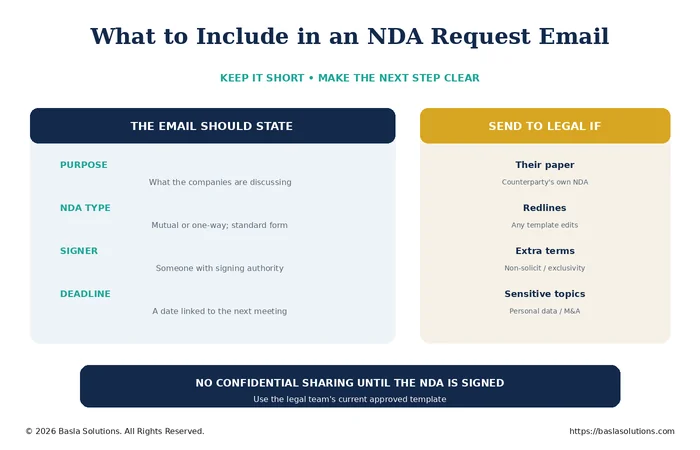
An NDA request email should say why you are asking, what the NDA covers, whether it is mutual or one-way, who needs to sign, and when you need it back. It should be short and matter-of-fact, because an NDA is a routine step in most business relationships.
Include these points:
- The purpose. One line on what the two companies are discussing.
- The NDA type. Mutual or one-way, and that it is your company’s standard form.
- The signer. Someone at the other company with authority to sign, usually a director or senior manager.
- The deadline. A date tied to the next meeting.
This NDA request email shows how to ask someone to sign an NDA in a sales or procurement conversation:
Subject: NDA before our call on Thursday. Hi Alex, before we go into pricing and product detail on Thursday, our standard process is to put a mutual NDA in place so both teams can share information freely. I’ve attached our standard mutual NDA, which covers our discussions about a possible supply agreement. Could someone with signing authority on your side sign and return it by Wednesday? Thanks, Jordan.
When should you use a mutual NDA instead of a one-way NDA?
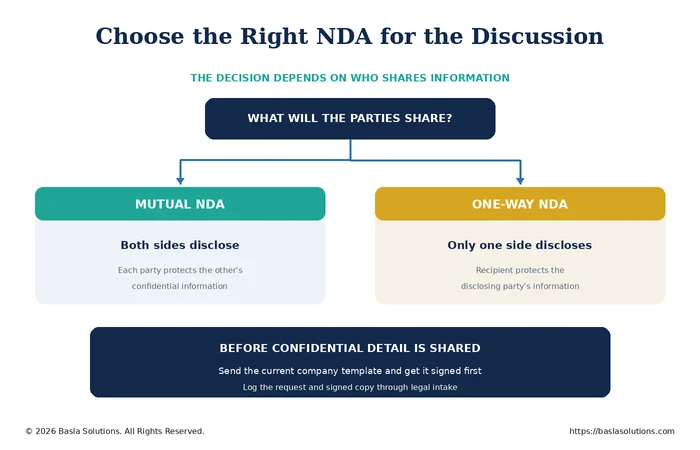
You should use a mutual NDA when both companies will share confidential information, and a one-way NDA when only one side will. Most commercial discussions involve information flowing both ways, so mutual is the usual default.
A one-way NDA fits when only you disclose, for example showing a supplier your product roadmap.
| Situation | Which NDA | Needs legal review? |
|---|---|---|
| Both sides share information, your standard template | Mutual | No, if unchanged |
| Only you share information, your standard template | One-way, you disclose | No, if unchanged |
| Counterparty sends their own NDA | Their form | Yes |
| Counterparty edits your template | Your form, edited | Yes |
| Personal data or customer data will be shared | Mutual or one-way | Yes |
| Merger, acquisition, or investment talks | Usually a bespoke NDA | Yes |
| Employee, contractor, or job candidate | HR’s template | Follow HR’s process |
When does an NDA need legal review?
An NDA needs legal review when anything departs from your company’s standard template: the other side’s paper, edits to your form, unusual terms, or sensitive information such as personal data or deal discussions. An unchanged standard NDA usually needs no review.
The common triggers are:
- Their paper. The counterparty’s NDA may have a longer term, a broad definition of confidential information, or clauses unrelated to confidentiality.
- Redlines. Any change to your template, even one that looks small, goes to legal.
- Extra terms. Non-solicitation, non-compete, exclusivity, or intellectual property assignment clauses do not belong in a routine NDA.
- Sensitive subjects. Personal data, regulated information, or merger talks always need a lawyer’s eye.
Everything else can move without a lawyer. Many companies let business users generate the standard form themselves, because automated self-service NDAs produce the approved template for signature without legal involvement.
How do you send an NDA request through legal intake?
You send an NDA request through legal intake by submitting it on your company’s legal request form, choosing the NDA request type, and attaching the counterparty’s draft if they sent one. Intake gives the request an owner, a deadline, and a record.
Most NDA intake forms ask for four or five things: the counterparty’s legal name, the purpose, mutual or one-way, whose paper it is, and the date needed. The contract request form asks the same questions in more depth for larger agreements.
When the other side insists on their own NDA, send it in through intake with a short note. A version you can adapt:
Hi Legal team, I’m submitting an NDA request for Northwind Supplies, who sent their own mutual NDA ahead of supply agreement talks. We plan to share pricing and volume forecasts, with no personal data involved. Their draft is attached, and we need it signed by Friday for a meeting on Monday. Their contact for comments is their contracts manager. Thanks, Jordan.
How long should an NDA take to turn around?
An NDA should take less than a day when it is your unchanged standard template, one to two business days when legal reviews minor edits, and three to five business days when legal reviews the other side’s paper. The process sets the pace.
Automation makes the biggest difference. A 2023 benchmark survey of 400 in-house legal staff found that 68 percent of teams with automated systems turn simple requests such as NDAs around in less than a week, against fewer than a quarter of teams relying on manual processes.
To keep your NDA process fast, submit early, send the counterparty’s draft in an editable format, and name a real deadline. Once the NDA is signed, mark the materials you share as confidential so the agreement has something clear to protect.
Conclusion
How to ask someone to sign an NDA is mostly a question of order and process: pick the right template, send a short email, log it through intake, and share nothing confidential until the signed copy is back. Route anything off-template to legal and let self-service handle the rest. A clear NDA process is often the first part of the legal front door that business users meet.
How Basla Solutions can help
Basla Solutions provides delivery teams for legal intake and request management software implementation, covering request type design, NDA intake forms and routing, self-service template setup, approval rules, testing, documentation, and post-go-live support. Basla brings legal technology consulting and hands-on configuration through staff augmentation or a Basla-managed delivery unit, so routine requests like NDAs move without waiting on a lawyer.
Frequently asked questions
Is it rude to ask someone to sign an NDA?
Asking someone to sign an NDA is a normal business step and is rarely seen as rude. Knowing how to ask someone to sign an NDA well mostly means explaining the purpose in one line and offering a mutual form.
Can you ask for an NDA after a first meeting?
You can ask for an NDA after a first meeting, and that is often the right time, once both sides know the next conversation will involve confidential detail. Anything shared before the NDA was signed may sit outside its protection.
What if the other side insists on their own NDA?
If the other side insists on their own NDA, send it to legal through intake for review before anyone signs. Legal will accept it, propose edits, or suggest your mutual template.
Can sales send the company’s standard NDA without legal?
Sales can usually send the company’s standard NDA without legal when the template is unchanged and no sensitive data is involved. Any edit, the other side’s paper, or personal data sends the request to legal.
Should an NDA be signed electronically?
An NDA can be signed electronically in most situations, and electronic signature is the norm for standard NDAs. It speeds turnaround and keeps an audit trail.
What details does legal need with an NDA request?
Legal needs the counterparty’s legal name, the purpose, whether the NDA is mutual or one-way, whose paper it is, the date needed, and whether personal data will be shared.
This article is for general information only and is not legal, business, financial or tax advice. For questions about your specific situation, please consult a qualified professional.