

A contract request form is the short set of questions a business user answers before legal drafts or reviews an agreement, so the lawyer starts with the counterparty, the commercial terms, the deadline, and the risk signals already in hand. It usually sits inside a legal request portal that groups every request type in one place, and it is the part of your legal front door that business users meet most often.
The cost of a weak form shows up as delay. A 2023 survey of 400 in-house legal staff found that 94 percent experience delays between the contract request and final signature. Much of it starts on day one, when legal chases facts the form never asked for.
What is a contract request form?
A contract request form is a structured intake form that collects the business facts legal needs to draft, review, amend, or approve a contract. It turns a “can you look at this?” email into a request record with the documents attached.
The form does two jobs. It gives legal everything needed to start work without a follow-up message, and a handful of its answers decide the lawyer, template, approval tier, and priority. It also splits responsibility: the requester owns the business terms and approval, and legal owns the legal terms.
What fields should a contract request form include?
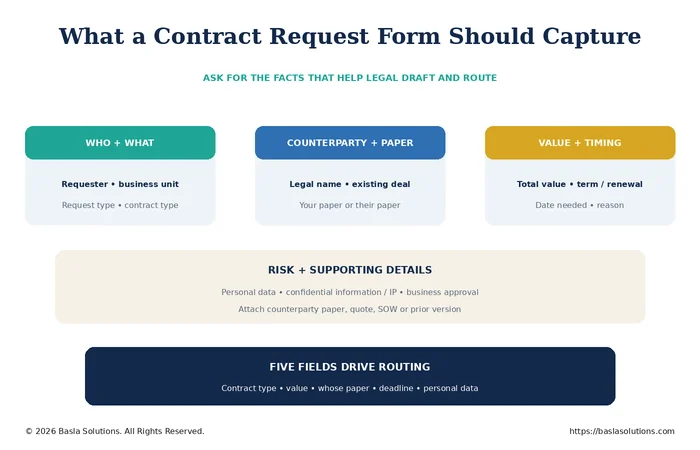
The request form should include about 10 to 14 fields covering who is asking, what kind of contract it is, who the counterparty is, what the deal is worth, when it is needed, and what risk it carries. Use the table below as a contract request form template, then cut any field your team never uses to route or draft.
| Field | Why legal needs it | Required or optional |
|---|---|---|
| Requester and business unit | Identifies who owns the commercial terms and who answers follow-up questions | Required |
| Request type | Separates new contracts, amendments, renewals, and terminations, which follow different workflows | Required |
| Contract type | Selects the template, the playbook, and the reviewer | Required |
| Counterparty legal name | Drives sanctions or conflict checks and a search for existing agreements | Required |
| Existing relationship | Shows whether a master agreement already covers this work | Optional |
| Whose paper | Your template means drafting; their paper means review against the playbook | Required |
| Estimated total value | Sets the approval tier and the seniority of the reviewer | Required |
| Term and renewal | Captures auto-renewal and notice periods for the repository | Optional |
| Date needed and reason | Lets legal set priority on an honest deadline | Required |
| Personal data shared | Triggers privacy review and data processing terms | Required |
| Confidential information or IP | Flags ownership, license, and confidentiality terms | Optional |
| Business approval obtained | Confirms the commercial deal is settled before legal review | Required |
| Attachments | Counterparty paper, quote, statement of work, or prior version | Required for third-party paper |
Write a one-line help text under each field, and give every pick list an “I don’t know” option that routes to a triage queue. A guessed answer sends the request to the wrong place.
Which contract request form fields decide routing?
Five fields on the request form decide routing in most in-house departments: contract type, contract value, whose paper, the deadline, and whether personal data is involved. Every other field supports drafting.
- Contract type. An NDA, a sales agreement, and a supplier agreement each go to a different template, playbook, and reviewer.
- Contract value. Value bands set the approval tier. Three bands are usually enough, for example under 50,000, 50,000 to 500,000, and above 500,000.
- Whose paper. Your own template can often go to a paralegal or self-service. Counterparty paper needs a lawyer and takes two to five times longer.
- Deadline. The date needed sets the queue position. Ask for a business reason whenever the date falls inside the standard turnaround.
- Personal data. A “yes” adds a privacy reviewer. Under the GDPR, processing by a processor must be governed by a binding contract, so this answer decides whether data processing terms are needed.
Global departments add two more routing fields, region and governing law, because contract intake across regions and languages has to route to the right local team.
How do you keep a contract request form short?
You keep the request form short by asking only questions that change routing or drafting, and by hiding every follow-up question until an earlier answer makes it relevant. Most business users should see 8 to 12 questions and finish in under five minutes.
- Conditional questions. Ask about data categories only when personal data is “yes”.
- Prefilled requester details. Pull name, business unit, and cost center from the user’s login.
- Pick lists over free text. Contract type, value band, and request type work best as pick lists, which keeps routing data clean.
- One free-text box. A single “what is this deal about?” field gives the lawyer context.
- Regular pruning. Review the form every quarter and remove any field that is blank or ignored on more than half of requests.
Generic templates often fail here, because most legal request form templates ask questions nobody uses for routing.
Should NDAs and low-risk contracts skip the form?
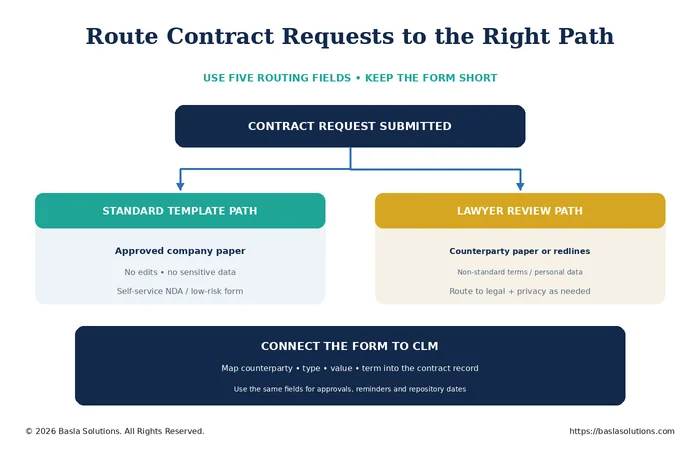
NDAs and low-risk contracts should get a shorter path through the form, and they should still go through it. Skipping the form entirely leaves legal with no record of what was signed, by whom, and on whose terms.
- Short path. A standard mutual NDA needs four or five answers: counterparty, purpose, requester, mutual or one-way, and whose paper.
- Self-service generation. When the answers fit the approved template, the system generates the NDA for signature with no lawyer in the loop.
- Automatic escalation. Counterparty paper, a requested edit, or a non-standard term sends the request to a lawyer through the normal queue.
The same pattern suits standard order forms and other high-volume, low-risk agreements.
How does a contract request form connect to CLM?
The request form connects to CLM by becoming the first stage of the contract record, so every answer flows into the draft, the approvals, and the repository without being retyped.
- Field mapping. Counterparty, contract type, value, and term map to the same fields in the contract record.
- Template selection. Contract type and whose paper pick the template or the review workflow automatically.
- Approval routing. Value bands and the personal data flag build the approval chain before drafting starts.
- Key dates. Term, renewal, and notice periods captured at intake become reminders in the repository.
The same design applies when intake runs inside an enterprise legal platform, as with contract request intake designed with routing rules and KPIs inside an ELM build. With one data model, legal measures cycle time from the moment of request.
Conclusion
A contract request form earns its place when every field either routes the request or helps legal draft it. Start with the template above, make contract type, value, whose paper, deadline, and personal data the routing fields, and hide everything else behind conditions. Give NDAs a short self-service path, connect the form to your CLM, and prune it each quarter.
How Basla Solutions can help
Basla Solutions provides delivery teams for legal intake and request management software implementation, covering business analysis, form and field design, routing and approval rules, CLM and ELM integration, testing, documentation, and post-go-live support. Basla delivers legal technology services through staff augmentation or a Basla-managed delivery unit, so your team can launch intake without pulling lawyers into the build.
Frequently asked questions
Who should fill in a contract request form?
The business person who owns the deal should fill in the contract request form, because that person knows the commercial terms and holds the business approval.
Is a contract request form the same as a contract intake form?
The two names usually describe the same form. Some departments use “intake form” for the general legal request and “contract request” for the contract-specific path.
Should the form ask for contract value?
The form should ask for estimated total contract value, because value sets the approval tier and the reviewer. Three or four value bands work better than a guessed exact figure.
Can a contract request form be a Microsoft or Google form?
A Microsoft or Google form works well as the first version of a request form, and many departments start there. Watch the limits: file upload questions in Google Forms require respondents to sign in to a Google account, and neither tool tracks status or turnaround without extra workflow.
How do you stop people bypassing the contract request form?
You stop people bypassing the form by making it the fastest route to legal and by redirecting email requests to it every time. A signature policy that requires a request number closes the gap.
What happens after a contract request is submitted?
After a contract request is submitted, the system routes it by contract type, value, and risk, and the requester gets a reference number and an expected turnaround. Drafting or review, approvals, and signature follow, and the signed contract lands in the repository.
This article is for general information only and is not legal, business, financial or tax advice. For questions about your specific situation, please consult a qualified professional.