


Matter staffing is the set of people a law firm assigns to bill time on a matter, and staffing guidelines are the client’s rules for who may bill, at what level, and in what numbers. Overstaffing is one of the hardest costs to see on a single invoice, because each line can look reasonable on its own. Staffing controls are part of the wider practice of outside counsel management, and they run through the invoice rules of any enterprise legal management platform.
What are matter staffing guidelines?
Matter staffing guidelines are the rules in your outside counsel guidelines that set who may work on a matter, how many timekeepers it should have, and which tasks belong at which level. They turn a general expectation of lean staffing into checks the eBilling system can apply, the same way outside counsel billing guidelines become invoice rules.
Most staffing rules live in the billing section of the outside counsel guidelines, next to rates, expenses, and invoice deadlines. A typical set covers:
- Approved team. The firm names its timekeepers at the start of the matter, and the client approves them.
- Changes to the team. New timekeepers need approval before they bill, and staff turnover should be kept low.
- Attendance limits. One attorney at meetings, depositions, and hearings unless more are approved in advance.
- Task level. Work is done at the lowest level that can do it well, so partners do not bill routine research or document review.
Some institutions write these rules in plain terms. One university’s policy requires that inside counsel approve every timekeeper and any later change to the team.
What staffing ratios do legal departments set?
Legal departments set staffing ratios as limits on the share of hours billed by partners, the number of timekeepers per matter, and the hours any one timekeeper may bill per day. The right ratios differ between matter types, so set them for each matter type separately.
- Partner share of hours. A cap such as 20 to 30 percent of hours on routine litigation, higher on bet-the-company matters.
- Timekeeper count. A target team of three to six timekeepers for an ordinary matter, with more allowed for trials or large transactions.
- Daily hours. A limit on hours billed by one timekeeper in a day, commonly 10 to 12, with a review for anything above it.
- Minimum involvement. A floor that flags timekeepers who bill only a few hours to a matter, a common sign of rotation or learning on the client’s time.
How does eBilling flag overstaffing?
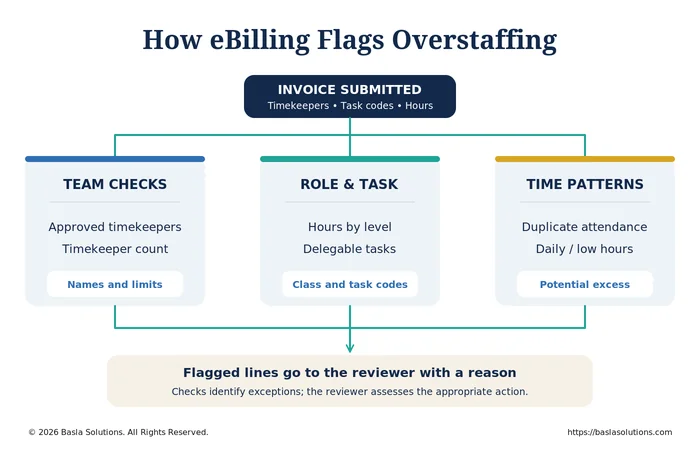
eBilling flags overstaffing by running matter staffing rules on each invoice that count timekeepers, compare hours by level with the agreed ratios, and look for several timekeepers billing the same task on the same day. Flagged lines go to the reviewer with the reason attached.
| Rule | What it flags | Typical action |
|---|---|---|
| Unapproved timekeeper | A name not on the approved team | Reject the line until approved |
| Timekeeper count | More timekeepers than the matter allows | Route to the matter attorney |
| Duplicate attendance | Two or more lawyers at the same meeting or deposition | Reduce to one unless pre-approved |
| Partner on delegable task | Partner time on review, research, or admin codes | Adjust to the associate rate or reject |
| Daily hours | One timekeeper above the daily limit | Request an explanation |
| Low-hours timekeeper | A timekeeper with only a few hours on the matter | Ask whether the time adds value |
The rules depend on clean data. Task codes have to be accurate, and each timekeeper needs the right class, so the system can tell partner time from associate time. That class comes from the timekeeper classification set when the timekeeper is approved.
How are unapproved timekeepers caught?
Unapproved timekeepers are caught by checking every fee line against the list of timekeepers approved for that firm and matter, and rejecting or flagging any name that is not on it. The check runs automatically when the invoice is submitted.
- Approved list. Each matter holds its approved timekeepers, usually set up through the timekeeper rate approval process with a rate and effective date.
- Submission check. Lines from timekeepers with no approval for that matter are flagged or rejected before review starts.
- Matter-level approval. A timekeeper approved for one matter is not automatically approved for another, so the firm requests access per matter.
- Grace rules. Some departments allow a short period, such as the first invoice, for a newly added timekeeper with a pending request.
How do you discuss staffing with a firm?
You discuss staffing with a firm by agreeing the team at the start of the matter, reviewing the staffing data at set points, and raising patterns in conversation before they become write-offs.
- Staffing plan at intake. Ask for the proposed team, roles, and expected hours by level with the budget.
- Periodic review. Look at the staffing mix quarterly or at the end of each phase, using eBilling reports.
- Specific examples. Point to the timekeepers, dates, and tasks behind a concern, so the firm can explain or correct them.
- Agreed changes. Record any agreed change to the team or ratios on the matter, so the rules stay current.
Make the guidelines clear on who at the firm owns compliance. A 2017 survey of 51 large and midsized companies found just 31 percent were satisfied with outside counsel’s compliance with their billing and staffing guidelines.
How do you report staffing compliance?
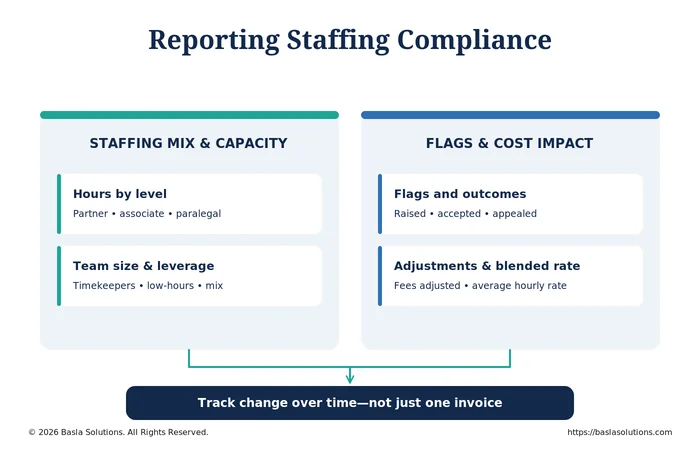
You report staffing compliance by measuring, for each firm and matter, how billed matter staffing compares with the agreed ratios and how many staffing flags were raised and resolved. The report should show trends over time, so a firm improving its staffing is visible.
- Staffing mix by firm. Hours by partner, associate, and paralegal, against the agreed ratio.
- Timekeeper count. Average timekeepers per matter, and the number of low-hours timekeepers.
- Flags and adjustments. Staffing flags raised, accepted, and appealed, and the fees adjusted as a result.
- Leverage and blended rate. Associate and paralegal hours per partner hour, and the average rate across all hours.
This follows established staffing guidance for in-house teams, which recommends analyzing billing data for the number of timekeepers, hours by level, leverage, and hours per day above guidelines.
Conclusion
Matter staffing stays under control when the team is agreed at the start, every timekeeper is approved per matter, and eBilling rules check the count, the level, and the attendance on every invoice. Set ratios per matter type, discuss the patterns with each firm using its own data, and report compliance as a trend.
How Basla Solutions can help
Basla Solutions provides delivery teams for enterprise legal management and eBilling software implementation, covering business analysis, staffing and billing guideline rules, approved timekeeper setup, rate and classification checks, compliance reporting, testing, documentation, and post-go-live support. Basla delivers legal technology services through staff augmentation or a Basla-managed delivery unit, so staffing rules are configured, tested, and enforced from the first invoice.
Basla teams have delivered matter management and eBilling across 10 or more global jurisdictions and doubled delivery team size to meet compressed implementation timelines.
Frequently asked questions
How many timekeepers should work a matter?
Most ordinary matters work well with three to six timekeepers, with more allowed for trials or large transactions. Set the number per matter type in your staffing guidelines and approve the team at the start.
Can a firm add a timekeeper mid-matter?
A firm can add a timekeeper mid-matter once the client approves the request, ideally before the new timekeeper bills any time. The eBilling system flags lines from timekeepers who are not yet approved.
Is partner-heavy staffing a guideline violation?
Partner-heavy staffing is a guideline violation when it exceeds the partner ratio or task rules in your guidelines. Without a stated ratio, it is a staffing concern to raise with the firm using the invoice data.
Do staffing rules apply to AFAs?
Staffing rules usually still apply to AFAs, because the approved team and attendance limits protect quality as well as cost. Rate and hours rules matter less on a fixed fee, so many departments relax those checks for AFA matters.
This article is for general information only and is not legal, business, financial or tax advice. For questions about your specific situation, please consult a qualified professional.