

Legal billing descriptions are the short narratives on each time entry that tell the client what work was done, on what, with whom, and why. They are the part of the invoice a reviewer reads most closely, and in legal eBilling software they are also the part most often reduced, rejected, or sent back. Write them well and invoices move through review on the first pass. Write them badly and every vague line costs the firm time, money, and goodwill.
What makes a legal billing description pass review?
Legal billing descriptions pass review when a reader who has never seen the file can tell exactly what task was done, on which document or issue, with whom, and why it moved the matter forward. If the reviewer has to guess, or open the file to find out, the entry fails.
Five elements cover almost every passing entry:
- The action. A specific verb such as drafted, revised, reviewed, or argued.
- The object. The named document, issue, hearing, or deposition.
- The people. Who was on the call, in the meeting, or on the email.
- The purpose. What the work was for, in a few words.
- The time. One task per line, with time that fits the work described.
What do billing guidelines require in a narrative?
Billing guidelines require legal billing descriptions to cover one task each, in enough detail that the client can judge whether the work was necessary and the time reasonable. Most guidelines then list phrases that will not be paid.
One university’s outside counsel guidelines require that each time entry reflect a separate task and state the nature of the work performed, and most corporate guidelines name phrases such as “attention to matter” and “work on file” as unacceptable. They usually add three more requirements:
- Participants on communications. Calls, meetings, and emails name the other side of the conversation.
- Documents by name. “Reviewed contract” becomes “reviewed draft supply agreement, section 9 indemnity.”
- No internal shorthand. Firm abbreviations and matter codes are spelled out the first time they appear.
What are examples of good and bad billing descriptions?
Good legal billing descriptions name the task, the object, the people, and the purpose, while bad ones use a generic verb with no object. The ten pairs below are generic examples, each showing a failing entry and a version that passes.
- Discovery. Bad: “Worked on discovery.” Good: “Drafted responses to plaintiff’s second set of interrogatories, Nos. 4 to 11, on warranty claims.”
- Research. Bad: “Legal research.” Good: “Researched enforceability of 24-month non-compete under state law for motion to dismiss.”
- Calls. Bad: “Telephone call.” Good: “Call with J. Rivera (client in-house counsel) on settlement range before mediation.”
- Emails. Bad: “Emails re: case.” Good: “Emails with opposing counsel on deposition dates for two plant managers.”
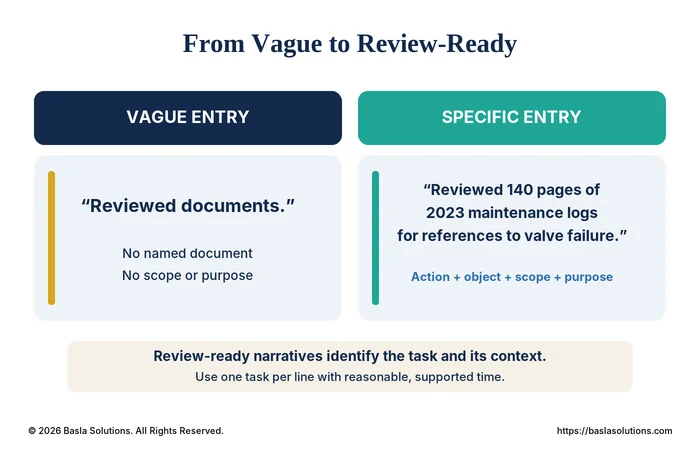
- Review. Bad: “Reviewed documents.” Good: “Reviewed 140 pages of 2023 maintenance logs for references to valve failure.”
- Drafting. Bad: “Drafting.” Good: “Revised draft master services agreement, sections 7 to 9, per client comments on liability cap.”
- Meetings. Bad: “Conference.” Good: “Meeting with A. Chen and M. Patel (firm) to divide deposition outlines for three witnesses.”
- Preparation. Bad: “Prepare for meeting.” Good: “Prepared issues list and exhibit set for board briefing on regulatory inquiry.”
- Hearings. Bad: “Court.” Good: “Attended and argued motion to compel, Superior Court, including 0.8 hours waiting for the call.”
- Analysis. Bad: “Attention to matter.” Good: “Analyzed opposing expert’s damages model and noted three assumption errors for rebuttal report.” The expert’s own invoice follows separate rules, covered in expert witness fees.
How does block billing fail review?
Block billing fails review because several tasks share one time figure, so the reviewer cannot check whether the time for any single task was reasonable. Most guidelines ban it outright, and many reduce or reject the whole line.
The concern is long-standing. A state bar fee arbitration advisory notes that an earlier version estimated block billing may increase billed time by 10 to 30 percent, which is why reviewers treat it as a pricing problem. The fix is simple: split the entry. “Reviewed file, called client, drafted letter, 2.4” becomes three lines with three times. eBilling rules catch the pattern by looking for multiple action verbs, semicolons, or long narratives on a single line, and the full detection logic is covered in block billing and vague narrative detection.
How do UTBMS codes relate to narratives?
UTBMS codes classify each time entry by phase and activity, and the narrative has to match the codes on the same line. A mismatch tells the reviewer either the code or the description is wrong.
- Task codes. The phase of work, such as L310 for written discovery or L330 for depositions on a litigation matter.
- Activity codes. What the timekeeper did, such as A103 for drafting or revising and A104 for reviewing and analyzing.
- The match test. An entry coded A106 (communicate with client) whose narrative describes a call with opposing counsel will be flagged, because that call belongs under A107.
eBilling systems check that both codes are present and valid for the matter type, and many route mismatches back to the firm automatically. How those failures reach the right person is covered in invoice validation alerts. When a reviewer adjusts a line by hand, mandatory comments on every adjustment make sure the firm sees which narrative failed and why.
How should a firm train timekeepers on narratives?
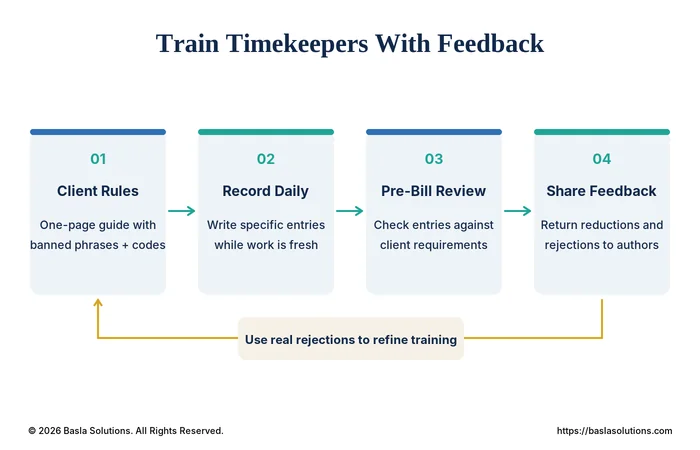
A firm trains timekeepers on narratives by giving them each client’s rules in one page, a short set of before-and-after examples, and fast feedback when an entry is cut. Training works best when it is tied to real rejections from that client.
- One page per client. Summarize each client’s banned phrases, participant rules, and code requirements on a single sheet.
- Record time daily. Narratives written the same day are more specific than ones reconstructed at month end.
- Pre-bill review. A billing partner or coordinator checks narratives against the client’s rules before the invoice goes out.
- Close the loop. Share every reduction and rejection with the timekeeper who wrote the entry within a week.
Firms that submit to many client portals also benefit from a single process for e billing for law firms, so one set of narrative habits works across every client.
Conclusion
Legal billing descriptions pass review when every line names one task, its object, the people involved, and its purpose, with codes that match the words. Ban the generic phrases, split blocked entries, and give timekeepers fast feedback tied to real rejections. In any enterprise legal management platform, the reward for both sides is fewer adjustments, fewer appeals, and invoices that get paid on the first pass.
How Basla can help
Basla provides delivery teams for enterprise legal management and eBilling software implementation, covering business analysis, billing guideline translation into validation rules, UTBMS and LEDES checks, narrative and block billing rules, reviewer workflows, testing, documentation, and post-go-live support. Basla delivers legal technology services through staff augmentation or a Basla-managed delivery unit.
Frequently asked questions
How long should a billing entry description be?
Most legal billing descriptions need one or two sentences, roughly 10 to 30 words, to name the task, the object, the people, and the purpose. Length matters less than specificity, and one task per line keeps each description short.
Can a narrative be rejected for vagueness?
A narrative can be rejected or reduced for vagueness under most billing guidelines. Generic phrases such as “work on file” or “attention to matter” are commonly listed as unacceptable, and eBilling systems can flag them automatically.
Should narratives name the person contacted?
Narratives for calls, meetings, and emails should name the person contacted, along with a brief note of the topic. One state’s billing rules require entries for calls, letters, and other communications to identify the parties and the nature of the communication.
Do AI-written narratives pass review?
AI-written narratives pass review only when they are accurate and specific to the work actually done. Reviewers reject generic or repeated wording whatever wrote it, and the timekeeper remains responsible for every entry submitted.
*This article is provided for general information only and does not constitute legal advice. Basla Solutions provides legal technology implementation and support services and does not practice law.*