

Legal bill review is the check every law firm invoice goes through before your company pays it, confirming that the work, the rates, and the expenses match what was agreed. Most departments now run that check inside their enterprise legal management platform, and a 2025 survey of 186 legal departments found that 84 percent use electronic billing technology. So the real decision for most teams is how the review gets done.
There are three ways to do it. A rules engine checks every line automatically, in-house reviewers read what the rules flag and judge the work itself, and a managed review service takes the line-by-line reading off your team. Mature programs use all three in some proportion, and the same layers apply to eDiscovery vendor invoices.
What is legal bill review?
Legal bill review is the process of checking law firm invoices against your billing guidelines, agreed rates, budgets, and matter records, then adjusting or rejecting anything that does not comply before the invoice is paid.
A complete review looks at four things on every invoice. Rates must match what you approved for that firm, year, and matter. Time entries need narratives that describe real tasks and hours that fit them. Expenses must be reimbursable and under any cap. And the invoice must sit on the right matter, with the right task codes, inside the budget.
The first pass is now almost always automated, because automated legal invoice review applies validation rules to every line of a LEDES file before a person opens the invoice.
How does automated legal bill review work?
Automated bill review works by running every invoice line through a set of configured rules in the eBilling platform at submission, then accepting, adjusting, or flagging each line before any reviewer sees it.
The firm uploads a LEDES file or enters the invoice on the vendor portal, and the platform reads each line as structured data: timekeeper, rate, hours, task code, expense type, and date. Each rule is a condition on those fields, and each rule has one of four outcomes:
- Hard rejection. Invoice-level errors send the whole invoice back to the firm automatically, such as a wrong matter number, a file that fails LEDES format checks, or an invoice dated outside the invoice submission window.
- Automatic adjustment. Clear-cut breaches are reduced on the line with a reason code attached, such as a rate above the approved rate or an expense over its cap.
- Warning. Possible problems are flagged for a reviewer to decide, such as a timekeeper billing more than 10 hours in a day, three or more attendees at an internal meeting, or a narrative that looks like block billing.
- Budget check. The invoice is flagged when it pushes a matter past a set share of its budget, typically at 80, 90, and 100 percent.
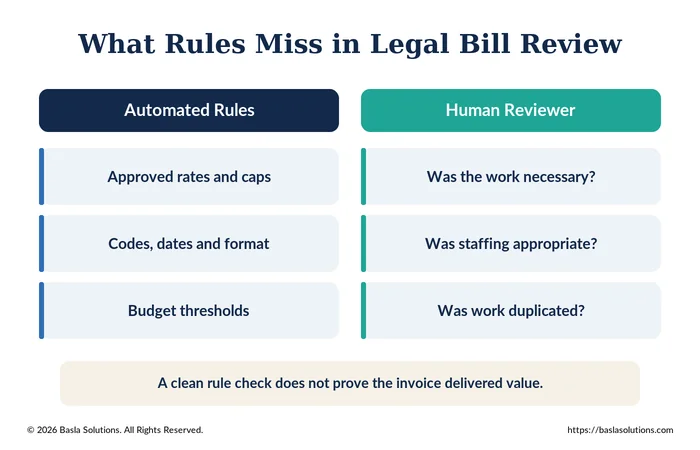
A typical first build carries 25 to 40 rules. The limit is equally clear: a rule can only test something that exists as a field. It can confirm that a partner billed at the approved rate. It cannot tell whether the partner should have done the work at all.
Rules also need tuning. A warning that fires on more than a third of invoices trains reviewers to click through it, so review rule hit rates and overturn rates each quarter.
What does a human reviewer catch that rules do not?
A human reviewer catches the problems that depend on judgment and knowledge of the matter, such as whether the work was necessary, whether the staffing made sense, and whether the hours bought real progress.
These are the issues that pass every rule and still cost you money:
- Necessity. Forty hours of research on a motion that was never filed, or a memo nobody asked for, can be billed at the right rate with a perfect narrative.
- Staffing. A partner doing associate work, a new associate learning on your matter, or a team that changes every month all show up only to someone who knows the file.
- Narrative quality. Firms learn your banned-word list quickly. A reviewer can see that “review and analysis of documents” across 30 entries says nothing about what was done.
- Duplication. The same task billed in two months, or two firms both billing preparation for the same deposition, rarely trips a rule that looks at one invoice at a time.
- Value for the phase. Spend that is within budget can still be out of line for where the matter stands, and only the matter lead knows that.
In-house review usually sits with the matter lead, who might spend 5 to 15 minutes on a routine invoice and much longer on a large litigation bill. Those invoices then move through a legal invoice approval workflow that routes each invoice to approvers by amount and matter, with higher tiers for larger amounts.
The weak point of in-house review is consistency. Reviewers are busy lawyers, and most departments name workload and bandwidth as their biggest challenge, so approvals drift toward a quick glance. A reviewer audit closes that gap. Each quarter, re-review 5 to 10 percent of approved invoices, weighted toward large invoices and firms with high warning counts. Check that every cleared rule warning has a recorded reason. Then compare approvers: if one adjusts 6 percent of billed fees and another adjusts nothing on similar matters, the guidelines are being applied two different ways.
What is a managed legal bill review service?
A managed bill review service is an outside team, usually attorneys or trained billing analysts, that reviews your law firm invoices against your guidelines inside your eBilling platform and recommends or applies adjustments for your approvers.
Rules still run first, and your approvers still make the final call on payment. What changes is who does the line-by-line reading. A typical scope includes:
- Line-item review. Every invoice, or only those above a threshold such as $10,000, or only certain matter types such as litigation.
- Guideline enforcement. Reviewers enforce your billing guidelines and your matter-specific terms, and they record a reason code on every adjustment, which also supports SOX audit trail requirements.
- Appeals handling. The service responds to firm appeals within an agreed turnaround, often 5 to 10 business days.
- Reporting. A monthly report of adjustments by firm, category, and matter type, with the amounts reinstated on appeal.
- Rule feedback. Catches that repeat across invoices are passed back so they can become automated rules.
When you compare services, ask three things. Who does the reviewing, and what qualifications do they have? How long does an invoice sit with the service before it reaches your approver, given that two to five business days is a common target? And how is “savings” defined in their reports? That third question matters most, because it decides whether the reported number means anything.
Should you outsource legal invoice review or keep it in-house?
Whether you outsource legal invoice review or keep it in-house depends mostly on your invoice volume, how much reviewer time your lawyers can give, and how consistently your current reviewers apply the guidelines. Most departments keep it in-house: a 2025 benchmarking survey of 395 legal departments found that 99 percent handle invoice review in-house.
Each model catches different things and asks for a different kind of effort:
| Model | What it catches | Effort |
|---|---|---|
| Automated rules | Rate, expense, timekeeper, date, format, task code, and budget breaches on every line | Four to eight weeks to build and test, then a quarterly tuning review |
| In-house reviewers | Necessity, staffing, narrative quality, duplication, and value for the matter phase | 5 to 15 minutes per routine invoice from matter leads, plus a quarterly reviewer audit |
| Managed review service | Guideline breaches spotted line by line, applied the same way across every firm | Two to four weeks of onboarding, a service fee, and approvers who still sign off |
These signals usually decide it:
- Keep it in-house when you receive fewer than a few hundred invoices a month, your matter leads know their files well, and your reviewer audit shows guidelines applied consistently.
- Outsource when approvals are backing up, reviewers are approving without reading, or a reviewer audit shows wide differences between approvers on similar matters.
- Split the work when only part of the portfolio needs close reading. Sending invoices over a threshold, or all litigation invoices, to a service while matter leads review the rest is a common pattern.
Whichever way you go, fix the rules engine first. A service placed on top of a weak rule set ends up paying people to catch rate and expense errors the software would catch for free.
How do you measure bill review savings?
You measure bill review savings by tracking the value of adjustments that hold after firm appeals, split by the layer that caught them, against the total spend that went through review.
The useful measures are few:
- Net adjustments. Gross reductions minus anything reinstated through the invoice dispute workflow. Gross figures overstate savings, sometimes by a wide margin on judgment calls such as narrative cuts.
- Adjustment rate. Net adjustments as a share of billed fees, tracked by firm, by category, and by matter type.
- Source of the catch. Separate what the rules caught, what in-house reviewers caught, and what a service caught, so you can see which layer is paying for itself.
- Firm behavior over time. Rejections and adjustments for a firm should fall over two or three quarters once it learns your guidelines. That drop is real savings that never appears on an adjustment report.
Two further numbers keep the picture honest. Cycle time from submission to approval shows whether a review layer is adding two weeks to every invoice, which costs you in firm relations. Cost of review, meaning reviewer hours at a loaded internal rate plus any service fees, is what net adjustments should be set against.
Set your own baseline: run the first 90 days after go-live as a measurement period, then report quarterly against that baseline.
How do bill review and billing guidelines fit together?
Bill review and billing guidelines are two halves of the same control: the guidelines state what you will pay for, and bill review checks each invoice against them.
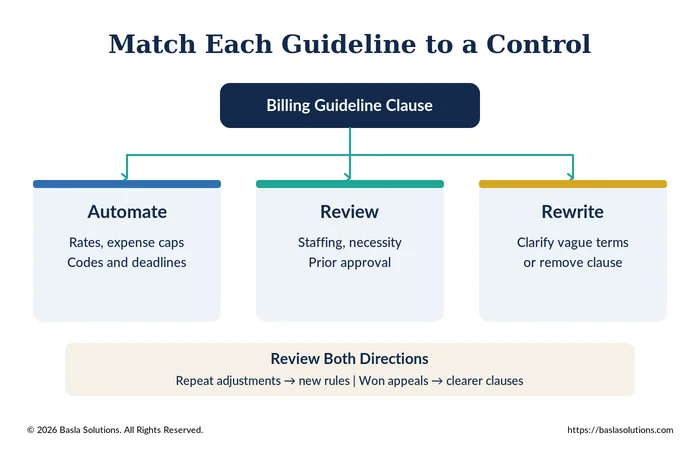
A guideline clause is only as good as the method that enforces it, and outside counsel billing guidelines become enforceable when each clause is translated into a rule the eBilling platform can test. In practice, every clause should map to one of three owners:
- Rules for clear-cut clauses. Rate limits, expense caps, required task codes, and submission deadlines all belong in the rules engine.
- Reviewers for judgment clauses. Staffing limits, prior approval for research over a set number of hours, and “reasonable and necessary” standards go on the reviewer checklist, whether that reviewer is in-house or a service.
- Rewrite for unenforceable clauses. A clause nobody can check, such as a vague request for “efficient staffing,” should be made specific or removed.
The link runs in both directions. When reviewers keep making the same adjustment, that pattern belongs in a new rule. When firms keep winning appeals on a rule, the clause behind it is probably unclear. Review both together once a year, and have firms acknowledge the updated guidelines before the new billing year starts.
Conclusion
Legal bill review works best as layers, each doing the job it is suited to. Rules handle the mechanical checks on every line. People, whether your own matter leads or a managed service, handle necessity, staffing, and value. A reviewer audit keeps that human layer consistent, and net adjustments after appeal tell you which layer is earning its keep. Start with a well-tuned rules engine, measure for a quarter, and then decide where outside reviewers add more than they cost.
How Basla can help
Basla provides delivery teams for enterprise legal management and eBilling software implementation, covering business analysis, translation of billing guidelines into validation rules, LEDES and UTBMS configuration, approval workflow design, reviewer reporting, testing, documentation, and post-go-live support. Basla delivers legal technology services through staff augmentation or a Basla-managed delivery unit, so your eBilling program can grow without slowing invoice approvals.
Basla teams have delivered matter management and eBilling across 10 or more global jurisdictions and doubled delivery team size to meet compressed implementation timelines.
Frequently asked questions
What is the difference between legal bill review and legal invoice audit?
Legal bill review checks each invoice before it is paid, applying rules and reviewer judgment so that problems are fixed or rejected up front. A legal invoice audit looks back at invoices already paid, often across a year or more, to find overbilling patterns and recover money.
What percentage of legal invoices have errors?
No reliable published figure exists for the share of legal invoices with errors, and it varies widely by firm, matter type, and how mature your guidelines are. Measure your own rate in the first 90 days after go-live by tracking how many invoices trigger at least one rejection, adjustment, or warning.
How much does managed bill review cost?
Managed bill review is priced per program, and common models are a fee per invoice, a percentage of the spend reviewed, a share of net savings, or a flat monthly fee. Compare offers on net adjustments after appeals, since that is the figure the fee should be set against.
Can AI review legal bills?
AI can review legal bills as an added layer, reading narratives to spot block billing, vague descriptions, and work that does not fit the matter phase. It works best alongside a rules engine for the mechanical checks, with a person still deciding on the adjustments it suggests.
Who should own bill review in a legal department?
Legal operations should own the bill review program, including the rules, the reviewer audit, and any managed service contract. Matter leads stay responsible for approving the invoices on their own matters, because they know whether the work was needed.
*This article is provided for general information only and does not constitute legal advice. Basla Solutions provides legal technology implementation and support services and does not practice law.*