

A conflict of interest disclosure form is how employees tell the company about outside interests, relationships, or roles that could affect their judgment at work. Collecting the forms is the easy part. The hard part is deciding who reviews each one, what gets decided, and where that decision is kept.
The simplest answer is to treat disclosures as one more confidential request type in your legal request portal, behind the same legal front door the business already uses for everything else.
What is a conflict of interest disclosure form?
A conflict of interest disclosure form is a written statement in which an employee declares any personal interest that could influence, or appear to influence, their decisions for the company. It covers outside jobs, financial stakes in suppliers or competitors, family relationships at work, gifts, and outside board seats.
Companies usually run two versions. The annual declaration asks every employee to confirm their interests, including a “nothing to declare” answer. The event-driven disclosure is a shorter form used whenever something new arises between annual cycles. Both should land in the same queue and the same record, so reviewers see an employee’s full history in one place.
What should an employee conflict of interest disclosure form include?
A conflict of interest disclosure form for employees should include who is disclosing, what the interest is, who else is involved, how it touches the employee’s role, and a signed attestation. Every field should help the reviewer decide quickly whether a conflict exists and what to do about it.
| Field | Why it is asked | Who reviews |
|---|---|---|
| Employee, role, and manager | Shows what decisions the employee can influence | Line manager |
| Type of interest | Routes the disclosure to the right reviewer | Compliance triage |
| Counterparty name | Checks against suppliers, customers, and competitors | Compliance and procurement |
| Value or ownership share | Separates trivial interests from material ones | Compliance |
| Overlap with role | Tests whether the employee decides matters involving the counterparty | Manager and compliance |
| Related person | Captures family and personal relationships | HR |
| Start date and status | Shows whether the interest is ongoing or ended | Compliance |
| Attestation | Confirms the answers are complete and the policy was read | Recorded automatically |
Keep the core form short and show follow-up questions only when an answer needs them. The guidance on legal intake form best practices for enterprises applies here as well: required fields only where a reviewer uses them, plain-language help text, and picklists wherever free text would be hard to report on.
How often should employees complete a conflict of interest disclosure?
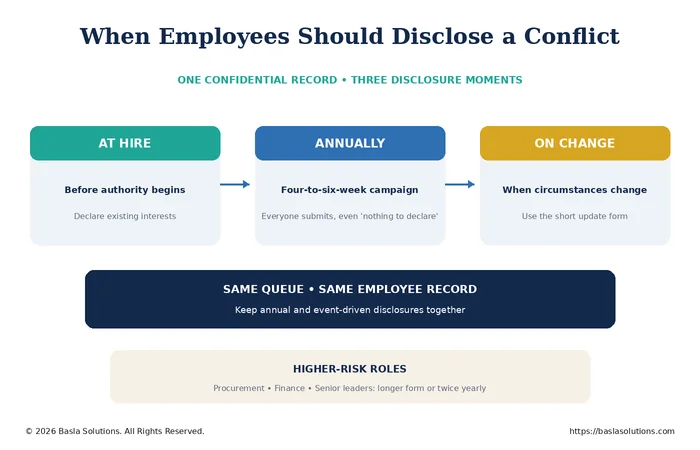
Employees should complete a conflict of interest disclosure when they join, once a year after that, and again whenever their circumstances change. The annual cycle catches what people forget, and event-driven disclosure catches what happens in between.
International public-sector guidelines set the same rhythm, with disclosure at the start of the role and then at regular intervals, usually annually, in writing, plus prompt updates when circumstances change.
- At hire. Make the declaration part of onboarding, before the employee gets budget or supplier authority.
- Annually. Run a fixed four-to-six-week campaign, with every employee submitting, including those with nothing to declare.
- On change. Keep a short change form available in the portal at all times, with a 30-day window to disclose a new interest.
- Higher-risk roles. Ask procurement, finance, and senior leaders for a longer form, or for disclosure twice a year.
Who reviews conflict of interest disclosures?
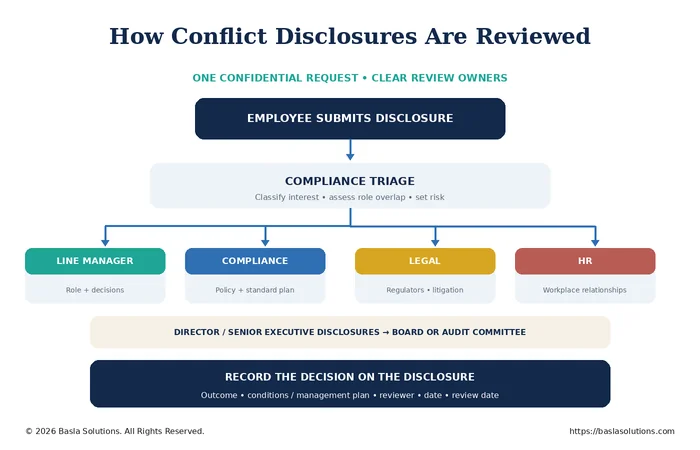
Conflict of interest disclosures are reviewed first by the employee’s line manager or by compliance, with legal brought in for complex or high-risk cases. Most disclosures need a quick confirmation, and a small share need a management plan.
One public-sector procedure has the employee and manager review each declaration together, with any management plan endorsed by the line manager and approved by a senior executive. Companies can use the same two-level model.
- Line manager. Knows the role and the decisions involved, and confirms whether the interest overlaps with them.
- Compliance. Owns the policy, triages each disclosure, and approves standard management plans.
- Legal. Reviews interests involving regulators, public officials, litigation, or significant contracts.
- HR. Handles personal relationships inside a reporting line.
- Board or audit committee. Reviews disclosures from directors and senior executives.
How do you route conflict of interest disclosures through legal intake?
You route conflict of interest disclosures through legal intake by making them a confidential request type in the same portal, with rules that send each one to the right reviewer based on the type of interest and the employee’s role. The employee submits once and sees the outcome in one place.
- A restricted request type. Only the employee, the assigned reviewers, and compliance can see the record.
- Rule-based routing. A small gift goes to automatic acknowledgment, a stake in a supplier goes to compliance and procurement, and anything involving a public official goes to legal.
- Risk scoring. Disclosures can be scored on value, seniority, and overlap with the role, using the same method legal applies to legal risk assessment of incoming requests.
- Reminders and escalation. During the annual campaign, send reminders at 7 and 14 days, then escalate to the manager.
- Turnaround targets. Aim for five business days on standard disclosures and 15 on complex ones.
How do you record conflict of interest decisions?
You record conflict of interest decisions on the disclosure record itself, with the outcome, any conditions, the reviewer, the date, and a review date. A decision that lives only in an email cannot be found at the next audit or the next disclosure.
- Outcome. No conflict, conflict managed under a plan, or interest not permitted.
- Management plan. Recusal from specific decisions, removal from a supplier selection, divesting a stake, or ending an outside role.
- Review date. Revisit each plan once a year or when the employee changes role.
- Restricted storage. Hold disclosure records as secured personnel records, under the same confidentiality restrictions.
- Audit trail. Log every change to the record, including who viewed it.
Reporting then becomes simple: completion rate for the annual campaign, open disclosures by age, and the number of active management plans by department.
Conclusion
A conflict of interest disclosure form works when it asks only what reviewers need, arrives at hire, every year, and on every change, and lands in a confidential queue with clear reviewers. Record each decision and its conditions on the disclosure itself, set a review date, and protect the records like personnel files. The result is a program you can audit and employees can complete in minutes.
How Basla can help
Basla provides delivery teams for legal intake and request management software implementation, covering business analysis, disclosure form design, confidential request types, routing and approval rules, reminders, reporting, testing, documentation, and post-go-live support. Basla delivers legal technology services through staff augmentation or a Basla-managed delivery unit, so your intake program can grow without slowing down.
Frequently asked questions
Is a conflict of interest disclosure form mandatory?
Most companies make disclosure mandatory through their code of conduct, usually at hire and once a year. Listed companies and regulated sectors often have further disclosure rules for directors and officers.
What counts as a conflict of interest for employees?
A conflict of interest is any personal interest that could influence, or appear to influence, an employee’s decisions for the company. Common examples are a stake in a supplier or competitor, an outside job, a relative in the reporting line, and significant gifts.
Do board members use a different disclosure form?
Board members usually complete a longer annual questionnaire covering other directorships, shareholdings, and related-party transactions. A conflict of interest disclosure form for board members is typically reviewed by the company secretary or general counsel and reported to the board or audit committee.
How long should disclosure records be kept?
Disclosure records should be kept for as long as your records retention schedule requires, which for most companies is the length of employment plus several years. Agree the period with HR and legal, and apply it to the disclosure request type automatically.
Can disclosures be kept confidential?
Yes. Disclosures should be visible only to the employee, the assigned reviewers, and the compliance and legal staff who need them, and stored with the same protection as personnel records.
*This article is provided for general information only and does not constitute legal advice. Basla Solutions provides legal technology implementation and support services and does not practice law.*