

A SOX audit trail is a complete, time-stamped, attributable, and tamper-evident record of every action that creates, changes, approves, or accesses financial data and the system settings that control it. For a public company’s legal department, that includes the eBilling and matter management platform, because legal invoices, accruals, and reserves flow into the financial statements. SOX publishes no single audit trail specification. It requires management to show that internal controls over financial reporting work, and the audit trail is the evidence auditors test. It must cover every step of legal bill review.
What is a SOX audit trail?
A SOX audit trail is the system-generated record that lets an auditor reconstruct who did what to a financial record, when they did it, and what the record looked like before and after. It is the evidence that supports management’s assessment of internal controls under Section 404 and the officer certifications under Section 302.
“SOX-compliant” is best read as “designed to support SOX compliance.” No platform is certified as SOX-compliant on its own. A platform’s audit trail supports compliance when it captures the right events, attributes each one to a person or system identity, and cannot be edited by the people whose actions it records.
Why does legal spend fall within SOX controls?
Legal spend falls within SOX controls because legal invoices, accruals, and loss contingency reserves are recorded in the general ledger and reported in the financial statements. For many companies, outside counsel fees run to tens of millions of dollars a year, which makes the legal platform a material financial system.
- Invoice approval. Each approved invoice becomes an AP liability. Auditors test that it was approved by an authorized person within their approval limit.
- Accruals. Month-end accruals for unbilled legal work post to the ledger. Auditors test how the estimate was made and who changed it.
- Vendor master data. Law firm records, including bank details exported to the ERP, determine where payments go.
- Matter reserves. Litigation reserves recorded in a matter management platform can feed contingency disclosures and need the same change history.
The integration that carries these figures into finance, covered in integrating ELM with finance and ERP systems, is usually in scope as well, since an export that drops or alters a value breaks the chain of evidence.
What should an eBilling audit trail capture for SOX?
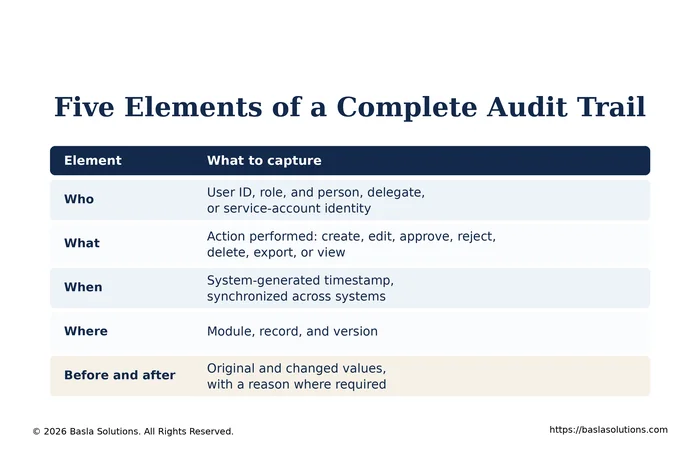
An eBilling audit trail should capture five things for every SOX in-scope event: who acted, what they did, when, where in the system, and what changed.
- Who. User ID, role at the time of the action, and whether it was a person, a delegate, or a service account.
- What. The action, such as create, edit, approve, reject, delete, export, or view.
- When. A system-generated timestamp, preferably in UTC, synchronized across the eBilling platform and the ERP.
- Where. The module, record, and version, such as invoice 48211, line 14, or rate card version 3.
- Before and after values. The original and changed values, with a mandatory comment and reason code where the workflow asks for one, for example an invoice adjusted from $18,400 to $16,900.
Before-and-after values are the item most often missing from an invoice audit trail. Many platforms log that a field changed without keeping what it changed from, which leaves the auditor unable to confirm the change was reasonable.
Which eBilling events are in scope for SOX logging?
The eBilling events in scope for SOX logging are those that affect amounts posted to the ledger, who can approve them, or how they are calculated. Every event in these four groups must be logged.
- Approvals and delegations. Each invoice approval, rejection, and appeal decision, plus every delegation of approval authority while someone is on leave.
- Rules and rates. Changes to approval limits, routing rules, billing guideline rules, and approved rate cards, since each one changes what the platform will pay.
- User access. New users, role changes, deactivations, and every grant of administrator rights.
- Accruals and exports. Accrual submissions and overrides, and each export batch to the ERP with its record count and total.
How long should SOX audit trail records be kept?
SOX audit trail records for in-scope financial controls are commonly kept for seven years, which aligns with the period SEC rules require external auditors to retain their audit workpapers. The statute itself sets a minimum of five years for auditor workpapers, and the SEC extended that to seven by rule.
Seven years applies to the evidence that supports in-scope controls. Check what the platform keeps by default, since in Unity, for example, the Activity Log keeps activities for the past 90 days, so evidence for longer periods has to be exported. Routine system logs outside those controls can follow your normal schedule. Scope the retention rule to approval history, change history, access logs, and accrual records in the legal platform, and agree that scope with your internal audit team. A litigation hold overrides any retention schedule, so logs tied to a matter under hold must be kept until the hold is released. Retention also means retrieval: a log that takes three weeks to restore will not satisfy an auditor during a two-day walkthrough.
How do you make a legal platform audit trail tamper-evident?
A legal platform audit trail is tamper-evident when no user, including a system administrator, can edit or delete log entries without that action itself being detected and recorded. Protecting the log matters because altering records carries serious legal consequences: knowingly altering or destroying a record to obstruct a federal investigation carries up to 20 years in prison, a provision added by Section 802 of the Act.
- Read-only storage. Store audit records in a table or service that application users cannot write to directly.
- Separation from administration. Platform administrators can configure rules but cannot modify or purge the audit log, and any purge function is restricted to a separately controlled role.
- External copy. Export logs on a schedule to a security log platform or an immutable archive, with hashing so any later change can be detected.
How do auditors test a legal platform audit trail?
Auditors test a legal platform audit trail by selecting a sample of transactions and changes, then using the log to reconstruct each one and confirm the control operated. A typical sample covers 25 to 40 invoices across the year, a handful of rate and rule changes, and the full list of user access changes.
For each sampled invoice, the auditor checks that the approver had authority at that amount on that date, that no one approved their own submission, and that the amount exported to the ERP matches the approved amount. For rule changes, they check that each change was requested, approved, and tested before it reached production. For user access, they compare the quarterly access review against the log to confirm leavers were removed promptly, often within a set window such as five business days.
What audit trail gaps do SOX auditors find in legal platforms?
The audit trail gaps SOX auditors find most often in legal platforms come from actions that happen outside the logged workflow or under a shared identity. Shared logins are a security risk too, since an analysis of 12,195 confirmed breaches found credential abuse was the most common way attackers got in, at 22 percent.
- Shared and service accounts. Bulk imports, integrations, and admin tasks run under a generic account, so the log shows “system” for changes a person initiated.
- Off-platform approvals. A reviewer approves by email and an administrator clicks approve on their behalf, recording the wrong approver.
- Untracked configuration changes. Rules edited directly in production, or promoted from a sandbox with no change ticket, leave no record of who requested or approved them.
The remedy for each is procedural as well as technical: named accounts for every integration owner, delegation configured in the platform, and a change log that pairs every production change with a ticket.
How should legal operations prepare for a SOX walkthrough?
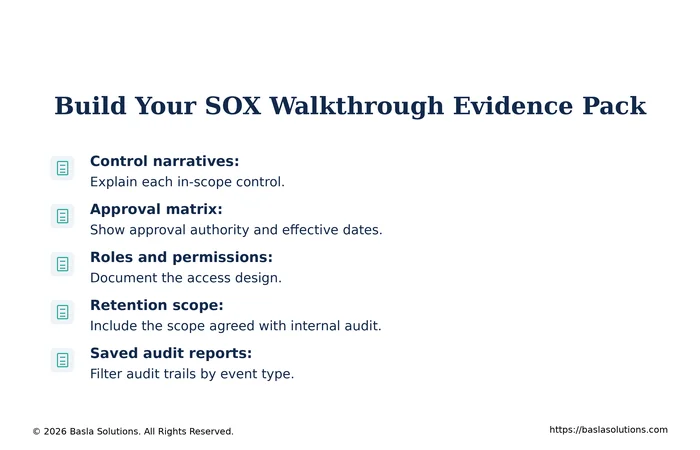
Legal operations should prepare for a SOX walkthrough by assembling a standing evidence pack that explains each control, shows where the platform records it, and includes saved reports that produce the log on request.
The pack should hold a short narrative for each in-scope control, the approval matrix with effective dates, the role and permission design, the retention scope agreed with internal audit, and saved audit trail reports filtered by event type. Keep the configuration documented as it changes, since an undocumented rule is hard to defend to an auditor, a point made in why code without documentation is a ticking time bomb.
Conclusion
A SOX audit trail in a legal platform has to record who approved, changed, or accessed legal spend data, show the values before and after, and stay out of reach of the people it records. Scope it to the events that affect the ledger, retain that evidence for seven years, and make sure it can be produced quickly. Close those gaps during implementation, and the annual walkthrough becomes a review of evidence you already hold.
How Basla can help
Basla provides delivery teams for enterprise legal management and eBilling software implementation, covering legal technology consulting for approval and access controls, audit trail and reporting configuration, role-based security testing, control documentation, and post-go-live support. Basla teams have delivered matter management and eBilling across more than 10 global jurisdictions.
Basla business analysts map each financial control to the platform events that evidence it, QA tests that every in-scope action is logged with the right user, timestamp, and values, and documentation teams build the control narratives your auditors ask for.
Frequently asked questions
What is a SOX audit trail?
A SOX audit trail is a time-stamped, attributable, tamper-evident record of actions that create, change, approve, or access financial data and related system settings. It lets auditors reconstruct financial events and confirm that internal controls over financial reporting operated as designed.
Does SOX specify audit trail requirements?
SOX does not publish a single audit trail specification. It requires management to assess and report on internal controls over financial reporting, and auditors expect system-generated, attributable, tamper-evident logs as evidence that those controls worked.
How long do SOX audit records need to be kept?
Audit records supporting SOX in-scope financial controls are commonly kept for seven years, matching the period SEC rules require auditors to retain workpapers.
Is a legal eBilling platform in scope for SOX?
A legal eBilling platform is usually in scope for SOX at public companies, because approved invoices become AP liabilities and accruals post to the general ledger.
What makes an audit trail tamper-evident?
An audit trail is tamper-evident when users and administrators cannot edit or delete entries without detection. Read-only storage, separation of log access from platform administration, and scheduled hashed exports to an immutable archive are the usual controls.
What are common SOX audit findings in legal platforms?
Common SOX audit findings in legal platforms include changes made under shared or service accounts, approvals recorded by an administrator on someone else’s behalf, configuration edited in production without a change ticket, and user access left active after an employee leaves.
*This article is provided for general information only and does not constitute legal advice. Basla Solutions provides legal technology implementation and support services and does not practice law.*