

A legal risk assessment at intake is a quick, consistent score that triage gives every incoming request, so a routine NDA and a cross-border data deal never land in the same queue with the same deadline. It is the scoring step inside legal request triage, where in-house teams decide who handles each request and how fast.
This page stays with requests and matters. Enterprise risk registers and board-level risk reporting are a different exercise. The goal here is a simple matrix that a triage owner can apply in under two minutes per request.
What is a legal risk assessment?
A legal risk assessment is a structured judgment of how likely a request is to lead to a legal problem and how serious that problem would be, expressed as a score that decides how legal handles it. At intake, it turns a description from the business into a routing decision.
Government guidance on legal risk defines it as the risk that a decision or act is unlawful, judged by the likelihood of a challenge, its chance of success, and its impact. The same three ideas translate well to in-house requests: how likely is something to go wrong, and how much would it cost the company if it did.
At intake, the score has one job. It tells triage which lawyer level, which approvals, and which service level the request gets. A score that changes nothing about handling is not worth collecting.
How do you build a legal risk assessment matrix?
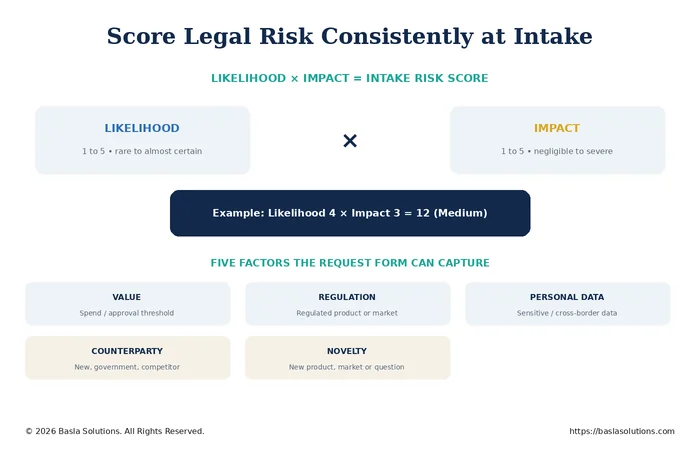
You build a legal risk matrix for intake by scoring likelihood and impact on a 1 to 5 scale each, multiplying the two, and mapping the result to three or four risk bands. A request with likelihood 4 and impact 3 scores 12, which falls in the medium band.
Keep the build simple:
- Likelihood, 1 to 5. How likely the request is to lead to a dispute, a regulatory issue, or a loss, from rare to almost certain.
- Impact, 1 to 5. How serious the outcome would be, from negligible to severe, judged on money, regulation, reputation, and operations.
- Score bands. For example, 1 to 4 low, 5 to 9 medium, 10 to 16 high, and 20 to 25 critical.
- Written definitions. One line per level for both scales, so two triage owners score the same request the same way.
- An override. A lawyer can raise a score with a one-line reason, which keeps judgment in the loop.
Test the matrix on 30 to 50 recent requests before launch. If more than a third land in high or critical, the band thresholds are too low, and the high-risk queue will clog within weeks.
Which factors should a legal risk assessment score?
An intake risk score should cover five factors: value, regulation, personal data, the counterparty, and novelty. Each factor can be answered from the intake form, so triage spends its time on judgment calls.
| Risk factor | Low risk | High risk |
|---|---|---|
| Value | Under the lowest approval threshold | Above the senior approval threshold |
| Regulation | No regulated activity involved | Regulated product, market, or license at stake |
| Personal data | No personal data shared | Sensitive or large-scale personal data, or cross-border transfer |
| Counterparty | Known partner on standard terms | New party, government body, competitor, or sanctioned region |
| Novelty | Repeat request with an approved template | New product, new market, or a question legal has not answered before |
Personal data deserves its own trigger. Privacy guidance recommends a risk assessment each time an organization starts new personal data processing or adopts a new processing tool, so a “yes” to new processing should add a privacy reviewer whatever the overall score.
Two more factors are worth adding for some departments: litigation exposure, for requests that touch an existing dispute, and reputational sensitivity, for anything that could become public. Keep the total to seven factors or fewer, or scoring slows down.
How do legal risk scores change routing and approvals?
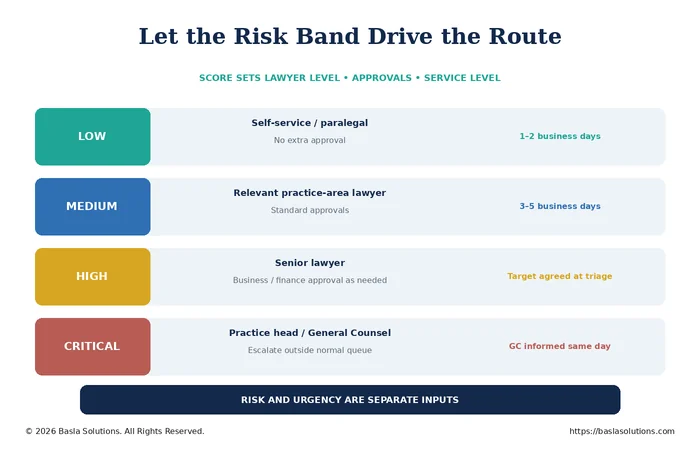
Legal risk scores change routing by setting the lawyer level, the approval chain, and the service level for each request. A low score can go to self-service or a paralegal, and a critical score goes straight to a senior lawyer with general counsel visibility.
A workable mapping looks like this:
- Low. Self-service template or paralegal, no extra approval, service level of one to two business days.
- Medium. Lawyer in the relevant practice area, standard approvals, service level of three to five business days.
- High. Senior lawyer, plus business and finance approval above value thresholds, service level agreed with the requester.
- Critical. Head of the practice area or general counsel informed the same day, with escalation outside the normal queue.
Score and urgency are separate inputs. A low-risk request with a tomorrow deadline still needs a fast lane, and prioritization with a risk matrix balances risk against urgency so neither one alone sets the queue order.
Once the bands are stable, most of this routing can be automated. Automated legal triage routes each request by rules on its intake answers, so the score is calculated from form fields and a person reviews only overrides and edge cases. The payoff is speed: a 2023 benchmark survey of 400 in-house legal staff found that 78 percent of teams with fully automated processes respond to legal requests within 72 hours, against a third of teams working manually.
Who should complete the legal risk assessment at intake?
The business requester should answer the factual questions behind the risk score, and a legal triage owner should confirm the score. Requesters know the facts, and legal knows what those facts mean.
Split the work this way:
- The requester answers facts. Value, counterparty, whether personal data is involved, and whether the request is new, all as plain pick lists.
- The system calculates a draft score. Rules turn the answers into a starting band.
- Triage confirms or adjusts. A paralegal or legal operations analyst checks the draft score, usually in under two minutes.
- A lawyer can override. Any lawyer who sees more risk can raise the band with a reason.
Avoid asking requesters to rate risk themselves. A business user under deadline pressure tends to rate everything low, while a cautious one rates everything high, and neither helps routing.
How do you review and update a legal risk assessment framework?
You review and update the scoring framework every quarter by comparing scores with outcomes, checking how often lawyers override the score, and adjusting factors and thresholds where they drift. The framework is right when overrides are rare and high-risk requests are the ones that actually needed senior attention.
Watch three numbers:
- Override rate. If lawyers change more than 10 to 15 percent of scores, a factor or a definition is off.
- Band mix. A healthy mix is mostly low and medium, with high and critical together under a fifth of volume.
- Misses. Any request scored low that later caused a dispute, a regulatory question, or a large loss gets a short review.
Record every change to the matrix with a date and an approver. New regulations, a new product line, or a new market are all reasons to add a factor or move a threshold between quarterly reviews.
Conclusion
A legal risk assessment at intake works when it is simple enough to apply to every request and specific enough to change how each one is handled. Score likelihood and impact on a short matrix, feed it from five factors on the intake form, and tie each band to a lawyer level, an approval chain, and a service level. Review overrides each quarter, and the scoring will hold up as your request volume grows through your legal front door.
How Basla can help
Basla provides delivery teams for legal intake and request management software implementation, covering risk scoring design, intake form and triage rule configuration, approval routing, service levels, testing, documentation, and post-go-live support. Basla brings legal technology consulting and hands-on configuration through staff augmentation or a Basla-managed delivery unit, so scoring rules work the same way for every request from day one.
Frequently asked questions
What is the difference between legal risk and compliance risk?
Legal risk is the chance that an action leads to a legal claim, dispute, or unlawful outcome, while compliance risk is the chance of breaching a specific law, regulation, or internal policy. At intake, both feed the same score, with compliance usually captured under the regulation factor.
Is there a legal risk assessment template?
A simple template is a 5 by 5 likelihood and impact matrix with written definitions for each level, plus a factor table covering value, regulation, personal data, counterparty, and novelty. Adapt the thresholds to your own approval limits.
Can AI score legal risk at intake?
AI can draft a risk score at intake by reading the request and suggesting factor answers, but a person in legal should confirm it. Start with rules on structured form fields, and add AI suggestions once the rules are stable.
How often should legal risk ratings be reviewed?
Risk ratings should be reviewed every quarter, and sooner after a new regulation, a new product, or a missed high-risk request. Each review compares scores with what actually happened.
Should the business see the legal risk score?
The business should see the band and what it means for turnaround, such as “high risk, senior review, five business days.” The detailed factor scoring can stay internal to legal.
*This article is provided for general information only and does not constitute legal advice. Basla Solutions provides legal technology implementation and support services and does not practice law.*