

A legal invoice review managed service is an outside team that reviews your law firms’ invoices inside your eBilling platform, applies your billing guidelines line by line, and sends each invoice to your approver with recommended adjustments. It sits between the automated rules and the in-house lawyer who signs off, and it is one of three legal bill review models alongside the rules engine and in-house reviewers. This guide explains what the team does that software cannot, how it is staffed and measured, when to use one, and how it connects to your enterprise legal management platform.
What is a managed legal invoice review service?
A managed legal invoice review service is a dedicated team of trained reviewers who handle first-level review of law firm invoices for a legal department, working to the department’s guidelines and inside its own eBilling system.
The in-house team keeps control of the money. Reviewers recommend or make adjustments within agreed limits, and a named in-house approver gives final approval before payment. A legal invoice review managed service usually covers five pieces of work:
- First-level review. Every invoice that passes the automated rules is read against the billing guidelines, the matter budget, and the engagement terms.
- Adjustments with reasons. Each reduction carries a reason code and a short note the law firm can understand.
- Appeals handling. Reviewers answer firm appeals and escalate the ones that need a lawyer’s judgment.
- Firm communication. Reviewers explain recurring issues to billing contacts so the same errors stop appearing.
- Reporting. Monthly reports show dollars adjusted, top issues by firm, and appeal outcomes.
What does a managed reviewer do that software does not?
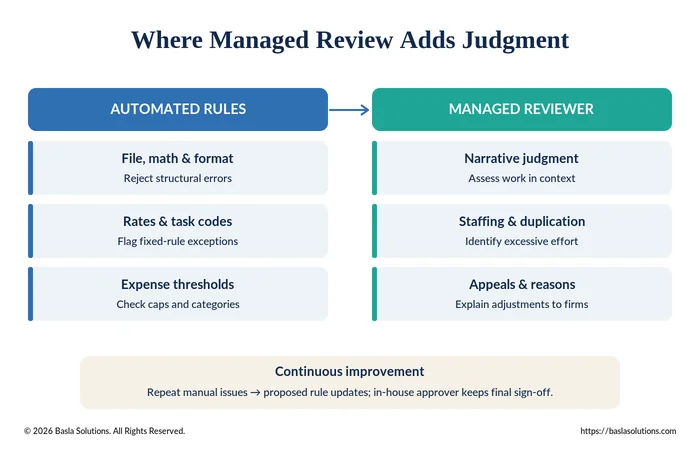
A managed reviewer judges whether the work described on an invoice was reasonable for the matter, which a rules engine cannot do because it only checks what can be expressed as a fixed rule.
Software is fast and consistent on the yes-or-no checks: format, math, rates, and codes. The automated rules check every LEDES line for rates, codes, and format before a person sees the invoice. The managed reviewer picks up where those rules stop.
| Task | Rules engine | Managed reviewer |
|---|---|---|
| Format and math checks | Rejects errors automatically | No action needed |
| Rates and timekeepers | Flags any rate off the approved list | Handles exceptions and new timekeepers |
| Task codes | Checks the code is valid | Checks the code matches the narrative |
| Block billing and vague narratives | Flags keywords only | Reads entries in context and adjusts |
| Staffing and duplicate effort | Applies simple thresholds | Spots over-staffing and repeated attendance |
| Expenses | Applies caps and banned categories | Checks receipts and reasonableness |
| Firm appeals | Not handled | Responds within the agreed SLA |
| Reporting | Standard dashboards | Explains trends by firm and matter |
The two work best together. Every recurring issue a reviewer adjusts by hand is a candidate for a new rule, so the engine gets stricter and the reviewer’s queue gets shorter over time.
How is managed review staffed and measured?
Managed review is staffed with trained billing reviewers, a senior reviewer or lawyer for escalations, and a quality lead, and it is measured against service levels for speed, accuracy, and appeal outcomes.
- Team shape. A typical team has two to six reviewers, one senior reviewer who handles complex matters and appeals, and a quality lead who samples completed work.
- Throughput. An experienced reviewer clears roughly 25 to 50 standard invoices a day, fewer when invoices are long or the matter is complex.
- Turnaround SLA. First-level review within two to three business days of an invoice reaching the queue, and appeal responses within five to ten business days.
- Quality checks. The quality lead re-reviews a sample of 5 to 10 percent of completed invoices each month and records any missed or wrong adjustments.
- Outcome measures. Dollars adjusted, adjustment rate by firm, share of appeals reversed, and time from submission to approval.
Review speed feeds straight into your payment timeline, so track it alongside legal invoice cycle time from submission to payment. A rising appeal reversal rate is the clearest early sign that reviewers are applying the guidelines more strictly than the department intends.
When should a legal department outsource invoice review?
A legal department should outsource invoice review when volume or complexity has outgrown the time its own people can give it, which is when a legal invoice review managed service costs less than the lawyer and operations hours it frees up.
The case for review itself is strong. A study of 51 large and midsized companies found only 31 percent were satisfied with outside counsel’s compliance with their billing guidelines. The question is who has time to find the errors. Common triggers include:
- Lawyers reviewing invoices. In-house lawyers spend several hours a week approving invoices line by line, time that belongs on legal work.
- A growing backlog. Invoices sit in queues for weeks, firms chase payment, and approvers start clicking through without reading.
- High volume. Several hundred invoices a month across many firms is more than one part-time reviewer can handle well.
- New guidelines. A new set of billing guidelines needs consistent enforcement from the first month, which is easier with a dedicated team.
Bandwidth is the wider constraint. A 2025 survey of 186 legal departments found 63 percent name workload and resource bandwidth as their top challenge.
What should you look for in a legal invoice review provider?
You should look for a legal invoice review provider that knows your eBilling platform, interprets guidelines the way your department does, protects confidential matter data, and reports openly on its own accuracy.
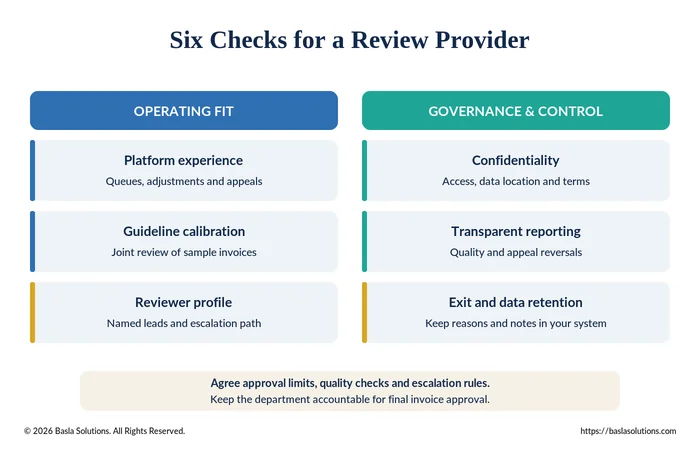
- Platform experience. Reviewers should already know your eBilling system’s queues, adjustment screens, and appeal workflow.
- Guideline calibration. Ask how the provider learns your guidelines, and expect a calibration period of four to six weeks with joint review of sample invoices.
- Reviewer profile. Confirm who does first-level review, who handles escalations, and how often team members change.
- Security and confidentiality. Invoice narratives describe privileged work, so check access controls, data location, and confidentiality terms.
- Transparent reporting. Reports should show the provider’s own quality results and appeal reversals, in addition to the dollars adjusted.
- Exit terms. Make sure reason codes, notes, and reports stay in your system if you change provider.
Review is only one part of enforcing billing guidelines. Rules engine settings, firm communication, and exception handling make up the rest of the enforcement program.
How does managed review connect to the eBilling platform?
Managed review connects to the eBilling platform by giving the reviewers their own user role and queue inside your system, so they work on the same invoices, data, and audit trail as your in-house approvers.
- Reviewer role. Reviewers get a role that lets them adjust lines and add notes, with approval limits set below the in-house approver’s.
- Approval routing. Invoices route to the review queue after the rules engine and before the in-house approver, with an escalation path for invoices above a set value.
- Reason codes. A shared list of adjustment reasons keeps reporting consistent between reviewers and in-house staff.
- Rule feedback. Recurring manual adjustments go to the platform owner each quarter as proposed new rules.
Plan two to four weeks to set up roles, routing, and reason codes, and test them with sample invoices before the first live month.
Conclusion
A legal invoice review managed service adds human judgment where the rules engine stops: narratives, staffing, expenses, and appeals. It works best when it runs inside your own eBilling platform, with clear approval limits, a shared set of reason codes, service levels you measure, and a feedback loop that turns repeat adjustments into rules.
How Basla can help
Basla provides delivery teams for enterprise legal management and eBilling software implementation, covering business analysis, billing guideline rules, reviewer roles and approval routing, adjustment reason codes, testing, documentation, and post-go-live support. Basla delivers legal technology consulting and hands-on configuration through staff augmentation or a Basla-managed delivery unit, so your platform is ready for whichever review model you choose.
Basla teams have delivered matter management and eBilling across 10 or more global jurisdictions.
Frequently asked questions
How much does managed legal invoice review cost?
A legal invoice review managed service is usually priced per invoice, per reviewer month, or as a share of the dollars adjusted. Compare the fee with the hours your lawyers and operations staff spend on review today.
Do managed reviewers need legal training?
First-level reviewers need billing and guideline expertise more than a law degree, and many have paralegal or legal billing backgrounds. Escalations and appeals on complex matters should go to a senior reviewer with legal training.
Can managed review handle high invoice volumes?
Managed review handles high volumes by adding reviewers, so a legal invoice review managed service can scale to thousands of invoices a month. Service levels and quality sampling should stay the same as volume grows.
Does managed review work with Onit, Legal Tracker and Brightflag?
Managed review can work with Onit, Legal Tracker, and Brightflag, because reviewers work as users inside the department’s own platform. Confirm that the provider’s team has hands-on experience with your specific platform and its review screens.
*This article is provided for general information only and does not constitute legal advice. Basla Solutions provides legal technology implementation and support services and does not practice law.*